


 Francais
 Deutsch
 Italiano

Refine Your Search
Kiska Aleutian Islands Alaska 1944 stock footage and images
- Showing 7951 to 7956 of 9862 results more
 Hide
Color Sound
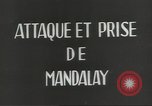
Japanese soldiers advance with tanks and ammunition towards Mandalay in Burma (WW2)
Activities of Japanese soldiers in Southeast Asia during World War II. A relief map of India, China and Indochina shows the locations of Rangoon and Mandalay in Burma (Myanmar). Japanese soldiers march along a dirt road. Trucks parked along the side of a road. Japanese troops march. Burmese civilians standing on the side of a road wave flags. A Burmese civilian fill vessels with water for Japanese horses to drink. Burmese man give Japanese soldiers water to drink. The troops march in the background. Two Japanese soldiers drink water from canteens. Japanese soldiers and U.S. prisoners of war seated on the ground. A Japanese officer points to a piece of paper and discusses. The soldiers marching on a street move past a sign which reads: 'Mandalay 82 Mi-Rangoon 348 Mi'. A Japanese soldier pushes a dump truck up a steep grade on a road. Japanese officers and a car in the background. A photographer and a medium tank in the background. A Japanese soldier drives steel wedges into the ground behind a piece of field artillery. The Japanese fire the field artillery. A column of smoke rises. Japanese tanks drive down a dirt road. The field artillery being pulled by Japanese soldiers. The soldiers march carrying Japanese flags. Demolished buildings in the foreground. Freight cars on a siding, bomb crates near railroad tracks. Japanese medium tanks advance over the railroad tracks.

A USAAF P-61 Black Widow aircraft strafe a German V-1 flying bomb aircraft in France.
United States Army Air Force ( USAAF ) P-61 Black Widows in France during World War II. Three P-61s parked on an air base in France. An airman in the cockpit of an airplane. Other man works on the airplane. 'Wandering Wench II' written on the airplane. The airplanes take off and fly in formation. A P-61 strafes a German V-1 flying bomb cruise missile which explodes. Three P-61s fly in formation.
Steel production and daily life in Youngstown in Ohio
Exterior of steel mill in Youngstown, Ohio. Houses next to steel mill. Downtown Youngstown Ohio. Transit bus picks up passengers. POV bus traveling downtown street. Family with child exits bus. Shoe store window downtown with pedestrians. Workers entering steel mills via overhead bridges. Steam locomotive trains passing steel mills with good nat sound of whistles. Overhead crane bucket picking up iron ore. Bucket dropping iron ore into skip hoist. Skip hoist buckets moving up conveyor to blast furnace top. Workers smelting iron ore in blast furnace. Molten iron and slag pouring from blast furnace. Johnny Chonko controlling wheel to adjust blast control to furnace. Pete Zeeman, the 'blower' looks through blast furnace look glass to evaluate. Frank Melai, an immigrant from Italy, at the blast furnace. Frank looking at his Christmas tree at home with family. Frank's family opens gifts during Christmas. Frank puts a new smoking pipe into his mouth.

Workers working in the steel industry and lives of their families in Youngstown, Ohio
Point of view (POV) overhead crane view of steel mill floor in the open hearth area. Workers 'slagging' and open hearth furnace by throwing shovels full of dolomite into the hearth. Worker Tommy Hughs pours huge ladle of hot iron from the blast furnace into the open hearth furnace. Foremen Billy Reilly and John Strouse confer. John's son, Ed Strouse, seen as a high school football player on the bench during a game. High school football game in Youngstown, Ohio. Audience cheers. Several views of spectators in stands cheering. Score keepers at score board. High School Band players seen with their instruments. High school Principal Glasgow talks to student Ed Strouse. Boys in vocational class view engine of a car. Lunch line at high school cafeteria. Teenage boys and girls eating lunch at high school cafeteria. Students leaving high school at end of day.

The Grand Palace, Paris, harboring French Resistance fighters, is set on fire by order of German General Dietrich von Cholitz
German occupied Paris, during World War II, around time of liberation of Paris. The Grand Palace (Grand Palais), a Free French stronghold, is set on fire by German troops under orders of German General Dietrich von Cholitz, Commander of the Paris Garrison. Dense smoke rises from the building. Clouds of smoke cover the top of the building. Shadow of trees in water.

Causes of indicator jamming in military radio sets; also civilian couple listening to1940s console radio
Military training film depicts the causes of indicator jamming on the radio set, SCR-268. A ship underway. Newspaper headlines read about the German battleships which escaped British Army because their radio signals were jammed. Soldiers talk on radio. During Jamming weird pattern start appearing on the monitor screen. Sensitivity knob of the radio. Signs of jamming are seen. Scene changes to a civilian couple in a family living room sitting on a couch beside a console radio. They listen to the radio and talk. The man gets up and adjusts the tuning dial and the volume dial on the radio. The couple switches off radio because of interference in the radio broadcast. An animated diagram explains the jamming. Radio waves bounce back from the target. Target sends radio energy longer then those that bounce back. Jamming takes place. Jamming can be improved by making adjustments. (World War II period).
CRITICALPAST.COM: About Us | Contact Us | FAQs - How to Order | License Agreement | My Account | My Lightboxes | Shopping Cart | Advanced Search | Featured Collections | Website Terms & Conditions | Privacy Policy ©2026 CriticalPast LLC.
License Agreement |
Terms & Conditions |
Privacy Policy
©2026 CriticalPast LLC.