


 Francais
 Deutsch
 Italiano
Refine Your Search
Kiska Aleutian Islands Alaska 1944 stock footage and images
- Showing 139 to 144 of 9823 results more
more Hide
Hide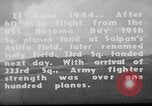
U.S. 19th and 73rd Fighter Squadron P-47s landing on Aslito Airfield, Saipan during World War II
After the battle of Saipan, during World War 2, P-47s of the 318th fighter Group 19th Fighter Squadron are seen flying in from the Carrier, USS Natoma Bay and those of the 73rd Fighter Squadron, flying in from the USS Manila Bay. View from a P-47 approaching Coastline of Saipan Island . Control tower operator on lookout for aircraft. Signal from the tower giving the planes directions for landing. Four P-47s peeling off for landing. P-47s approach and land on Aslito airfield, island of Saipan. Fliers standing around their aircraft watching other planes come in for landing. 19th Fighter Squadron P-47s taxiing into parking area. Pilot talking to the crew chief of his plane. View across airfield showing the demolished hangar building with P-47s in 19th Fighter Squadron's dispersal area. Fuel Trucks and ground crew personnel attend to the arriving aircraft. One of the P-47s carries the name: "Jackie Eilen" and another, the name "Angel." (Note: Although written introduction to this film refers to 11 June, the events depicted occurred after 20 June, 1944. The invasion of Saipan did not begin until 15 June, 1944. Aslito Field was captured on 19 June, 1944. The first P 47 aircraft (a few) arrived on 20 June, 1944 while the Seabees were working to make the field operational.)
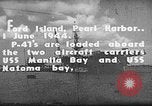
Loading of P-47s on aircraft carriers and 19th Fighter Squadron men embarking on ships at Ford Island, Pearl Harbor.
The Pacific campaign on the Island of Saipan, Mariana Islands during World War II. P-47 Thunderbolt planes loaded aboard carriers in Ford Island, Pearl Harbor. P-47s of the 318th Fighter Group, 19th Fighter Squadron , are loaded aboard the two aircraft carriers, USS Manila Bay and USS Natoma Bay, at Ford Island, Pearl Harbor. Among the aircraft seen are: P-47 named "Big Baduzi;" P-47 number 42-75783 named "Little Rock-ette;" one named "The Wicked Wench;" and one with serial number 43-2530. Various views of aircraft being loaded on carriers from dock area. Crane in operation. Plane being swung over onto the deck where it is pushed on the elevator and moved down into the hold of the ship. Air Force mechanics working with Navy personnel moving planes and placing them below deck. Navy personnel pushing the aircraft around into position above and below the deck of carrier. Sailors cut loose the mooring lines. Several officers and sailors standing on deck of a carrier as they move out of the harbor. View across Pearl Harbor at Diamond Head mountain in background. Remaining ground crews, support personnel, and others of the 318th Fighter Group assembled on the pier, ready to embark on a troop ship, June 6, 1944. They commence boarding via a gangplank, being checked off as they board.(This third convoy, departs on June 7th.) Various sections of ship with views looking out across at land and ships parked in the harbor.
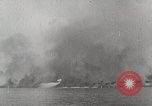
U.S. amphibious assault on Peleliu, Palau Islands, during World War II
U.S. 1st Marine Division amphibious assault agaist Peleliu, Palau Islands, on September 15, 1944, in World War 2. Coordinated assault involving many landing craft, troop ships,supporting warships firing at Japanese positions and F4U Corsair fighter bombers attacking from overhead.The entire island is shrouded in smoke. A U.S. carrier-based TBF Avenger aircraft is seen clearly banking overhead. An F4U in flight overhead. Explosions and smoke from bombardment. Two Landing Craft infantry (large) race toward the beach. The Cruiser, USS Louisville (CA-28) in camouflage (Measure 32, pattern 6d). U.S. aircraft bombing near the beachhead. Numerous landing craft assembling offshore. U.S. warships and LCIs (Landing Craft Infantry) offshore. Sun breaking through clouds and smoke.
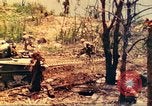
United States Army tanks support U.S. Marines, at Horseshoe Valley in Peleliu Island, Palau during World War 2
U.S. Army tanks of 1st. Platoon, A Company, 710th Tank Battalion operating in support of Marine Corps infantry at Horseshoe Valley in Peleliu Island, Palau on October 8th 1944. Tanks are receiving fire from hidden Japanese 37mm guns up on the hills. Damaged trees in the area. United States Marines with tanks patrol on the island. U.S. tanks equipped with flamethrowers fire at Japanese positions. Marines on alert positions watch from behind bushes.
Information about unidentified airplanes is transmitted in the United States.
A public television program by the U.S. Army entitled 'The Big Picture.' U.S. troops are seen hunkered down and looking through binoculars in a defensive position in Korea, during the Korean War. American soldiers riding atop a Sherman tank on a city street in Germany, during World War II. Ski troops moving across snowy hill in Alaska. U.S. Army amphibious assault training on a beach in Puerto Rico. Army Master Sergeant Stuart Queen, narrator, speaks about America's defense against threat of atomic attack in these times of lukewarm peace. View of mountainous region in Alaska. A cluster of Cup'it Eskimo dwellings is seen on Nunivak Island, in the Bering Sea. Several of the local inhabitants are fishing through holes cut in the ice. Vapor trails are seen from Soviet aircraft flying at high altitude. A sign on a tarpaulin displaying logo of the Army Signal Corps, reads,"Alaska Communication System, Long Distance Commercial Telephone-Telegraph." A tracked vehicle carries a soldier to a facility posting a sign reading, "Alaska Communications System Receiver Station." Several tall antennas loom above the site. The soldier, dressed in arctic gear, steps from the tracked vehicle and walks past several snow shoes, standing upright in the snow, to enter a white wooden building. Inside, a man in civilian clothes works at a battery of telecomunications equipment. He transmits a message about the aircraft sighting, to the Alaska Communication System facility in Fairbanks Alaska (briefly shown) by means of a telegraph key. From there it is relayed to a Signal Corps facility, shown, in Washington, DC. A soldier is seen Inside that facility, in a room filled with computers and telecommunications equipment. A Sergeant handles paper tape messages being sent and received by teletype. Another soldier plugs connections into a communications switchboard. Next, the camera pans over the entrance to the Office of the Secretary of Defense, in the Pentagon. More views of soldiers attending banks of teletype machines. Animated map displays paths of orders being transmitted to U.S. Air Defense Centers in San Francisco, Chicago, Seattle, New York, and Atlanta. View from control room, of several U.S. Air Force F-94 Fighter Interceptor aircraft on an airfield ramp. A controller activates a Klaxon horn and pilots on alert, in the Fighter Interceptor Squadron ready room, jump up and scramble to their aircraft. A pair of F-94s taking off. One is number 51-5385. Next, a U.S. Navy F-9 fighter plane is seen taking off from an airfield. It displays tail code AE. It is followed by another F-9 aircraft.
Battle for Leyte Gulf between the Allied naval-air forces and the Japanese naval-air forces in region of Philippine island of Leyte during World War II
Documentary titled 'Battle for Leyte Gulf' depicts the battle fought between the Allied naval-air forces and the Japanese naval-air forces in Pacific waters off the Philippines, in World War 2. Montage of views chronicling the battle, opens with aerial views of pacific islands seen through clouds followed by glimpse of numerous ships maneuvering far below. Port bow views of U.S. New Mexico class battle ship, followed by the USS Pennsylvania (BB-38) of the 7th Fleet. Glimpse of troops on landing craft and charging across an island. Transport ships underway. Cruisers and battleships firing their guns. An Essex class aircraft carrier silhouetted against the horizon. An F6F aircraft comes up on elevator to flight deck next to the island on the USS Enterprise (CV-6). It has white triangle on tail containing its number. An F6F taking off from the Enterprise. Formation of U.S. aircraft in flight overhead. Gun crew firing twin bofors 40mm anti-aircraft cannon. Flak bursts and tracer bullets seen in the sky as a Japanese warplane falls. Gun camera footage of American aircraft strafing Japanese aircraft on ground at an airfield. View, from an aircraft carrier, of a Mahan class destroyer traveling to her port side. Glimpse of two ships close together during refueling operation at sea. Animated map dominates remainder of the film. It illustrates movement of Task Force 38 to Okinawa on 10 October 1944 and launching of aerial attacks. the map shows further maneuvers and activities of the task force. During these activities, Narrator notes that the cruisers USS Canberra and USS Houston are torpedoed and taken in tow. Animated propaganda cartoon depicts Japanese naval commander (speaking accented English) talking about Japanese naval prowess. Glimpse of Japanese sailors cheering. Animated map continues showing maneuvers of U.S. task forces. Narrator notes the Houston is again torpedoed. Animated map continues to illustrate movements and attacks against Luzon and amphibious landings on outpost islands in Leyte Gulf.
CRITICALPAST.COM: About Us | Contact Us | FAQs - How to Order | License Agreement | My Account | My Lightboxes | Shopping Cart | Advanced Search | Featured Collections | Website Terms & Conditions | Privacy Policy ©2026 CriticalPast LLC.
License Agreement |
Terms & Conditions |
Privacy Policy
©2026 CriticalPast LLC.