


 Francais
 Deutsch
 Italiano
Refine Your Search
Kiska Aleutian Islands Alaska 1944 stock footage and images
- Showing 175 to 180 of 9823 results more
more Hide
Hide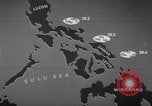
Battle for Leyte Gulf between the Allied Naval Air Forces and the Japanese Naval Air Forces.
Animation shows Allied Naval Air attack over the Philippines island of Leyte during the Battle for Leyte Gulf against the Japanese Naval Air Forces in October 1944. The battle is fought around a chain of islands such as Luzon, Samar, Leyte and Mindanao. Allied 3rd and 7th naval fleet launch a massive attack and cripple the Japanese naval-air support. Results show heavy damage inflicted to Japanese Naval Air Forces. (World War II period).
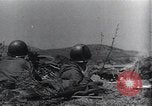
United States Army 187th Airborne Regimental Combat Team returns to Japan from Korea and is welcomed by City of Beppu, Oita
Clip opens with rapid changing scenes: American troops in trench in Korea during the Korean War. American tank on street in Germany. American Ski troops in Alaska. Amphibian assault training in Puerto Rico. Rotating Globe shows: U.S. Army on alert to defend against aggression. Sergeant Stuart introduces episdoe and states that U.S. Army has come to Japan to know their culture and make friends after war and occupation. U.S. Army troops of the 187th Airborne Regimental Combat Team, are seen arriving by railroad train at a train stateion near their base near Beppu,Oita on the island of Kyushu, Japan. U.S. Army soldiers, including white and African American soldiers, exit train cars. They receive a warm welcome from Japanese population. Banner reads:" Welcome Pala Troop comin back from Korea, City of Beppu."[sic] Women holding flowers and families with small children waving American and Japanese flags, welcome them on the train station. A sign over the train station platform reads: "Welcome 187 Para Troop Coming Back From Korea, City of Beppu." The troops stand in formation on the platform while the unit's officers receive the flowers from the women. Japanese men in fraternal uniforms and the general population all join in the welcoming ceremonies. The troops march off the train station under another sign reading: Welcome Home 187 RCT." and march down the main street of Beppu under a swirl of paper confetti. Next scenes are from autumn of 1945, as U.S. soldiers march through streets of Japan during occupation following the end of World War 2. U.S. troops seen marching behind Japanese police to occupy Japan, in 1945, amidst the aftermath of suffering and destruction of the war. The local population standing at road sides and watching with worry and concern. Scenes of postwar destruction in Japan. Rubble of bombed buildings. Scene of simple wooden dwelling shacks and wreckage nearby. A Japanese boy with his baby brother on his back. The baby is crying. Next scene moves again to circa 1950 in streets of a Japanese city, possibly Tokyo, rebuilt and with busy scenes of traffic on streets and commerce. Large outdoor rally with a Communist speaker addressing large crowd of Japanese people who sit and listen. Scenes from a what the narrator describes as a Communist rally in Japan, against America, which turns violent. Protestors running in streets during demonstration, with signboards and police and fire fighters extinguish flames at scene of an overturned, burning car. Flashback again to 1945 or 1946 as U.S. Army soldiers use tractors and heavy equipment to clear and level an area of war rubble and debris during rebuilding efforts after World War 2. Japanese citizens look on, watching the machines at work.
U.S. aviators are welcomed at different places during their journey around the world.
A flight around the world. A globe rotates. U.S. President Calvin Coolidge bids goodbye to army airmen. The President and Major General Mason Patrick and the fliers on a lawn of the White House, Washington DC. The journey starts from Seattle, Washington. Douglas World Cruisers ( DWC ) in flight. The DWCs parked in a bay. A forest in the background. They arrive at Chignik Bay, Alaska. The aircraft in flight. An iceberg. Lieutenant Lowell Smith stands on one of the pontoons and works with propellers on his DWC. The DWCs in flight from America to Asia. The aviators are welcomed by Japanese officials in Yetorufu, Japan. Japanese children playing in a school yard. A child has a Japanese and a U.S. flag, one in each hand. They reach Hong Kong, China. A fleet of native junks to welcome them. In Calcutta, India , a DWC taxis on water. A large number of people gather around a DWC. A crane lifts a DWC out of water. The aviators land in Constantinople. People around the aircraft. They reach Paris, France.. Aerial views of the city. Mrs. Maclaren congratulates the airmen in London, England. The crew of USS Richmond cheers the aviators. The aviators board their aircraft from a small boat. People watch as the aircraft land in Labrador, Canada. The DWCs are anchored in a bay and the aviators are brought to the shore in a boat. Naval officers greet them. The aircraft in flight over the Boston skyline. A motor launch in Boston Harbor. The DWCs land on water. The aviators arrive at the dock in the motor launch and are greeted by officials. They fly over New York. A large crowd greets the aviators at Mitchel Field, Long Island. They arrive at Bolling Field in Washington and are congratulated by President Coolidge and U.S. Secretary of War John Wingate Weeks. The three DWCs are followed by an XNBL-1 Barling bomber in flight in Dayton. Lt. Jack Harding is welcomed home. The world flight ends in Seattle, Washington. Photographers click pictures as a DWC lands. Major Martin greets aviators standing beside a DWC.
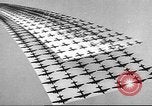
United States Air Transport Command operations during World War II.
Animated description of the U.S. Air Transport Command (ATC) network of routes covering 110 thousand miles connecting U.S. Air Forces bases across the globe in World War 2. Formation of C-47 transport planes flying overhead. Air Force dispatcher annotating blackboard with flight schedules. A C-47 taking off. A crew arrives in a jeep and goes to their C-87, 4-engine transport plane, parked outside the operations building of the Aloha Transport Command, Honolulu, Hawaii. C-47s in flight. A C-45 landing at a remote Pacific island. Cargo, including a jeep and a live pack animal.being loaded into a C-46 Commando airplane. C-47s delivering an operating field hospital to Alaska and delivering shipments of grenades to troops on Guadalcanal, who are seen using them in combat. A Consolidated C-87 cargo aircraft in flight.(its landing gear not fully retracted).
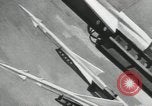
U.S. Army National Guard serves the country during peace and war.
Film opens showing a poster of a National Guardsman with Nike missiles in the background. Sketches of National Guard (the Militia) maintaining order during civic disturbances in history. Sketches of Guardsmen in various uniforms over the ages. An early National Guard encampment. Mounted National Guard cavalry moving in formation during World War 1; Guard soldiers climbing a hill under fire on a Pacific island in World War 2; Guard troops marching in review during the Korean War; Guardsmen directing traffic during an emergency; Views of a disaster site. A National guardsman giving water to disaster victims. A contingent of National Guard demonstrating the manual of arms using their rifles. National Guard members training under supervision of the U.S. Army. They move across a field, cross a pontoon bridge. National Guard training in M4A3E8 Sherman medium Tanks. Guardsmen in Hawaii and in Alaska. National Guard maintaining a Nike Hercules missile.
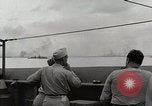
Major General Smith and other Marine officers aboard flagship USS Mount McKinley (AGC-7) at Peleliu, in World War II
Major General Oliver Prince Smith, Assistant Division Commander of the 1st Marine Division,along with other Marine officers aboard the USS Mount McKinley (AGC-7), watch bombardment of Peleliu during the U.S. 1st Marine Division amphibious assault on September 15, 1944. Landing craft are seen. The USS Louisville (CA-28) in camouflage, is seen firing her guns from close to shore. The island is covered in smoke from the exploding shells. General Smith is seen alone looking through binoculars. A group of Marine officers later look through binoculars. Marine officers line the deck to observe the action.
CRITICALPAST.COM: About Us | Contact Us | FAQs - How to Order | License Agreement | My Account | My Lightboxes | Shopping Cart | Advanced Search | Featured Collections | Website Terms & Conditions | Privacy Policy ©2026 CriticalPast LLC.
License Agreement |
Terms & Conditions |
Privacy Policy
©2026 CriticalPast LLC.