


 Francais
 Deutsch
 Italiano
Refine Your Search
Kiska Aleutian Islands Alaska 1944 stock footage and images
- Showing 181 to 186 of 9823 results more
more Hide
Hide
U.S. task force underway for Peleliu (Palau) Invasion during World War II.
Opening slate reads LST 554, and date 8-13. Views of U.S. invasion task force vessels underway toward Peleliu Island (Palau), during World War 2. A 110 foot wooden Subchaser, number SC 633 is seen close, to starboard of camera boat (LST-554) and refueling lines are stretched between the LST and the Subchaser. Ensign Maynard K. Ross of Philadelphia, PA, directs the take-up of slack in the refueling lines while a Navy Commander on the LST bridge oversees the operation. (Note: SC 633 ended up running aground during the invasion.) Break in sequence and scene shifts to glimpse of slate reading August 20, 1944, and then view aft on LST 554. On the bridge, 21-year-old Ensign Charles Kahler, of Schenectady New York, uses a sextant to shoot sun lines. Another officer is seen taking relative bearings with a pelorus. Sailors are resting on deck. A series of splashes are created in the water by gunners testing their weapons. LST 557 is cruising to starboard. Puffs of black FLAK smoke appear overhead as antiaircraft weapons are tested.

German prisoners arrive at Ludwigsburg Palace during World War II war crime trials in Ludwigsburg,Germany.
World War II war crime trials in Ludwigsburg, Germany. Fifteen Germans come out of a prison gate. They are on a trial for killing seven U.S. airmen captured on Borkum Island after their aircraft crashed there on August 4, 1944. The prisoners, including both former German Army soldiers and Borkum Island civilian resdients, aboard a truck. Two armored cars escort the truck. They arrive at Ludwigsburg Palace. Sign over door reads "Borkum Island Court Room." The prisoners enter the courtroom in the palace. They take their seats. Seven United States judges seated in the court.
The battle of Saipan during World War II in the Pacific.
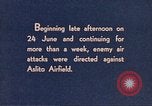
U.S. forces battle against the enemy on Saipan, Mariana Islands during World War II. The 4th Marine Division advances on the eastern side of Saipan. Marines fire rifles. The 2nd Marine Division fires at enemy snipers. The 8th Marine Regiment advances amidst heavy firing. A Marine M3 Stuart (M3A1) light tank equipped with flamethrower (Satan flame tank) is seen in action. Marines moving slowly behind a tank. Two marines running, under fire, carrying a wounded on a stretcher. Others run for cover before a huge explosion. The 8th Marines capturing Mount Tapochau. The 4th Division moving M16 rocket launchers into position for deployment. barrages of rockets striking distant targets in the Bluff Point area. Closeup of rockets being fired from launcher on back of a truck. Map showing Saipan and the disposition of the various Marine units as of 24 June, 1944. American P-47 aircraft parked at Aslito airfield. One has the name "Rosemary" painted across its engine cowling. P-47s taking off on 26 June, to strike at Tinian. A Grumman TBF Avenger is seen taking off at the same time. Another status map shows improved U.S. positions.
The Battle of Iwo Jima in World War II
Scenes filmed by Navy and Marine combat photographers, of the Battle for Iwo Jima, in February and March, 1944, during World War 2. View from a boat offshore, of Mount Suribachi, on the Island of Iwo Jima. Warships of the U.S. 5th Fleet attack with naval gunfire, as landing craft manuever near shore. U.S. Marines aboard Landing Vehicles Tracked (LVTs) head for the beach, with the heavy cruiser, USS Baltimore (CA-68) in the background. U.S. Carrier-based Grumman TBF Avenger aircraft drops bombs on Mount Suribachi. Landing craft arriving at a fairly level area of beach. U.S. marines moving cautiously on the beachhead. The USS Baltimore and a Fletcher class destroyer offshore in background. Marines hunkered down with smoke rising near them, and then moving forward again, through the black sands. Closeup of a marine with flame thrower. Several U.S. Chance Vought F4U Corsair aircraft fly overhead, dropping bombs on the mountain. Marines continue to move forward, under constant fire from Japanese small arms. A heavy landing craft Infantry, LCI(H) moves toward shore in background. A DUKW ("Duck") coming ashore. Marines using a crane to offload a 105mm howitzer from a landing craft. As they raise the gun, the landing craft moves away and marines Hook the howitzer to a DUKW to help move it. Next, marines are seen setting up two 105s on the beachhead and firing them. Marines with more artillery pieces stacked on the beachhead. A gunboat, LCI (G), firing from close to the shore behind them. Marines digging in sand that the narrator calls the floor of an active volcano. Smoking sulphur gases are seen rising behind them. The USS Baltimore firing her guns from close to shore. Machine gun tracer rounds crossing the beachhead, as Naval gunfire resumes from offshore. Marines crawling and then occasionally sprinting forward across the sand dunes. (One carries a stretcher.) Four marines carrying one wounded back to the beachhead, on a stretcher. Two marines carry another between them. Marines scrambling over brush and rough ground. View from hillside of marines climbing up from below, as shell bursts only a few yards away. Scene shifts to later in the battle for Iwo Jima. A catapillar tractor is parked near bodies of Japanese soldiers strewn across the landscape. (Narrator notes that more than 14 thousand such dead had been counted by March 6, 1944.) Finally, the iconic moving images of U.S. marines raising the American flag over Mount Suribachi.
Log book entries depict events that took place on USS Franklin as it was underway in the Pacific Ocean during World War II.
The film 'The Saga of the Franklin' to honor and remember the men who served in the U.S. Navy during during World War II. A board reads USS Franklin (CV-13). The log book of the ship. An entry from the log book. The ship leaves San Francisco, California in February 1945. A U.S. flag flutters on the ship. The ship in the western Pacific Ocean. A fleet of ships underway at sea. Aircraft take off from the deck for a mission on July 4th, 1944. The target is Iwo Jima, Japan. Other ships nearby. Guns are fired. A Japanese Kamikaze aircraft crashes on a ship. An aircraft in flight. Explosions on the ground below. A Kamikaze aircraft is hit by guns fired from USS Franklin by Air Group 13. Rocket equipped aircraft struck Japanese ships. Aerial view of burning ships in water. Kamikaze aircraft in flight. A Kamikaze aircraft which has been hit, falls downwards in a mass of fire. It crashes into water. A Kamikaze aircraft crashes into water near a ship. A ball of fire rises up. A Kamikaze aircraft crashes into USS Franklin on October 30, 1944. After being repaired, USS Franklin reaches Ford Island in Pearl Harbor, Hawaii. A band plays to welcome the ship. U.S. Navy WAVES ( Women Accepted for Volunteer Emergency Service) on the ship. A U.S. Navy Vice Admiral decorates sailors. Air Group 75 and 35 aboard the ship. Aircraft on the deck. An aircraft takes off from the deck of the carrier. An aircraft prepares for a take off. A white diamond painted on the tail of an aircraft in flight. An aircraft comes in for a landing. An LSO ( Landing Signal Officer ) signals using flags. He makes a signal for an aircraft to cut off its engine while landing. The aircraft makes an arrested landing. An aircraft lands on its nose. Men sunbathe in Hawaii. A party abroad USS Franklin. A cake to celebrate the 9000th landing on the carrier. Ensign A. W. Graf who had made the landing cuts the cake.

The Philippines gains independence from the United States on July 4, 1946; also scenes from 1941 Japanese invasion WW2
The Philippines are established as an independent nation. Crowds of Filipinos gathered at Rizal Park (Luneta Park) in Manila on the July 4, 1946. View of Independence Grandstand (a temporary structure built in front of the Rizal Monument) with American flag and Philippine flags on tall flag poles.. View looking down on General Douglas MacArthur at a podium, speaking into microphones. Camera pans over various segments of the audience. A map shows the Philippine Islands in context of its neighbors in the Pacific Ocean. Camera pans closeup across faces of many Filipinos gathered at the independence event. View of the Jones Bridge over the Pasig River in downtown Manila. Heacock’s Department Store on the Escolta. The Legislative Building. (later the National Museum of the Philippines). Ocean going ships in a harbor. Cargo being offloaded from a ship onto smaller boat. An industrial complex with eight tall smoke stacks emitting smoke. Steel and petroleum plants. Filipino workers in an assembly plant. The Legislative building with people coming and going. Air raid sirens sounding and people running in streets of Manila at onset of Japanese invasion of the Philippines in December, 1941, at start of World War 2, in the Pacific. People running across the Jones Bridge, seeking shelter. Others boarding a bus. Smoke rising from Japanese bombing. Glimpse of Japanese tanks entering Manila during attack and invasion. Japanese infantry climbing a hill. Bodies of persons killed during the Japanese invasion. Glimpse of Japanese troops occupying Corregidor. U.S. General Wainwright negotiating the surrender of Corregidor with Japanese General Homma. View of an American warship firing during the U.S. campaign to defeat the Japanese on islands in the Pacific. An American landing ship carrying U.S. troops who storm ashore. General Douglas MacArthur striding ashore with a retinue of officers, at Leyte, Philippines, on October 20, 1944. as he keeps his promise to return to the Philippines. Views, back again, to MacArthur speaking at the Independence Day ceremony in Manila on July 4, 1946. Also seen at the ceremony are: U.S. Senator Millard Tydings, (co-sponsor of the 1934 Tydings–McDuffie Act, which provided independence to the Philippines after a 10-year transition under a limited autonomy), and Paul V. McNutt, U.S. High Commissioner of the Philippines, who read President Truman's proclamation of Philippine Independence to the assembly. Camera pans over the gathering which includes many U.S. Service personnel in uniform. The oath of office is administered to the elected President of the Philippines, Manuel Roxas. At the conclusion, the American flag is lowered by Paul McNutt, as President Roxas raises that of the Republic of the Philippines. A celebratory parade in Manila includes a float with signs reading: "Let's Produce and Rebuild," among other things. Other floats represent "Mountain Province," and "The City of Manila," "The University of the Philippines," and "The Division of City Schools." One float, sponsored by the Chamber of Commerce, contains a huge replica machine gear, and models of an aircraft and a ship. It's message is about turning the gear that helps make the nation great. American and Filipino soldiers march, carrying their respective national flags. A white-helmeted military band plays for the marchers. Final scene shows large loose formation of military aircraft in flight very high above the Independence Grandstand, at Rizal Park.
CRITICALPAST.COM: About Us | Contact Us | FAQs - How to Order | License Agreement | My Account | My Lightboxes | Shopping Cart | Advanced Search | Featured Collections | Website Terms & Conditions | Privacy Policy ©2026 CriticalPast LLC.
License Agreement |
Terms & Conditions |
Privacy Policy
©2026 CriticalPast LLC.