


 Francais
 Deutsch
 Italiano

Refine Your Search
Kiska Aleutian Islands Alaska 1944 stock footage and images
- Showing 559 to 564 of 9862 results more
 Hide
Color Sound

Advance party leaving San Francisco to support U.S.Army Air Corp's Alaskan Flight project in 1934
View of U.S. Army transport ship, "El Aquario," at dockside in San Francisco, California, preparing to get underway in support of the Army Air Corp Alaska Flight Project, in 1934. Views from aboard the El Aquario, as it makes its way out of San Francisco. View from amidship, forward to the pilot house. Views of surrounding scenery as the ship makes way in protected inland waters from Seattle Washington through Vancouver, British Columbia, and Southern Alaska. View on deck as the ship rolls while underway.. View in ship's dining hall during meal as she rolls slightly (not enough to upset the dishes). An isolated waterfront house seen along the way.
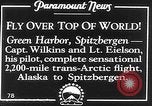
Captain Wilkins and Lt. Eielson stand near an aircraft in Spitsbergen, Svalbard after completing a trans-Arctic flight.
The history of famous airplanes. Australian polar explorer Captain Sir George Hubert Wilkins and American aviator Lieutenant Carl Benjamin Eielson in Spitsbergen, Svalbard after completing a 2,200 mile trans-Arctic flight from Alaska to Spitszbergen. Captain Wilkins in a civilian dress. An aircraft being moved out of the area. 'Detroit news, Arctic expedition' written on the side of the airplane. Captain Wilkins and Lt Eielson check over the airplane prior to a take off. Men dressed in civilian garb. The aircraft starts to taxi across the field. It is a Lockheed Vega aircraft. Animated world map shows the start of the Wilkins flight on April 15th from Point Barrow in Alaska and traces the route of the flight to Spitsbergen. The time of the flight was 20 hours, 20 minutes. They land at Green Bay in Spitsbergen.
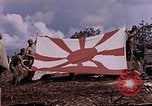
Aftermath of Japanese Banzai charge on Saipan, Mariana Islands during WWII
Americans display (holding it upside down) a huge Japanese rising sun Vice Admiral rank flag , captured after a desperate "banzai" attack by Japanese forces on Saipan, during World War 2. A photograpner takes a picture. Ammunition left on the ground from the battle. Two knocked-out Japanese Type 95 Ha-Go tanks. Destroyed defensive positions and buildings. Americans examine remains of buildings and defensive positions. Several local civilians walk into the center of the scene of death and destruction. Dead Japanese soldiers are seen everywhere, throughout the sequence. (Note: Aftermath of the "Tanapag Plain banzai attack" on July 6th and 7th, 1944. Americans engaged included units of the 105th Infantry; 165th Infantry; 23rd Marines; 24th Marines; 25th Marines; 20th Marines; and 10th Marines.)

People walk at Anchorage International Airport in Anchorage, Alaska.
Exterior view of passenger terminal building at Anchorage International Airport. People exit the terminal and walk on tarmac, presumably toward a waiting aircraft.

U.S. sailors man a deck gun on a submarine and bombard Japanese phosphate works on Faisi Island, Solomon Islands.
An attack on a Japanese ship off the coast of Faisi Island, Solomon Islands during World War II. A periscope view shows a Japanese ship burning after an explosion. Smoke rises from the ship. U.S. sailors man a deck gun on a submarine. Smoke billows up from the ship. Bombardment of Japanese phosphate works on Faisi Island. Men secure the deck gun on the submarine. The deck gun is fired and it bombards the island. American flag flies on deck of the surfaced submarine.
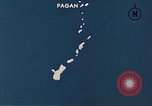
Animation shows U.S. forces bombing Pagan Island in the Mariana Islands during World War II.
Animated map shows U.S. forces acquiring Pagan Island, Mariana Islands from the Japanese during World War II. Pictures of bombings on Pagan Island. Fire and explosions on a ship. American ships fire at the Japanese Army on a beachhead. A fleet of aircraft drop bombs on the island.
CRITICALPAST.COM: About Us | Contact Us | FAQs - How to Order | License Agreement | My Account | My Lightboxes | Shopping Cart | Advanced Search | Featured Collections | Website Terms & Conditions | Privacy Policy ©2026 CriticalPast LLC.
License Agreement |
Terms & Conditions |
Privacy Policy
©2026 CriticalPast LLC.