


 Francais
 Deutsch
 Italiano

Refine Your Search
Leipzig Germany 1945 stock footage and images
- Showing 145 to 150 of 10470 results more
 Hide
Color Sound

Postwar field Testing of German Armor, by Allies, 1945
Postwar Allied testing of German Armor at secret Henschel tank testing grounds (Henschel Panzerversuchsstation) in Haustenbeck, a village in the center of the Sennelager training area, West of Oesterholz and Schlangen, and East of Lager Staumühle, Germany. Seen are Valentine tank, Tiger II (AKA King Tiger, or Royal Tiger) Tank and Self-propelled Gun mounted on Valentine chassis tank. The Royal Tiger Tank with broken gun barrel moves on the ground and breaks through a grove of small trees. The tanks circle a Tiger E, chassis number 250001, which has been abandoned and stripped after years of testing. The seventy-six mm antitank gun mounted on a Valentine chassis fires shells at the Tiger E. (Note: These tests could provide data affecting future Allied tank designs.They were organized by Major-General Sir Percy Cleghorn Stanley Hobart, a renowned pioneer in motorized mobile warfare. Paradoxically, his ideas influenced German tank development and tactics before World War 2. Also present was Dr. Arnold from the Henschel and Sons Company that manufactured tanks at its Mittelfeld Works.)
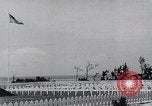
U.S. Army aircraft bombing raids on Japanese cities in 1945, and atomic bomb explosion in World War 2.
Air raids and battle in Japan in the Pacific Theater near the end of World War II. A cemetery of United States military soldiers in the Japanese island of Okinawa. Memorial at the tombstone of Ernie Pyle built by the 77th Infantry Division of the U.S. Army. General Doolittle, General Henry Arnold, General George Kenney, General Ennis Whitehead and other officers during a discussion standing before planes at the 48th Air Force base. B-29 aircraft advances towards Tokyo. Bomber aircraft dropping of a number of guided bombs towards their targets. Targets include Japanese airplane factories, shipping industry, military supply chains in the cities of Tokyo, Nagasaki, Nagoya, Okinawa and Yokohama of Japan. Explosion and smoke arises from bombed targets on ground. Aerial wide and close up views of a B-29 aircraft in flight. Narrator notes that on 05 August 1945, Enola Gay, a B-29, carries the atomic bomb and flies towards Hiroshima. Atomic explosion seen signifying the one in Hiroshima on August 6, 1945, but narrator indicates the image seen is that of the first atomic explosion (the Trinity test) during on July 16, 1945 in New Mexico. Immense cloud of smoke and light. This atomic explosion, the first of two, was pivotal in compelling Japan to surrender unconditionally. Film ending includes public service announcement image "Buy Bonds. Hold Them. Victory Loan."
French General Charles de Gaulle is feted in Chicago during his visit to the United States in 1945
Film opens showing people in an American city (possibly Chicago) celebrating the Allied victory over Japan on VJ Day, August 15th, 1945. Scene shifts abruptly to Chicago, Illinois, where French General Charles de Gaulle is seen saluting in a reviewing stand at Victory Plaza near Lasalle Street entrance to City Hall. (On August 24th, he had accepted an invitation from Mayor Edward Kelly to stop in Chicago on August 27-28, 1945, during his visit to the U.S. and Canada.) Next, general de Gaulle and Mayor Kelly are seen in an open car in a motorcade amidst crowds of well-wishers. Enthusiastic spectators run along side their car. Glimpse of a dense crowd of people, including a contingent of sailors in dress whites. Final scene shows General de Gaulle speaking with reporters and photographers near a sign reading "W-G-N." (A Chicago radio station). (World War II period).
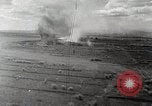
Views of Clark Field and environs,Luzon, Philippines, after liberation by U.S. in 1945
Aerial views from airplane flying very low over portions of Luzon, Philippines, after liberation by the U.S. in World War II. Smoke from farmers burning parts of their fields. View of Clark Field and environs. Barracks and other installations, including a hospital with red cross on the roof. Aerial view of the Holy Rosary Church in Angeles City, Pampangga, Philippines whose roof was damaged by an American Mitchell B-25 bomber on January 7, 1945. The bomber, dubbed the "SAG Harbor Express" of the 499th Bomb Squadron, had been hit by Japanese anti-aircraft artillery. 2nd Lt. Arthur Browngardt was manning the bomber, and perished with all crew as the plane crashed near Holy Angel Academy. Destroyed and damaged Japanese warplanes on Clark Field. Two Americans (one with a rifle) and a local mechanic examining an undamaged Japanese Mitsubishi G4M "Betty" bomber (tail number: 763-12). They open the fuselage door and go inside.
USAAF strikes on ground, water, and railroad targets on Kyushu Japan in early August 1945
Gun camera footage of U.S. Army Air Force 19th Fighter Squadron, 318th Fighter Group aircraft. Footage from aircrafts of Lt. Towner on August 1 and Lt. Taylor on August 5, 1945. Shows ground, ship, and railroad targets in Kyushu Japan being struck. Incoming anti-aircraft fire is seen. (World War II period).
American ships of Task force 58 defend against Japanese Kamikaze attacks during April and May, of 1945 in World War II battle of Okinawa.
Film opens with shaky views of Japanese Kamikaze airplane attacking and being shot down by gunners on a U.S. Navy aircraft carrier of Task Force 58, during the Okinawa campaign of World War 2. Burning wrecked aircraft seen on the carrier flight deck. Firefighters run across flight deck with hoses. A landing F4F fighter plane number 59 runs into the flaming wreckage on the deck, and explodes. View from the side of F4F number 58 engulfed in flames as it sits in a pool of firefighting foam. Black flak clouds in the air. A Kamikaze aircraft crashes harmlessly into the sea. Deck crewmen help a pilot out of the cockpit of a fire scorched F4F. View of sailors standing next to a pair of heavy gun barrels on a U.S. warship. Parachuting U.S. pilot seen touching down in the water after bailing out of his aircraft. Sailors running across the flight deck of a carrier. View of the pilot in his life vest being helped aboard the carrier. More views of flak filled sky and a flaming Japanese airplane diving straight down to crash harmlessly in the water. View of American flag at half mast on a U.S. Navy warship. It is April 12, 1945 and President Franklin D. Roosevelt (FDR) has just died. View of sailors on deck in a memorial service for the President. Closeup of mourners singing with hymnals open. Closeup glimpse of FDR. More views of mourners. Scene changes to Japanese Kamikaze being blasted out of the air in pieces, by anti-aircraft fire from a U.S. carrier. The remains fall into the sea. View from U.S. ship, of a Japanese Nakajima L2D transport aircraft with flames coming out of its right wing, as it descends close to the water near the ship, with its landing gear down. View from a more distant ship of the transport plane exploding in the water near a U.S. Escort aircraft carrier. Twin Bofors anti-aircraft guns firing from a U.S. ship. Tracer bullets fill the sky aimed at a Japanese Kamikaze plane. Slates overlay the scene announcing Japanese aircraft shot down: "April 6th: 277 aircraft; April 12th: 100; May 3rd: 97;" Film ends showing more anti-aircraft fire from ships against attacking Japanese aircraft.
CRITICALPAST.COM: About Us | Contact Us | FAQs - How to Order | License Agreement | My Account | My Lightboxes | Shopping Cart | Advanced Search | Featured Collections | Website Terms & Conditions | Privacy Policy ©2026 CriticalPast LLC.
License Agreement |
Terms & Conditions |
Privacy Policy
©2026 CriticalPast LLC.