


 Francais
 Deutsch
 Italiano

Refine Your Search
Leipzig Germany 1945 stock footage and images
- Showing 187 to 192 of 10470 results more
 Hide
Color Sound
Remains of the USS Gamble (DM-15) being towed out to sea for scuttling, near end of World War II
The USS Gamble, destroyer/mine layer, DD-123, DM-15 being prepared for scuttling off of Guam, in final days of World War 2. Her severely damaged hulk is seen tied up to a pier. An inspection party examines her. View from camera on the Gamble as she is towed out of Apra Harbor, Guam. View of tugboat ahead, pulling her. View from another boat, of the Gamble with a tug at her port side. Six men are seen riding on her superstructure. Camouflage paint and numerals "15" are still visible on her hull. The tug at her side pulls away. Continued views from nearby boat as the Gamble is towed seaward for scuttling. (Note:The USS Gamble was struck by two Japanese bombs off Iwo Jima on 18 February, 1945. After finally being assessed as damaged beyond repair, she was decommissioned, on June 1, 1945, and scuttled on July 16, 1945.)
Operation of United States Coast Guard in Okinawa and Iwo Jima, Pacific Theater during World War II
Overseas activities of United States Coast Guard in World War 2. February 19, 1945, U.S. Marines invade Iwo Jima in Pacific Theater. Naval guns and aircraft bombard Iwo Jima. Mountain in the background. Aircraft in flight. Marines and Coast Guardsmen aboard landing craft. Marines landing on Iwo Jima under heavy Japanese fire. Destroyed landing ships litter water's edge. Marines hunkered down and treating wounded, under fire. LSTs and other ships at established beachhead. Vehicles drive onto beach. April 1, 1945, Marines attack Okinawa. Navy warships bombard Okinawa with heavy guns and continuous rocket fire. Beachhead is established against light resistance. Japanese kamikaze aircraft attack American invasion ships. Several ships are hit and sunk. Surviving sailors are helped aboard rescue boats. Antiaircraft fire from American ships fills sky with smoke and flak. A kamikaze aircraft crashes in the sea. Sky filled with American bombers. Aerial view of Atomic bomb explosion over Nagasaki Japan on August 9, 1945. Raising American Flag on Japan homeland.
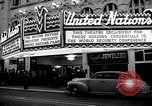
Delegates of United Nations Conference watch motion picture on surrender of Germany and work toward defining UN Charter.
Exterior of a United Nations theater in San Francisco, with movie theater marquee indicating its use exclusively for pass holders attending the United Nations Conference on International Organization. Inside the Delegates of United Nations conference gather during the 2nd week of the conference to watch footage of the German surrender at Reims, signed by General Alfred Jodl. Projectionist and movie projector in booth of theater are shown. View of men and women in movie theater watching movie, including an elevated side view of people watching the movie, and views of the theater screen and movie playing, with backs of heads of people in foreground. Delegates talking and attend meeting in San Francisco, California as they continue work leading toward defining the UN Charter and founding the United Nations organization. Footage from the San Francisco Conference vote, chaired by Anthony Eden of Great Britain, approving the Charter of the United Nations on June 26, 1945
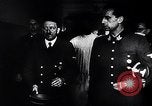
Adolf Hitler and the fall of Nazi rule in Germany, the Nuremberg trials and signing of UN charter after World War II.
Documentary about significant events of the year 1945. German dictator Adolf Hitler visits German hospitals. He talks to and asks well being of Nazi soldiers. The famous Nuremberg trials of the Nazi leaders. Prominent Nazi leaders Hermann Goering, Speer and others facing the trial in a Court of justice. The United Nations Conference with delegates from various nations. Delegates sign the UN Charter.
USAAF airmen load bombs on B-26 of 323rd Bomb Group preparing for mission to bomb targets in Germany during World War II
Slate identifies location as A-83 (Denain-Prouvy Airdrome, France) and date as 29 April (1945). Ground crew armorers are connecting wires to bombs and loading them into the bomb bay of a a U.S. Army Air Forces Martin B-26 Marauder aircraft of the 323rd Bombardment Group. View from under the aircraft as a crewman gives signal to close bomb bay doors and they slowly close and lock. Ground crewman removes a metal chock from the aircraft wheel. Flight crew members climb aboard the aircraft. A crew member writes in chalk on a bomb sitting on the ground. The message is: "Happy Boithday Hoimann from Duffy's Tavern," (conveying the New York accent associated with characters in "Duffys Tavern" radio show). World War 2; WWII; WW2.
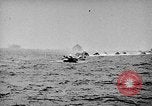
Japan Kamikazes attack U.S. Navy Task Force 58, in battle of Okinawa in World War II
Role of U.S. Navy Task Force 58 in Okinawa, Japan during the Battle of Okinawa in World War 2. Film begins showing amphibious assault by U.S. forces of Navy Task Force 58, against Okinawa, on Easter Sunday, April 1, 1945. Higgins Boats from U.S. transport ships race through the water and discharge troops on the land, with no signs of Japanese resistance. Some of the boats' markings show they came from the U.S transport ship USS Barnett (APA-5). Sailor aboard a transport ship uses ax to cut a line and release a power boat from its davits. The boat drops into the water with a huge splash. View of lines of U.S soldiers and marines wading through shallow water toward mud flats on the land. Closeups of Troops with landing craft behind them. advance overland with no signs of Japanese resistance. Troops sitting on a landing vehicle tracked (LVT) parked in sand. U.S. infantry begin moving inland accompanied by armor and military trucks and other vehicles. The area is very quiet, with no sign of enemy activity. Views of Army and Marine Corps infantry walking beside an M4 Sherman tank. Views of soldiers using binoculars in effort to detect any signs of the enemy. Crews in combat gear, at battle stations aboard Navy ships waiting patiently for enemy action. It came suddenly in the form of Kamikaze attacks on April 6, 1945, when the Navy's radar picket ships were attacked followed by general attacks against U.S. Capital ships. A kamikaze is seen striking an Essex-class aircraft carrier amidst ship, setting off explosions on the ship. Anti-aircraft gunners on various ships are seen firing at the Japanese planes. Another ship is struck by a Kamikaze. Douglas Dauntless and F4F aircraft being launched from carriers. The Battleship, USS Maryland (BB-46), is struck by a kamikaze that knocks out some of her gun emplacements, but she continues her mission in spite of the damage. A kamikaze aircraft is seen attacking the USS Yorktown (CV-10). It is hit by anti-aircraft fire and just misses the ship, splashing into the water nearby. Air is filled by black smoke puffs, from anti-aircraft fire as Japanese aircraft maneuver overhead. One is struck and falls burning to crash in the water, just off the flight deck of a carrier. Gun camera clip showing a multi-engine Japanese aircraft being shot down from behind, by a U.S. aircraft. Closeup of a Japanese Kawasaki Ki-61 aircraft in flight, peeling off to attack. More gun camera footage of a Japanese multi-engine aircraft being shot down from behind. A Kamikaze airplane diving down under anti-aircraft fire and crashing into the sea. Gunners firing Bofors anti-aircraft guns from gun emplacements beside the flight deck of an aircraft carrier. Skies filled with black flak clouds. On 11 April, a low-flying kamikaze Zero, although fired upon, is seen crashing on the battleship, USS Missouri USS (BB-63). It strikes her starboard side, just below her main deck level. The starboard wing of the plane was thrown far forward, starting a gasoline fire at 5 in (127 mm) Gun Mount No. 3. At the same time, another kamikaze crashes into the sea in the foreground. An aircraft carrier's gunners fire anti-aircraft Bofors guns at a Kamikaze plane that swoops over her flight deck and crashes, exploding, into the sea just off the flight deck. A low flying Kamikaze aircraft crashes into the sea off the bow of an escort carrier, underway. Heavy black smoke rises from the airplane blowing up. A huge explosion with a white cloud of smoke is seen above the battleship USS Missouri.
CRITICALPAST.COM: About Us | Contact Us | FAQs - How to Order | License Agreement | My Account | My Lightboxes | Shopping Cart | Advanced Search | Featured Collections | Website Terms & Conditions | Privacy Policy ©2026 CriticalPast LLC.
License Agreement |
Terms & Conditions |
Privacy Policy
©2026 CriticalPast LLC.