


 Francais
 Deutsch
 Italiano

Refine Your Search
Leipzig Germany 1945 stock footage and images
- Showing 337 to 342 of 10470 results more
 Hide
Color Sound
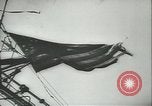
USS Franklin heads towards the United States after facing a Japanese attack during World War II.
United States aircraft carrier USS Franklin after being attacked by a Japanese bomber in the Pacific Ocean on March 19, 1945, during World War II. The U.S. flag flies from USS Franklin while on its way to the United States. A chaplain conducts a religious service on the deck of the aircraft carrier. The ship enters the Panama Canal. The men who faced the Japanese attack on USS Franklin being decorated. Men lined up with medals on their uniforms. Crew members smile after being decorated. The ship enters New York Harbor with the Statue of Liberty in the background.
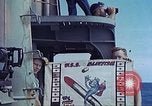
U.S. Navy submarine USS Bluefish underway with Japanese prisoners aboard it in the Pacific Ocean during World War II.
U.S. Navy submarine USS Bluefish submarine underway in the Pacific Ocean during World War II. An insignia aboard the U.S. Navy submarine USS Bluefish. Japanese prisoners go topside aboard the submarine. Smoke rises in the background as a small boat burns. Two small boats burn in the background as the submarine pulls away. Lookouts with binoculars. The USS Bluefish approaches a Japanese schooner. A lookout with binoculars on the background. Oil afire on the surface at night. The oil fire is from the i350, a Japanese submarine sunk by the Bluefish on 15 July 1945.
Invasion of Corregidor by U.S. 503rd Air Regiment and 24th Division during World War II.
Battle of Corregidor fought between U.S. troops and Japanese troops in Corregidor, Luzon Island, Philipinnes during World War II. Japanese troops lower the U.S. flag and raise the Japanese flag after the fall of Corregidor in 1942. U.S. troops in Japanese prison camps. Invasion of Corregidor on February 16, 1945 by U.S. 503rd Air Regiment and 24th Division. A U.S. convoy underway at sea. U.S. naval battleships attack shore targets. Planes take off from an airfield. U.S. 503rd Air Regiment dropped by parachutes. Paratroopers land in Corregidor. U.S. 24th Division comes ashore in amphibious vehicles, troops land and fight their way inland.
United States 9th Army troops and equipment cross the Rhine River in Europe during World War II.
A 1976 training film in the United States details the role of Combat Military Police of the United States Army in supporting river crossing during war. A member of U.S. Military Police looks through binoculars on a hillside while the division advances on a training battlefield. Rest of clip shows actual footage from World War 2: U.S. 9th Army troops cross the Rhine River in Europe in 1945 during World War II. Equipment and U.S. Army soldiers cross the river. Landing crafts and barges across the Rhine River. The troops disembark from landing crafts at the river bank. A pontoon bridge is built by men. An MP directs traffic of vehicles and other equipment along the bridge.

Japanese 1931 aggression in Manchuria condemned by the League of Nations. Continued Japanese aggression in the Pacific, through World War II
Japanese international activities during 1931-1945. Opening scene shows Japanese troops embarking on ships bound for an invasion of Manchuria, in 1931. Officers walking on the dock, amongst the departing troops. Scenes of explosions and destruction. Views of Shanghai during Japanese attacks in 1937. Destroyed buildings. Civilian dead lying in the streets. Japanese soldiers racing along a street in a three wheeled motorcycle vehicle. Change of scene shows Japanese diplomat Yosuke Matsuoka addressing a League of Nations meeting in 1933, after that body adopted a report blaming Japan for events in Manchuria. He objects to that action and then leads his delegation in walking out of the meeting. View of Japanese delegates in top hats and bowler hats exiting the building. Scene shifts to Japanese forces firing artillery and machine guns in Manchuria.They wave large Japanese flag victoriously after a battle. The next scene shows Italian forces occupying Ethiopia and raising the flag of the Kingdom of Italy, as Italian troops salute, presenting arms of rifles with fixed bayonets. Axis leaders celebrate the 1940 Tripartite Pact between German, Italy and Japan. The festivities take place in a hall displaying the three nation's flags on the walls. A large number of persons attend including Japan's Prime Minister, General Hideki Tojo, seen with two celebrants. Scene reverts to China with Chinese civilian people trying to escape from invading Japanese forces. The refugees carry their belongings as they flee. Occasional shell burst is seen among advancing Japanese troops as Chinese soldiers put up resistance. Chinese soldiers firing artillery. In the U.S., Japanese envoys Kichisaburō Nomura and Saburō Kurusu are seen walking together into a building and entering a room inside. Next, are views of the Japanese attack on Pearl Harbor, with huge plumes of smoke obscuring the bombed U.S. battleships in the harbor. U.S. battleships in line formation in the Pacific during World War 2. Aerial view of U.S. warships moving in parallel. British ships augmenting the U.S. warships. Naval guns firing. U.S. amphibious assaults on Japanese held islands in the Pacific. Prisoners of the Japanese who suffered in the Philippines. General Douglas MacArthur mingling with former prisoners and internees upon his return to Manila in 1944. Aerial views of Iwo Jima. Naval bombardment and amphibious assault of Iwo Jima. Numerous fallen Japanese soldiers. The iconic American flag raising by U.S. Marines on Iwo Jima. View of Lieutenant General Simon Bolivar Buckner Jr. during the campaign on Okinawa, where he was killed in action. A Soldier being carried on a stretcher. Another throwing a hand grenade. U.S. soldier firing at a Japanese defender who falls out of his bunker. Large numbers of Japanese prisoners of war assembled in a field. Japanese Kamikaze attacking U.S. warships off Okinawa. The sky filled with antiaircraft flak clouds. View of 40mm Bofors antiaircraft cannon firing and a Japanese plane falling and exploding on impact in the ocean.
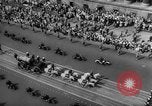
Funeral services for Franklin D. Roosevelt in Washington DC and at Hyde Park, New York (WW2)
Funeral procession of President Franklin D. Roosevelt on the streets of Washington DC. Horse drawn carriage with casket escorted by men on motorcycles. Crowd lined up on sidewalks. Various U.S. military units march. Funeral procession arrives at White House. Casket is carried into building. Casket is placed in East Room, lying in state. Scene change to funeral services for FDR at Hyde Park, New York. President Truman and Franklin D Roosevelt's wife among the mourners. A volley is fired over the president's grave. Symphonic music track in background is interspersed with audio quotations from Roosevelt, including, from his State of the Union on January 7, 1943: "Therefore, let us all have confidence, let us redouble our efforts. A tremendous, costly, long-enduring task in peace as well as in war is still ahead of us. But, as we face that continuing task, we may know that the state of this Nation is good--the heart of this Nation is sound--the spirit of this Nation is strong--the faith of this Nation is eternal." Also heard at the beginning of the clip is Roosevelt saying, "American fighting men looked to the statesmen of the world to finish the work of peace for which they fought and suffered. We failed them then. We cannot fail them again, and expect the world again to survive," from his address to Congress on Yalta, March 1, 1945 (World War II).
CRITICALPAST.COM: About Us | Contact Us | FAQs - How to Order | License Agreement | My Account | My Lightboxes | Shopping Cart | Advanced Search | Featured Collections | Website Terms & Conditions | Privacy Policy ©2026 CriticalPast LLC.
License Agreement |
Terms & Conditions |
Privacy Policy
©2026 CriticalPast LLC.