


 Francais
 Deutsch
 Italiano
Refine Your Search
Long Beach California USA 1960 stock footage and images
- Showing 10135 to 10140 of 27665 results more
more Hide
Hide
Women training and working at war materiel factories in the United States (WW2)
Soldiers on tanks fire artillery mounted on the tanks. Aircraft in flight. Views of explosions in the battlefield. Soldiers walk in lines. The soldiers in front of tents. Anti-aircraft artillery crew fire at enemy aircraft during World War II. New recruits in civilian clothes arriving for training in military armed forces in the United States. Men are trained for the army. Workers in an American factory make war equipment and war materiel. Men work on airplanes. They carry tire tubes for aircraft. People move inside an aircraft production building. Women stand in a line. Women workers report at a war production plant. A woman is being interviewed. Female war materiel workers are seated on benches and an official briefs them about the job. The women receive uniforms including a one-piece coverall uniform, wiping cloth, a cap, hairnet, and safety glasses or safety goggles, and a towel. A woman takes out uniforms from shelves in a closet. A woman wears a pair of glasses and a cap. Women move inside the production factory on the factory floor. A female worker teaches another woman how to operate a lathe. A liquid comes out of a pipe of the machine in operation. Two women work on the lathe. A truck in front of the receiving department. Women at a table make a note of the incoming material. Women work with hammer on a sheet. Women check for flaws in the raw materials. American flag seen on the wall above the women workers.
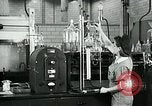
Women work on equipment in a laboratory and on various machines in the United States (WW2)
Female war production workers working in a laboratory during World War II. The women work with chemicals and on specific equipment. A woman takes out a material from a flask containing a liquid with the tongs. Bottles of chemicals kept on a table in the laboratory. Women weigh chemicals on a weighing machine. Narrator mentions their work making turbo superchargers and other parts for military aircraft. Women war production workers operate milling machines, lathes, grinders, tapping machines, punch presses, Natco multiple drill press, hydraulic presses for war materiel manufacture.
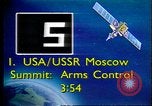
U.S.and Soviet efforts at disarmament during Reagan-Gorbachev era
Film opens with U.S.President Ronald Reagan commenting about mistrust between America and the Soviet Union. View of President Ronald Reagan and Soviet General Secretary Mikhail Gorbachev signing the arms control agreement banning the use of intermediate-range nuclear missiles, at the White House in Washington, DC on December 8, 1987. A Soviet RT-2PM Topol mobile ICBM moving on its carrier vehicle. A U.S. intermediate range missile being launched. Another view of U.S.President Reagan and Soviet General Secretary signing the Intermediate-Range Nuclear Forces Treaty (INF Treaty) on December 8, 1987, to become effective on June 1, 1988. Views of ICBMs being test launched from silos. A Soviet Tupolev Tu-95 strategic bomber in flight, seen from the side and from underneath. A U.S. Navy heavy cruiser, armed with cruise missiles. Closeup of a cruise missile rising from the ship and firing across it toward a target. Illustration of a seaborne missile fired from a warship. General Secretary Gorbachev in a group, including his wife, Raisa, visiting a Soviet Navy submarine. Major General William F. Burns, Head of the Arms Control and Disarmament Agency (in civilian clothes), is seen raising doubt about the feasibility of the Soviet suggestion to use scientific methods for checking from a distance about arms control compliance. Artist conception of satellites being shot down in space. Secretary of State, George Schultz and his wife, Helena Maria, descending steps from an airplane upon landing at Moscow, in the Soviet Union to confer with Soviet leaders in Moscow on Nov. 4, 1985, in preparations for the meeting between President Reagan and Mikhail S. Gorbachev, the Soviet leader, later in the month in Geneva, on November 19th and 20th. Negotiating teams assembling in a meeting room in Moscow. Secretary Schultz and Soviet Foreign Minister, Eduard A. Shevardnadze conversing. William F. Burns, saying, " I think we are well on the road to achieving a useful, good, and balanced treaty." Views of civilians killed by chemical weapons in the Iran-Iraq war. Soldiers in protective gear associated with chemical weapons. One soldier decontaminating a tank using a water hose. Tanks moving in Europe. U.S. troops firing an antiaircraft gun. Scenes of World War II showing conventional arms being used on tanks and from landing craft. Afghan fighters carrying a wounded comrade. Glimpse of soldiers in a trench firing a mortar and one firing a machine gun, during the Iran-Iraq war. An armored personnel carrier moving across a muddy field. More views of Reagan and Gorbachev signing the INF treaty in 1987. A U.S. spokesman noting that the USSR has not changed the offensive nature of its force structure and deployment patterns.
U.S. President Ronald Reagan delivers a New Year's greeting to the people of the Soviet Union
American President Ronald Reagan is seen in the the Roosevelt Room of the White House in Washington, DC, from where He delivers a New Year's greeting to the people of the Soviet Union. He is seated in front of a fireplace mantle decorated with holly. A large poinsettia plant sits in front of the fireplace. The American flag is displayed to his right. The President describes the ways typical American families celebrate Christmas, Hanukkah, and the New Year. He mentions the U.S.Presidential election scheduled for next year (1988). Reagan notes that he and General Secretary Gorbachev signed the Intermediate Nuclear Forces Treaty, last month and hope to meet again, in a few months, in Moscow. He alludes to Soviet and American representatives in Geneva discussing a 50 percent reduction in strategic nuclear weapons suggests they may have a treaty ready to sign in Spring. President Reagan notes that America and the Soviet Union have the opportunity to develop a defensive shield against ballistic missiles (also called SDI or Star Wars), and that the U.S. intends to pursue the possibility that technology offers. In other matters, the President speaks of expanding contacts and communications between our two countries. He mentions Human rights and human dignity. He expresses concern about senseless conflicts in a number of regions. He closes by wishing the Soviet people a Happy New Year. (Note: President Reagan's message was recorded on December 23, 1987, in the White House and broadcast on January 1, 1988.)

Americans during various dance performances and protests in the United States during the roaring 1920s.
The life of Americans in the 1920s. Women dance the Charleston. A man dances the Charleston with a woman. Musicians play in the background. Patrons of Steeplechase Park, in Coney Island, on a spinning wheel. Clown steer a woman to where her dress gets blown up from a hidden air jet. Women on the boardwalk in batihing suits and being arrested by police. A man lifts up a woman during the dance performance. A sketch shows women applying make up. Several scenes showing the gap between the people who could accept the modern ideas and those who couldn't. Clarence Darrow and William Jennings Bryan. Views of Steelmaking at steel factory plants. A scene with the Ku Klux Klan, or KKK. People protesting the trial of Sacco and Vanzetti, accused anarchists. Various banners during the protests.
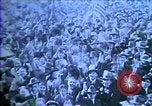
Strikes in various cities, formation of the Communist Parties, and disorder in the U.S. and Soviet Union after World War I.
The aftermath of the World War I. People of America celebrate the end of the war. Soldiers aboard a ship as they return back to America. Several scenes of America before war. A parade. Sketch depicts the era during the presidency of Thomas Woodrow Wilson. Soldiers on the battlefield fight and fire artillery. A parade in America. Sketches depict the willingness of Woodrow Wilson to join the league of nations and America's refusal to join it. Woman of America casts her vote. Sketches depict the financial status of the Americans and the inflation after the war. Steel workers on strike. The policeman go on a strike in Boston. Sketch depicts the unsafe cities of United States. Picture of John Calvin Coolidge, Governor of Massachusetts. The governor inspects new police force after the strike is called off. Sketches of the revolution in Russia. Papers shows the various communist revolutions. Several sketches show the formation of communist party in America. A bomb packet reads name of John Davison Rockefeller, an American industrialist. Explosion occurs in a wagon. People injured and loss of property due to explosion. Police arrests the suspects. Sketches of the various strikes and disorders in America. Sketches of the immigrants to the United States. An official checks the immigrants. The U.S. Senator Warren Gamaliel Harding addresses the people. Harding with Thomas Woodrow Wilson in a car . Sketches compare the two Presidents.
CRITICALPAST.COM: About Us | Contact Us | FAQs - How to Order | License Agreement | My Account | My Lightboxes | Shopping Cart | Advanced Search | Featured Collections | Website Terms & Conditions | Privacy Policy ©2026 CriticalPast LLC.
License Agreement |
Terms & Conditions |
Privacy Policy
©2026 CriticalPast LLC.