


 Francais
 Deutsch
 Italiano
Refine Your Search
Long Beach California USA 1960 stock footage and images
- Showing 1597 to 1602 of 27665 results more
more Hide
Hide
Troop transport, USS Elizabeth C. Stanton, AP-69, engaged in amphibious training exercises during World War II
United States soldiers and sailors participate in amphibious training exercise, in the Chesapeake Bay, during World War 2. Soldier and Sailors exit a Landing Craft Personnel Large, LCPL, and run across a beach towards some woods. Soldiers crouched aboard a Landing Craft Vehicle Personnel, LCVP, under way. Note many of the soldiers armed with M-1 Garand rifles, have applied condoms to the muzzles of their rifle barrels, to prevent salt water corrosion. The fleet transport USS Elizabeth C. Stanton, AP-69, flagship for amphibious exercises in Chesapeake Bay., at anchor. A Landing Craft Personnel Large, LCPL passes by in the foreground. Soldiers aboard and exiting a beached Landing Craft Vehicle Personnel, LCVP. An LCVP with 'P69-10' painted on its side hits the beach. Soldiers exit near yellow cloth beach signal panel and run across the beach.
Signal Corps weekly film reports sent to Photographic Center and used in training films for U.S. troops during World War II.
The role and contribution of the U.S. Army Signal Corps in combat and war. Amphibious landings of the first wave of Allied troops including Signal Corps Units in Normandy, France on D Day during World War 2. The Joint Assault Signal Companies (a Signal Corps Unit that accompanies the soldiers on every beach landing) go ashore in Normandy. Soldiers in landing crafts approach the beach. Landing crafts anchored along the shore line. A U.S. flag on the beach. Crafts approach the beach. U.S. Army Signal Corps combat photographers using motion picture cameras to film the battle that ensues on the beach and in the fields. Gun fire and explosions in the battlefield, filmed by combat cameraman. Allied aircraft in flight. Airmen load weekly film reports of the war in all Theaters made by Signal Corps officers from a van into an aircraft. The films are sent to the Photographic Center in New York. A soldier assembles the films. Technicians organize and arrange the films. They place the film reels onto racks. The film content is used to make training and orientation films for the U.S. troops. Troops watch the films in order to cut down the training period, and stay informed about the order of event in other Theaters of Operation. The films include 'Why We Fight' and 'The Fighting Men' series. Clips and recordings from these films.
Men learn to operate DUKWs in a training school in the United States.
A film titled 'DUKW: the sea going truck' on working and general features of DUKWs. Soldiers at a beach in the United States. Cargo and equipment stacked on the beach. A landing craft and a DUKW underway at sea. A truck moves along the beach. Men learn to operate DUKWs at a training school. They learn how to drive it on land. Men seated in DUKWs and operating them. The DUKWs moving along a street. A man comes out of a DUKW. He works on a tire and boards again. The DUKW moves. DUKWs moving along an area. Men shovel mud on a beach. A man comes out of a DUKW. Men standing behind the DUKW shovel mud. The importance of proper tire pressure for roads and beaches is emphasized. A bogged-down DUKW winches itself free. (World War II period).
Coast guards on patrol in the U.S., aboard a yacht and a life boat; rescuing men from ships underway at sea
Domestic activities of the United States Coast Guard in the United States during World War II. Coast guardsmen patrol a beach. Men seated in a car drive past on the beach. A U.S. Coast Guard man seated on a horse patrols along the beach. A Coast Guard patrol walks on the beach. Newspaper showing headline and article about disruption of Operation Pastorius by Coast Guard in World War 2, leading to capture of Nazi German would-be saboteurs. View of two of the captured saboteurs being escorted by guards. Smoke in the foreground from the burning of a ship. Men on the deck of a ship. They take an oath. Men aboard a motor boat. Men aboard a yacht and other ships underway at sea. Men aboard a life boat arrive at a beach. They carry the men rescued by them on stretchers.
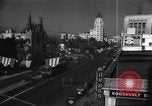
Hollywood Boulevard views, entrance of the Roosevelt Hotel, and traffic on streets in Hollywood, California.
View down Hollywood Boulevard in Los Angeles, California, with Hollywood First National Bank Building featured near center. View of the Hollywood Roosevelt Hotel (7000 Hollywood Blvd, Los Angeles, CA 90028, United States) in Los Angeles, California. A view of Hollywood Boulevard in front of the Roosevelt Hotel. Grauman's Chinese Theater, later Mann's Chinese Theater (6925 Hollywood Blvd, Hollywood, CA 90028, United States), is seen. Red Car trolley and automobiles move along the road. Entrance of the Roosevelt Hotel. A sign on the entrance reads 'Hollywood Roosevelt'. People walk in front of the hotel entrance. A view of buildings in Hollywood.
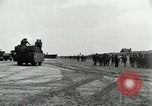
Allied soldiers in amphibious crafts, military jeeps and trucks as they establish a beachhead in Normandy.
Allied troops establish a beachhead at Normandy. Beach area. Allied troops on the beach. DUKW (amphibious crafts) cross the beach. A house in the background. A Landing Craft Tank (LCT) with cargo on deck being beached. A medic on the beach. Soldiers in military jeeps and trucks. A mobile crane moves across the beach. Soldiers load lumber into trailer alongside a Landing Craft Tank (LCT). Soldiers march by. Several landing crafts on the beach. (World War II period).
CRITICALPAST.COM: About Us | Contact Us | FAQs - How to Order | License Agreement | My Account | My Lightboxes | Shopping Cart | Advanced Search | Featured Collections | Website Terms & Conditions | Privacy Policy ©2026 CriticalPast LLC.
License Agreement |
Terms & Conditions |
Privacy Policy
©2026 CriticalPast LLC.