


 Francais
 Deutsch
 Italiano
Refine Your Search
Long Beach California USA 1960 stock footage and images
- Showing 4765 to 4770 of 27665 results more
more Hide
Hide
National League wins 1959 Major League Baseball All Star Game at Forbes Field, Pittsburgh
Newsreel clip on baseball's July 7, 1959 All-Star Game -- the first of two games played that year. Clip opens with view of the 35,000 fans jammed into PIttsburgh's Forbes Field for the daytime game. With score tied 1-1 in the seventh inning, the Chicago Cubs' Ernie Banks (seen in brief closeup) hits a long drive off the left field wall, runs into second for a double. Milwaukee's Del Crandall then singles to score Banks and give the National League a 2-1 lead. Fans stand and cheer as the Pittsburgh Pirates' Bill Mazeroski comes to bat. Mazeroski gets hit to left field to score Crandall. In the eighth inning, the Chicago White Sox' Nellie Fox gets a single to ignite a rally. The Baltimore Orioles Gus Triandos hits a double to put American League in front 4-3. But in the bottom of the eighth, hits by Ken Boyer and Hank Aaron tie the game. Then Willie Mays (seen in closeup) hits a long drive just beyond the reach of the center fielder. Forbes Field's ivy-covered outfield wall seen in the shot. Mays' triple scores Aaron to put National League on top 5-4. Brief view of the scoreboard. In the ninth inning, Harvey Kuenn pops up to the end the game.
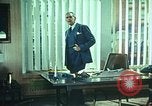
Description of North American Air Defense system components and operation
Actor Raymond Massey talks about the nation's need for defense against possible air attack. He walks to a large wall map depicting North America and discusses joint efforts of Canada and the United States to establish an effective air defense system for North America. On the map, lines of radar stations are shown: The DEW line;Mid Canada line; and the Pine Tree line. Other radar installations are highlighted along East and West coasts on land, on towers in the ocean, on picket ships and on picket aircraft. Sites of the SAGE (Semi-Automatic Ground Environment) network of radars, computer systems, and aircraft command and control equipment are depicted on the U.S. part of the map. The headquarters of NORAD (North American Air Defense Command) at Colorado Springs, Colorado is highlighted. Massey points to models of intercepter missiles and long range bombers, on his desk, and discusses their employment. He then speaks of an intricate communications system to tie everything together. This is depicted on the animated map. Views of men laying telephone cable. Underground view of telephone cables. View of telephone microwave tower. Telephone poles and lines along a rural road. A mother and child telephoning the father long distance. Office workers using telephones. Teletype machines and television communications. A ship laying telephone cable at sea.Map depicts lines of communication provided by undersea cables. views of emergency supplies and equipment available in times of disaster. Downed power lines being repaired. Men at a large emergency diesel generator. Underground communication cables being installed by team of tracked vehicles. Remote lines of communication away from possible targets are depicted.
Bob Burns plays bazooka and Shirley Ross sings 'Clementine' on the 'Sing with the Stars' show.
'Sing with the Stars' features Bob Burns as 'Bob Bazooka Burns'. Begins with scene showing a bazooka being fired. Bob talks about the bazooka and shows the audience his humorous musical instrument, for which the weapon was named. Then, he and American Hollywood actress and singer Shirley Ross sing 'Clementine' together. For part of the song, Bob Burns actually plays his bazooka as one would play a trombone. The lyrics of the song are displayed for audience sing-a-long. Bob and Shirley joke about Clementine.Cartoon artwork of funny characters are shown on screen along with the lyrics, and a bouncing ball over the words for sing-a-long.
Cattle driven to slaughterhouse in Chicago, Illinois
A herd of long-horn cattle herded through the Chicago stock yard gates on the way to the slaughter house. Man seen prodding a few with a long pole. (Filmed by Edison Company, July, 1897)
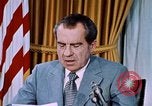
President Richard Nixon gives an energy crisis statement from the Oval Office of the White House in Washington DC.
U.S. President Richard Nixon addresses the nation from the Oval Office of the White House in Washington DC, United States. President Nixon says that lack of energy supplies would bring temporary shortages in fuel supplies and some increase in fuel prices. He says that if energy resources were properly developed they could fulfill American energy requirements for centuries. He says that his administration was going to end quantitative controls on oil imports and establish a national energy office in the United States. He talks about increasing the ability of the United States to prevent oil spills. The President proposes that the Congress should remove government regulations which discouraged the growth of domestic natural gas industry. Secondly, the Congress should help to establish research and ground work for developing new forms of energy for a long range future (alternate sources of energy). Thirdly, the Congress should permit the licensing of new deep water ports to open the way for long delayed Alaska oil pipeline.

U.S. recruits being classified for assignments and being informed about the progress of World War II and why they fight.
New U.S. army recruits seated at benches in the classification center, taking notes, as an instructor at a blackboard tells them how to fill out their classification questionnaires, during World War 2. View of machines processing the questionnaires. Hollerith 88 column punch cards being sorted by machine. Newspaper article about the Air Force efforts to improve classification and assignments of new airmen. A recruit being counseled. An Airmen in barracks, filling out a post card form to complain about his assignment. Servicemen working with sewing machines and at long cobbler's benches repairing shoes. U.S. soldiers in pith helmets, laying communications cable from a truck. A soldier recording information about a shipment of supplies. Soldiers filling 5-gallon "jerry cans" with fuel from a hose. Others serving at a communications center in woods. A soldier fastening a cable to a tank. Soldier standing on a truck. Large group of soldiers gathered to listen to a lecture about explosives. Army draftsmen at their work tables. Soldiers using information and training materials.(Narrator states these materials are often ignored.) An army newsmap for Monday, August 31, 1942 posted on an Army office wall. A sergeant points to July, 1943, on a current calendar next to it, illustrating that the newsmap is long out-of-date. View of another news map and narrator notes they are produced weekly. An officer speaking to an auditorium of soldiers. A soldier arranging his personal gear. Infantry on field maneuvers, firing rifles as they advance across a field. Soldiers firing a Browning water-cooled machine gun; a mortar; and a 105mm M101A1 howitzer. The sergeant using a newsmap to brief his staff about the progress of the war. Opening frames of a War Department Film Bulletin, and soldiers in a theater, watching the film. Opening frames of the film,"Why We Fight," that goes on to show animated map of the German advance across Europe in World War 2. Scenes of German forces on the move, towing artillery, riding on tanks, and entering towns as they invade countries of Europe. Women and children running in streets under bombardment, and civilians fleeing from their homes during aerial bombing. A Bombed out city and civilian corpses lying on the ground. Women in Poland, identifying their dead and grieving over them. German Heinkel He 111 aircraft dropping bombs. Norwegians evacuating the city in trucks, and other vehicles and on foot, during the German invasion. A squadron of German Messerschmitt Bf-109 aircraft in flight. German Ju-87, Stuka dive bombers diving on targets. Civilians rushing to a bomb shelter, and other refugees boarding a truck to evacuate. More He-111 bombers dropping bombs. A Ju-52 trimotor transport (type used to transport German paratroopers). Buildings ablaze in a town. Large formations of German aircraft of various types flying overhead. Building destroyed and burning from bombing. Ju-87s flying close past the camera.
CRITICALPAST.COM: About Us | Contact Us | FAQs - How to Order | License Agreement | My Account | My Lightboxes | Shopping Cart | Advanced Search | Featured Collections | Website Terms & Conditions | Privacy Policy ©2026 CriticalPast LLC.
License Agreement |
Terms & Conditions |
Privacy Policy
©2026 CriticalPast LLC.