


 Francais
 Deutsch
 Italiano
Refine Your Search
Long Beach California USA 1960 stock footage and images
- Showing 5551 to 5556 of 27665 results more
more Hide
Hide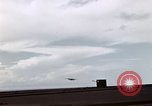
A North American AJ (A-2) Savage aircraft lands on the flight deck of USS Midway (CVB-41) in the Atlantic.
A North American AJ (A-2) aircraft makes a long low final approach and lands on the flight deck of USS Midway CVB-41 in the Atlantic.
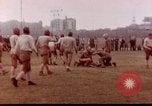
U.S. Navy and Marine Corps compete in football game at infield of racecourse in Tsingtao, China
Scene is football field, set up in the in field of the city racecourse at Tsingtao (Qingdao) China, in 1946. The unusual thing is there are no goal posts. U.S. Marine and Navy spectators stand around the field, and some occupy a small viewing stand. Various multistory buildings are seen in the far background, as the camera pans about,following the play on the field. Players wear football uniforms, and leather helmets. One team (probably Marines) wears Khaki jerseys and the other (probably Navy) wears white. As the film begins, one Khaki team player is being helped as he walks off the field, while others attend to a player lying on the ground. Play resumes with a play in the Khaki end zone, followed by a Khaki kickoff to white, who return the ball. Camera stops there and switches to another Khaki kickoff. White seems unable to overcome Khaki defense on the ground and resorts to a long pass that is intercepted by Khaki. The rest of the film shows glimpses of plays on the field. A White team player is seen on the ground attended by sailors. Play resumes again, with Navy punting. As the game ends, players of both teams walk off the field and are greeted by Marine and Navy spectators respectively. Camera shows view of the much larger racecourse area that encompassed the playing field. U.S. military trucks begin driving over the field. Scene shifts to view from a grandstand at far end of the racecourse, near buildings in downtown Tsingtao. Marines and sailors are leaving the field. Camera pans over the large racecourse infield where marines and sailors are cleaning up the playing field. Change of scene shows U.S. Army Lieutenant General Albert C. Wedemeyer, Navy Admiral Charles M. Cooke, and a Rear Admiral, sitting with Madame Chiang Kai-shek. She is examining an American football, as the Rear Admiral explains it to her. Scene shifts to more shots of the football game including several fumbles. It ends with Khaki team huddle.
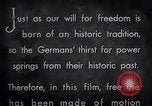
U.S. Army orientation film "Here is Germany" showing the contrast in life in Germany pre-war and during World War 2
U.S. Army training film titled 'Here is Germany'. Circa 1930 - 1938 views of pre-war German countryside, and German cities including Berlin and others before destruction in World War 2. Shots include famous German landmarks and buildings in major cities including Brandenburg Gate and Victory Column sculpture close-ups and other monuments all before bombing of World War II. Lifestyle of German people with families and children in their routine lives in the decade of 1930 before the war. Farmers working fields, mined coal transported by rail, potatoes poured from a full sack, a boy shepherd with geese; a farmer counting pigs descending a ramp at a farm. City port or harbor scene with ships and a modern looking railroad train arriving at a station, sign on side reads Deutsche Reichsbahn (German Reich Railway). High speed highway roads like the Autobahn. German cruise ship at sea. Aerial view of airport with "Berlin" sign on ground. German schools, offices, factories and markets. German woman braiding a girl's hair. German woman taking in washed clothing from a clothesline. German men, women, and children cleaning and polishing work areas and possessions. A German library with people studying and others at book shelves. German classroom with a teacher instructing children and writing on a blackboard. Scenes of German musicians and symphony orchestra and musical instruments, artisans, masons, cooks. Busy roads with cars. Narrator then presents a darker other side, showing an arms factory during rearmament of Germany, German soldiers escorting away a religious priest. German military officials. Scenes circa 1945 of victims of German armies and of the concentration camps. Lumps of dead bodies from massive public shootings, a man being tortured, burning chambers, prisoners of war, concentration camps, human ovens, gas chambers. Survivors of the German custody in relief camps of Red Cross. Evidence of atrocities committed by Nazi Germany. Articles made of human skin and bones. Daily utility items like toys and brushes made from human body parts. Scenes of survivors of concentration camps. Polish people dead from Nazi atrocities at Lublin Castle. Italians and Belgians murdered by Germans, American POWs murdered by Germans. Scenes return again to 1930s views of peaceful German citizens and German lifestyle juxtaposed with views of German soldiers and military actions in World War 2. Some famous Americans of German roots: Wendell Willkie, Admiral Chester Nimitz, Henry J. Kaiser. Narrator talking about American customs and values. View of two teenage American boy students viewing a housing area and taking notes. One of the teenage boys is African American. Some men gathered at a bar in an American town. A man holding a long fly fishing pole preparing to depart on a fishing trip. Woman neighbors in discussion. Young American women walking down a sidewalk in an American town as a group of American boys watch and admire them.

French officers examine facilities used by Gestapo during Nazi occupation of France in World War II
Views of Nazi facilities that had been used by the Gestapo to torture and kill prisoners during the German occupation of Paris, France, in World War 2. A long low tunnel is seen (that had been a rifle range for the Ministry of Aviation). French soldiers and Partisans examine wooden stakes and hand prints of victims on the walls. Closeup of the uniformed French officers examining the wooden stakes where prisoners were executed by firing squads. Numerous bullet holes and damage is evident in the stakes. A blindfold and rosary are found on one stake. In another area, the officers examine wooden coffins ready for use. In the courtyard, a large excavation is shown where numerous bodies were dug up. Wooden boxes are seen that contained bodies.
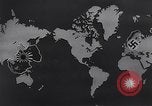
American paratroopers training and operating from C-47 and C-46 aircraft during World War II
Opens showing maps of German and Japanese occupied territory during World War 2. Camera zooms in on the Japanese territory and shows points of Allied pressure against it during the war. Camera zooms in on German occupied areas and shows Allied pressure from The Atlantic and Mediterranean. View from above of formations of C-47 transport aircraft flying over water. (It may involve an invasion rehearsal, because the planes are not in D-Day stripes.) Formations of boats leaving long wakes as viewed from aircraft overhead. U.S. paratroopers relaxing inside a C-47 aircraft. They are alerted and don their helmets preparing to jump. Formation of C-46 Commando transport aircraft viewed from below. A paratrooper hooked up to a static line inside a transport plane. View from one of the aircraft in a formation dropping paratroopers over desert area. Their black chutes opening below the aircraft. Occasional white chutes seen. White parachutes seen from above as they descent toward agricultural land below.
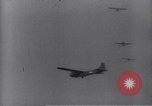
U.S. gliders landing in France on D-Day during World War II
U.S. Army Waco CG-4A combat gliders viewed from the ground where others have already landed, in France on D-Day during World War 2. One lands successfully. Another looms overhead near trees, makes a landing, and while sliding a long way to a stop, noses over completely and is destroyed.
CRITICALPAST.COM: About Us | Contact Us | FAQs - How to Order | License Agreement | My Account | My Lightboxes | Shopping Cart | Advanced Search | Featured Collections | Website Terms & Conditions | Privacy Policy ©2026 CriticalPast LLC.
License Agreement |
Terms & Conditions |
Privacy Policy
©2026 CriticalPast LLC.