


 Francais
 Deutsch
 Italiano
Refine Your Search
Long Beach California USA 1960 stock footage and images
- Showing 5557 to 5562 of 27665 results more
more Hide
Hide
U.S. President Richard Nixon and First Lady Pat Nixon arriving at Moscow Vnukovo II airport
President of United States Richard Nixon and First Lady Pat Nixon arrive at the Vnukovo II airport, in Moscow, Soviet Union (USSR). View from the cockpit of the Presidential VC-137C (Boeing 707) aircraft, named "Spirit of 76", as it taxis on the active runway, and then on the ramp, after landing. View from Air Force One, as the cabin door is opened. A red-carpeted stairway is rolled toward the aircraft. The American flag flies next to the Soviet flag, atop the airport terminal building. A military brass band and honor guard, stand in formation. Several Soviet officials walk toward the Presidential aircraft. Mrs. Pat Nixon, exits the airplane a step ahead of President Nixon. They descend the stairway and are greeted by USSR President Nikolai V.Podgorny, Premier Alexei N. Kosygin, Foreign Minister, Andrei A. Gromyko, and other Soviet officials. The President and Mrs. Nixon shake hands with the officials and Mrs. Nixon accepts a bouquet of flowers. Next, the President is seen at attention, on the airport ramp, with three Soviet officials, and a U.S. Army attache, as the Soviet bandmaster conducts the band in what appears to be the U.S. National Anthem. View shifts, again, to the doorway of the President's airplane. The Soviet band and honor guard are seen from a stand of trees, as they parade past the airplane. Finally, a long line of automobiles is seen in a motorcade headed toward the city.
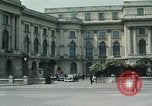
U.S. President Richard Nixon and First Lady leaving Romania, escorted by dignitaries at the Bucharest airport, Romania.
United States President Richard Nixon on tour to Romania. Bucharest Otopeni Airport (Henri Coandă International Airport, Calea Bucureştilor 224E, Otopeni 075150, Romania) during the arrival of President Nixon and First Lady Pat Nixon. Poster on terminal building reads 'Long Live Peace and Friendship between people'. Military band musicians play. The United States Air Force One, a Boeing C-137 Stratoliner aircraft (VC-137), on the runway. President Richard Nixon and First Lady Pat Nixon arrive at the terminal along with Romanian President Nicolae Ceausescu and other dignitaries. They are presented various gifts and bouquets. The couple moves up the stairs and waves towards the people at the terminal. Honor guards watch as the Air Force One flies away.
Documentary titled 'Copenhagen, Gay and Vivacious' showing buildings, markets and monuments of Copenhagen, Denmark.
Aerial views of Copenhagen, Denmark. Swedish Fokker F.XXII passenger airplane, named "Lappland," at the airport. Danish Airline Fokker F.VII passenger airplane. It taxis quickly, and stops in front of the airport terminal. Woman passenger deplanes. Luggage is removed from aft of the cabin. A German Lufthansa Junkers JU-52 with wheel pants, taxis, and parks. Passengers and a uniformed crew member disembark from the plane. The name "A.B. Aerotransport" printed on Fokker F.XXII. A steam locomotive pulls a passenger train into railroad station (possibly leaving and not stopping). A passenger ocean liner docks. Cars, taxis and buses meet the ship. Passengers disembarking from ocean liner. Taxi carrying passengers to hotel. A finely dressed, wealthy man and woman sign in at hotel desk, as bellman or bellhop brings luggage into hotel lobby. The couple peruse a booklet showing sights in Copenhagen and discuss them in English. View of the Copenhagen City Hall (Rådhuspladsen 1, 1550 København, Denmark). Trams and cars driving past and pedestrians on sidewalks. View of clock tower on City Hall. View from high above Town Hall Square (City Hall Square 1599 Copenhagen, Denmark). Rack filled with bicycles. A messenger heading off on a bicycle. An open-air market, with many farmers' and mongers' small trucks parked in lines. Numerous customers visiting the marketplace. Flower sellers' stalls along sidewalk. Fishing boats at the pier in Nyhavn (New Harbor). People eating at tables and women preparing foods for sale. Tram operators boarding their cars and driving away. Tram operators boarding their cars and driving away. Boats in a canal and a rowboat moving through a picturesque arch under a bridge. Diners at long tables in a restaurant. A policeman. Tower of Saint Nicholas Church, now presently known as the “Nikolaj, Copenhagen Contemporary Art Center” (Nikolaj Plads 10, 1067 København K, Denmark). View of Frederik's Church (Frederiksgade 4, 1265 København, Denmark). Church of Our Lady (Vor Frue Kirke, Nørregade 8, 1165 København, Denmark). Statue of Moses near the Church of Our Lady. An Expressionist style church, the Grundvig Memorial Church (På Bjerget 14B, 2400 København NV, Denmark). Gefion Fountain (Churchillparken, 1263 København K, Denmark). Hans Christian Andersen statue (Rådhuspladsen, 1550 København V, Denmark) near Tivoli Gardens. The equestrian statue of King Christian IX Monument (Christiansborg Ridebane 25, 1218 København, Denmark) by Anne Marie Carl-Nielsen, the first equestrian statue of a monarch created by a woman sculptor. Statue of King Frederick VII (Christiansborg Slotsplads 1, 1218 København, Denmark). The equestrian statue of Archbishop Absalon (Højbro Pl., 1200 København, Denmark), the founder of Copenhagen. Statue of King Frederick V (Amalienborg Slotsplads, 1257 København K, Denmark). Formal gateway with Doric columns. King Frederick IX and Queen Ingrid of Denmark in open coach. Drawbridge opening for small sailboat. Man feeding birds on the park. A bored driver presses car horn. Cars waiting for drawbridge to lower down.
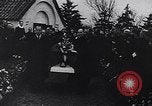
Denmark under German martial law during World War II
Film made by Danes, after increasing tensions between them and German occupation forces that invaded Denmark in 1940, boiled over in August 1943, and the Germans placed Denmark under martial law. It covers the period 1943 and 1944, after which the film was smuggled out of the country. Opening scene shows pallbearers at the funeral of Kaj Harald Leininger Munk (aka Kaj Munk) a Danish playwright and Lutheran pastor, who was assassinated by Nazi Gestapo agents, on 4 January, 1944. Narrator states that Nazi murder leagues assassinated some of Denmark's greatest leaders to intimidate the Danes and quell any rebellions. The coffin of Pastor Munk is lowered into its grave. Memorial stone and flowers are shown. Smoke rising and then a large conflagration are seen, from Danish acts of sabotage. Damaged buildings and more fires, from Danish resistance, are seen. In response, the "Schalburg Corps," a Danish volunteer branch of the Nazi SS, began counter-sabotage (called Shalbotage by the Danes). Film shows fireman on ladders at the building of the Paramount Movie Company, Ltd. where smoke is coming from the windows. (Narrator says film companies that refused every form of collaboration were blown up.) View of severely damaged Nordisk film studio at Helerup. Windows shattered in department stores and in all shops along a street. Illums Bolighus (famous store of Scandinavian design) and many others are wrecked. Camera pans up the side of damaged building with bird painted on its side and the words: "mod lysere Dage.." (Brighter Days). Views of the destroyed Royal Yacht Club pavilion, in Copenhagen harbor. Destruction in Tivoli Gardens. Its concert hall completely destroyed. Fire burning at the Syndicate, Denmark's largest armaments factory, from bombing by saboteurs, in June, 1944. Danes walking in Copenhagen, on a summer evening, flaunting the Nazi curfew from 8PM to 6AM and then lighting bonfires after dark. Abandoned wheel barrows and empty streets are shown when residents of Copenhagen all go home in a general strike. Several German soldiers are seen in otherwise empty street, as the German Commander in Chief declares the city of Copenhagen under siege. A German tank parked in the street amidst pedestrians. Barricades set up by strikers in a street. The American flag flying high over a street. The "Bulldog" a department store in flames. A car serving as an ambulance drives down a street displaying a white flag. A long line of Danes wait at a street corner shop for self-rationed food. Danes drawing fresh water from lakes to be brought to hospitals, where needed. View from above of strikers at a barricade. Narrator states that after 5 days, the Germans gave in and agreed to Danish terms. View of open area in the city, where people stand in silence to commemorate those who lost their lives in the struggle. Danish man looking through chain link fence. More scenes of continued sabotage by Danes.
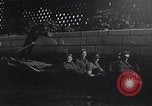
British Eighth Army troops, on furlough, enjoy sights of Venice from gondolas, at end of World War II in Europe
British troops of the Eight Army on vacation in Venice at the end of World War 2 (Europe). On leave British soldiers fill several gondolas for rides along the canals of Venice. A British soldier on the gondola salutes to the camera while another soldier flashes the “V” sign. A smiling British soldier waves at the camera before giving a thumbs up. Italian gondoliers stand in the rear of each boat and propel and maneuver them with long poles. British soldiers riding a gondola in the Grand Canal. The Palazzo Giustinian and Ca’ Foscari University of Venice are seen behind the British soldiers in the Grand Canal. Views of buildings along the canals and of bridge under which the boats pass. Another segment shows a steam-powered tour boat moving rapidly along a canal. In change of scene, shot from a gondola, Italian civilians are seen standing in a large gondola water taxi moving along a canal. Italians are also seen seated in a normal size gondola underway. More views of buildings lining canals, including the Hotel Canal Grande (Campiello S. Simeone Grande, 932, 30135 Venezia VE, Italy). Another gondola carrying three British soldiers, passes the camera. A large, powered tour boat passes, with Allied troops aboard, flying the American flag.
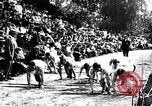
Athletes participate in various athletic events and spectators enjoy at a sports meet, in Great Britain.
A sports meet organized with various athletic events underway, in Great Britain. Athletes run on tracks in men's relay race. Spectators watch and cheer for athletes. Men jump and advance in a sack race competition. Athletes participate in hurdle race. Athletes in another event climb structure of bamboo poles and jump on ground. Athletes run and jump from inside a roll. Rope climbing,obstacle race, high jump and long jump events underway.
CRITICALPAST.COM: About Us | Contact Us | FAQs - How to Order | License Agreement | My Account | My Lightboxes | Shopping Cart | Advanced Search | Featured Collections | Website Terms & Conditions | Privacy Policy ©2026 CriticalPast LLC.
License Agreement |
Terms & Conditions |
Privacy Policy
©2026 CriticalPast LLC.