


 Francais
 Deutsch
 Italiano
Refine Your Search
Long Beach California USA 1960 stock footage and images
- Showing 5683 to 5688 of 27665 results more
more Hide
Hide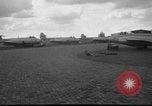
A Gloster Meteor jet of the Royal Netherlands Air Force is fueled at Gilze Rijen air base in Holland
NATO Project Cirrus, Gilze Rijen Air Base, in the Netherlands, 1951. Camera shows a group of parked Gloster Meteor jet aircraft of the Netherlands Royal Air Force. An officer and airman climb about the cockpit of one plane. One aircraft is seen parked in front of a large cylindrical structure. The number "3" is displayed on its nose wheel cover. A portable power unit sits under its left wing. Next scene shows a fuel truck with long boom positioning the fuel hose directly above the fuel port on the aircraft. An airman atop the aircraft handles the refueling hose during the refueling. Closeup of him controlling the hose. Scene shifts to a Meteor aircraft taxiing past parked aircraft. View back to the fuel truck that has now retracted its boom and refueling hose. Next, a pilot wearing flight suit and a seat pack parachute climbs into the cockpit of a Meteor plane. Closeup of him settling into the cockpit and checking the flight instruments and controls. A Meteor aircraft is seen landing in the background.
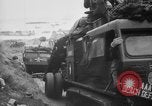
Allied paratroopers in gliders continue airborne assault in daytime, on D-day, after initial airborne troop drop the night before, in World War II
Allied invasion of Normandy, France during World War 2. Allied trucks and equipment move up from beachhead after D-Day. Half-tracks, armed with antiaircraft guns, move up from the beachhead. Back in England, gliders are readied for mission. A long line of Paratrooper medics wearing Red Cross Arm bands, board gliders. View from airplane flying over an airfield filled with C-47 tow planes, and gliders, all painted with invasion stripes. Closeup of Sergeant with British 6th Airborne Division showing Pegasus insignia on his sleeve. British paratroopers boarding a Hamilcar glider. U.S. paratroopers boarding gliders. View from above of Allied gliders being towed across the English Channel View from a ship in the invasion convoy, of tow planes and gliders overhead. View, from aircraft overhead, of invasion flotilla below. Distant view of Allied aircraft shot down by German antiaircraft fire, near the coast of Normandy and exploding in flames upon impact. View from the air of areas flooded by the Germans as a defense measure. Parachutes and gliders on the ground from earlier sorties. Gliders in this wave cut loose from tow planes and maneuver independently. Glimpses of Allied fighter planes moving fast and high above the scene. A glider splashing down in one of the flooded fields. Other fields, studded by the Germans, with poles 12-to 15 feet tall as defense against gliders. Gliders landing. Paratroopers leaving a Horsa glider, after landing.
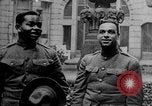
African American soldiers and army officers posing in front of building with fountain having small elephant carvings
Following World War 1, U.S. Army African American soldiers posing in front of a fountain at an official building. At about 10 feet above the ground, there are many small carved elephants encircling the fountain. Group of American Army officers poses in the same place, including Colonel William Hayward, commander of the African American 369th Infantry, 93rd Division (also known as the 15th New York National Guard or Old Fifteenth or "Harlem Hellfighters." A bigger group of American officers poses in front of what looks like a memorial with bas relief carvings. They hold a long banner reading "The Stars and Stripes forever."
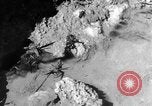
Scenes of Khuzestan Province and Isfahan, Iran, circa 1916
Views of Khūzestān Province and Esfahan (Isfahan) Persia, circa 1916. (The southern part of Khuzestan was also known as "Arabistan.") Rugged hills and dunes in desert region. A single dirt road through part of the area connecting some clusters of dwellings. Water splashing from the rear driving wheel of a Stern wheeler river boat underway on the Karun River. Black smoke billowing from the boat's stack. It appears to be towing a barge. Several long wooden passenger boats tied up at riverside, near building. Palm trees in the background. Closeup of art on the dome of the ancient Safavid-era Shah Mosque in Esfahan (aka Isfahan). Front of the mosque, with minarets. Iranian man herding some livestock and Merchants bringing goods to market on donkeys, passing through ancient arch way. Some men and a girl walking through the town. Two men smoke hookahs. A sandal maker at work. A local bazaar, lined with merchants selling their wares. People walking through the bazaar, including one who appears to be a British Colonial Officer in the South Persian Rifles.
Displaced persons obtain food and water at the former Wehrmacht barracks at Bad Bergzabern, Germany during final days of World War II in Europe.
Displaced people in Bergzabern, Germany a about a month before the end of World War 2 in Europe. .Film begins showing destroyed buildings and rubble in the town. A long extension ladder is raised in an open lot. Many people are gathered in a street and in a large field. Some in the field are cooking meals. An American army truck is parked in a vacant lot, next to a covered elevated platform. Closeup of people obtaining water from a pipe at the platform. A large number of people assembling in a field where others are dispensing soup from large buckets and distributing other foods. Milk is being ladled from large milk cans into containers held by recipients. Closeup of a young man eating from a large bowl.
Australian Prime Minister Ben Chifley arrives at Gatow airport in Berlin, Germany.
Australian Prime Minister in Berlin, Germany. An Avro Lancaster XPP aircraft (a modified long-distance transport version of the Lancaster Mark X bomber) taxis to a parking place at the Gatow airport in Berlin, Germany. Australian Prime Minister Ben Chifley steps from the plane and is greeted by military officers and others including Lieutenant General Sir Edwin Otway Herbert, Commandant of the British Sector in Berlin.. Prime Minister Chifley speaks to news reporters as a photographer takes his pictures.
CRITICALPAST.COM: About Us | Contact Us | FAQs - How to Order | License Agreement | My Account | My Lightboxes | Shopping Cart | Advanced Search | Featured Collections | Website Terms & Conditions | Privacy Policy ©2026 CriticalPast LLC.
License Agreement |
Terms & Conditions |
Privacy Policy
©2026 CriticalPast LLC.