


 Francais
 Deutsch
 Italiano
Refine Your Search
Long Beach California USA 1960 stock footage and images
- Showing 5689 to 5694 of 27665 results more
more Hide
Hide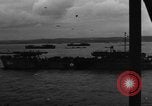
Allied invasion fleet underway towards Normandy, France during World War II.
Allied invasion fleet on their way to Normandy, France during World War II for D-Day invasion.Views from a transport ship of various Allied amphibious invasion craft leaving British waters, en route to Normandy France during World War 2. Seen nearby are several large landing craft, each carrying troops and military vehicles, as well as 4 Higgins Boats on top. Soldiers on the transport ship look at the attack transport ship USS Joseph T. Dickman (APA-13) as it comes, abeam. On deck of the camera ship, an Army Major General points, as he converses with a Marine Colonel. Next a Destroyer Escort in camouflage paint is seen moving rapidly past the camera ship. A transport ship and various landing craft are in the background. Barrage balloons fly low over the horizon. Camera tracks the passing Destroyer Escort as it moves ahead. Drastic change of scene shows three large American Landing Craft Infantry, LCI(L) docked at Weymouth, England. (They are numbers: 487, 493,and 488.) Landing Craft, LCI (L) number 498, getting underway. View to the rear of a number of large landing craft underway in British waters behind the camera boat. Closeup of the bridge on Landing Craft, LCI(L) number 87, with officer and sailor. Large landing craft underway in loose formation with a line of barrage balloons overhead. Several troop ships in a line. A troop transport underway with a Benson Livermore class destroyer behind it. Closeup of soldiers on the deck of a ship, using a belt loader to place loose rounds into a machine gun belt. Soldiers looking over ship's railing at the ocean below. Officer with binoculars on ship's bridge, relays instructions to a sailor who passes them by radio to others. A sailor manning a fire control position on deck. He rotates it and focuses on formations of Allied aircraft in flight overhead. An 83 foot U.S. Coast Guard rescue cutter racing past a transport ship. Allied capital war ships in the convoy, viewed by sailors from the camera ship. Soldiers napping in out-of -the -way places on deck. An officer using a long pointer as he briefs Coast Guardsmen about landing craft tactics. A Coast Guard Commander leaning over a briefing board with a sailor.
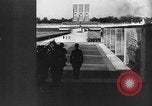
Nazi Party ceremonial grandeur is contrasted to the horrors perpetrated under the 3rd Reich
6th Nazi Party Congress at Nuremberg, in 1934, featuring a "Totenehrung" ceremony, honouring dead. Nazi SA ( Sturmabteilung) and SS (Schutzstaffel) troops in precise formations fill the Zeppelin Field Luitpold Arena, leaving only a wide pathway to the Ehrenhalle war memorial. View from behind honor guard standing at the Ahrenhalle, as Adolf Hitler, flanked by SS leader, Heinrich Himmler (in Black) and Viktor Lutze, head of the Sturmabteilung (SA), approach. Three huge banners with swastikas are seen in the far background. Scene shifts to 1945. American troops are now assembled at the main grandstand (Ehrentribüne) of Zeppelin Field. The American flag covers the wreathed swastika sculpture at the top of the Grandstand. View of German soldiers, who have been mustered out, mingling with civilians in a town. Some speak with an American soldier, who is part of the U.S. occupying force. Scene shifts to the Yalta conference in February, 1945. Winston Churchill, Franklin D. Roosevelt, and Joseph Stalin are seen seated while their most senior military staff members stand in the background. Allied leaders sit around a large conference table. U.S. Secretary of State James F. Byrnes, sits near Prime Minister Winston Churchill. Scene shifts back to Nazi era. Joseph Goebbels, Reichminister of Propaganda is speaking and haranguing a crowd. In contrast, German soldiers are seen conversing with occupying American soldiers. This is contrasted with more scenes of Nazi leaders giving impassioned speeches to a hall filled with Nazi faithful. German soldiers, prisoners of war are seen directed by U.S. military police, behind a barbed wire enclosure. Large numbers of German prisoners of war in an open holding area. Closeups of some. Bucolic scenes of farmers working in fields and herds of sheep and cattle. Hitler speaking in a forceful, animated way and haranguing an audience of rapt listeners. German civilians standing quietly in a group. (Narrator refers them being the people of Beethoven, Goethe, and Martin Luther, as statues of those iconic Germans are shown.) In dramatic contrast, numerous dead bodies of victims are being shown to German citizens by American troops, at Nordhausen, Buchenwald, and Bergen-Belsen concentration camps. This is contrasted against views of German people folk dancing in traditional costumes, German contributions to science (view of Albert Einstein speaking) and industry (view of professional glass blowers at work). Glaring contrast shows German civilians moving the body of a concentration camp victim; several civilians being shot dead by a firing squad (unseen); Rudolf Himmler; and an image Germany being destroyed, as result of the Nazis. American soldiers are loosely assembled in an open field. by the Elbe River at Torgau, Germany on 26 April 1945. American and Russian officers greet each other at the site, where their armies have met in World War 2. American and Russian soldiers mingle and greet one another. Views of Allied forces entering Germany. Another scene of victims' bodies stacked at a concentration camp. French soldiers examine stake where prisoners were tied and executed in the Gestapo headquarters on Paris France. Other views of the Gestapo prison, where victims were buried. Examples of torture devices used to coerce information from prisoners. More views of stacked bodies of victims. Germans carrying bodies from a concentration camp. General Dwight Eisenhower and General George Patton visiting the Ohrdruf Concentration Camp. Burned remains of victims. Closeup of General Patton. German officials and citizens confronting horror as they are compelled to walk through the camp. A huge wagon loaded with bodies of the dead. German women appalled and repelled by the sights. Countless numbers of dead victims covering a large courtyard. German citizens compelled to carry body of a victim from the yard. Others carrying bodies of victims. Large numbers of German citizens, seemingly shamed and remorseful at the revelations. A group of German men carrying shovels and others carrying crosses to commence burying the victims appropriately. Men carrying victims bodies in open wooden caskets along a road lined with spectators. Coffins of victims laid out in a cemetery. (Narrator alludes to them never forgetting.) German men gently place covered coffins in a long mass grave.
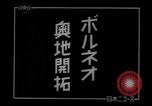
Scenes of British Borneo under Japanese occupation during World War II
Opening scene shows map of Borneo, with several locations marked. A group of Japanese soldiers stands on a boat moving away from a wharf, during World War 2. Across from them a group of others, dressed in white shorts, shirts, and white hats, along with several Japanese soldiers, stand on the wharf. They wave farewell to the Japanese soldiers, some by saluting, others by raising and tipping their hats. The next scenes are taken from the moving boat and show a river and surrounding forests. View into the boat, where soldiers are seated. Very long canoes carrying many local persons wearing large conical straw hats pass nearby at high speed. A canoe, with roofed structures, navigates past a rock jetty in fast moving river waters. Japanese soldiers in pith helmets disembark from docked canoes and make their way uphill toward a camp. Sign identifying the camp. View from above, of barracks buildings at the camp. Camera pans across a wide region of landscape. Natives standing on platform, built around a huge tree, are chopping the tree down, under supervision of Japanese soldiers nearby. Closeup of the men chopping the tree. Views of the tree falling. Local farmers working in an irrigated rice paddy. Camera pans across a number of paddies. Buildings near the rice paddies.
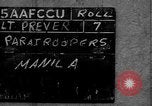
U.S. paratroopers board a USAAF C-47 Skytrain and jump off it in the Philippines (WW2)
The United States Army in the Philippines during World War II. Paratroop infantrymen try on parachutes and adjust them. They prepare equipment waiting to board an aircraft. Paratroopers pick up equipment from long tables. A group of paratroopers with packs and equipment besides a United States Army Air Force Douglas C-47 Skytrain aircraft. They adjust their equipment and parachutes. The paratroopers walk towards the aircraft in a line and board it. A line of parked C-47 military transport aircraft on either side of a road. Aircraft in flight towards a water body as seen from an aircraft. Paratroopers jump off the aircraft and descend near Manila.
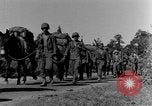
Chinese and U.S. soldiers with pack mules of the 35th Quartermaster pack train enter Momauk in Burma during World War II.
U.S. 475th Infantry in Burma during the Burma Campaign of World War II. Chinese and U.S. soldiers with pack mules of the 35th Quartermaster pack train enter Momauk. A long column of soldiers walks along a road. The soldiers march past two natives sitting on the ground.
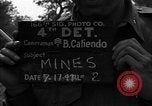
United States Engineers detect and uncover German mines in Emelie, France during World War II.
United States Engineers locate German Teller mines in Emile, France during World War II. 134th Regiment soldiers of the United States 35th Division move forward along the edge of a road. U.S. Major General Paul W. Bade visits soldiers of 35th Division. He speaks to Engineer officer. General Bade and officer confer over a map as a photographer takes pictures. Engineers of 60th Engineer Battalion probe mines. Engineers probe the ground for mines. German Teller mine being uncovered and engineers hook a long line onto the mine for removal.
CRITICALPAST.COM: About Us | Contact Us | FAQs - How to Order | License Agreement | My Account | My Lightboxes | Shopping Cart | Advanced Search | Featured Collections | Website Terms & Conditions | Privacy Policy ©2026 CriticalPast LLC.
License Agreement |
Terms & Conditions |
Privacy Policy
©2026 CriticalPast LLC.