


 Francais
 Deutsch
 Italiano
Refine Your Search
Long Beach California USA 1960 stock footage and images
- Showing 5725 to 5730 of 27665 results more
more Hide
Hide
Young men in uniform during an International Youth Camp in Nazi Germany.
International Youth Camp in Germany. Scenic view of a lake with mountains in the background. A long line of young men in uniform. The young men carry their luggage. Brassard on arms of uniform. Young men stand in formation. Insignia on uniform. Nazi officer welcomes leaders with Nazi salute. Names of living quarters in camp include "Nordland," "Wifinger", and "Widufind." Young men run out of barracks in uniform and then march and do exercise while shirtless.
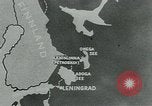
Finland allied with Nazi Germany at war against the Soviet Union in 1941 during World War II
Film opens showing animated map of the Finnish Front during World War 2. Two Finnish women are seen search the horizon with binoculars and keeping a log of some kind. Uniformed Finnish men and women ride with supplies on sleighs pulled by tractors. A group of them are seen at an outdoor field kitchen getting a meal. Women take blood from a uniformed Finnish woman volunteer donor. Women lined up in a wooded area are being decorated by a Finnish officer. A large number of Soviet prisoners of war (some showing minor wounds bandaged) is directed up a hill to begin work on defensive positions. Some carry long logs. Closeup of some prisoners passing the camera. Prisoners shoveling sandy soil and carrying building materials.
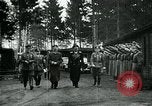
Brief film of Hitler and senior Nazi German military officers at the Wolfs Lair (WW2)
Adolf Hitler is seen strolling toward his rustic Eastern Front Headquarters building, at The Wolf's Lair (Wolfsschanze), near Rastenburg in East Prussia during World War II. He is accompanied by General Wilhelm Keitel, Admiral Karl Doenitz (Dönitz) and an unidentified Nazi German officer. They are wearing long winter coats and gloves. The Camp staff stand in formation rendering the Nazi salute in front of the building. Hitler steps forward and leads the way into the building.

Men and women workers work at a factory manufacturing alarm clocks in Soviet Russia.
An alarm clock manufacturing factory in Soviet Russia. Men and women work in a factory manufacturing 'Salute' alarm clocks. Several women seated on either side of a long table. Many 'Salute' alarm clocks on the table. Tables arranged in the room. Workers work with small parts of the alarm clocks.
Construction of a new Subway Line in Moscow, Soviet Russia.
Post-war subway condtruction in Moscow, Russia, Soviet Union. Brief view of cars driving along street, followed by scenes of subway workers in tunnel, 165 feet below the surface. The tunnel ceiling and walls are reinforced by shoring structures. A power shovel dumps dug out rock and earth into an open rail car where a worker packs it with a long-handled tool. Drillers at the tunnel face use pneumatic tools to dig through sedimentary layers of material. A man and woman push a rail car full of diggings through the tunnel. A surveyor uses a transit suspended from the ceiling by a wire. A woman fastens a thin rope to a light cable. Back at the face of the excavation, drillers stop and one calls out to others drilling from the opposite end (unseen). The drillers then commence again, and break through the remaining wall separating the two ends of the tunnel. Drillers from the opposite sides greet one another and celebrate the completion of this 12 mile segment of the subway tunnel.
A new rolling mill begins operation at the first Metallurgical Plant in Uzbekistan, USSR
Title slate reads,"the First Metallurgical Plant in Soviet Central Asia." Narrator says construction started 4-years ago during the Battle of Stalingrad in World War 2 (1942-43). Interior of the plant is shown from a vantage point high above the factory floor. Strips of hot steel are seen being extruded from a rolling mill. Closeup of the rolling mill in action and workers standing beside it. Closeup of the mill's rollers and hot steel blank passing through them. Workers handle the hot steel with long tools, as they move it back and forth to different sets of rollers. Narrator says the rolling mill has a capacity of 50 thousand tons per year. Closeup of two steel workers. Change of scene with view from above and then from below, as a furnace is tapped and molten steel flows into a crucible, emiting smoke and flames. Closeup of Uzbek steel workers employed at the steel plant. Next, workers are gathered in a ceremony marking the opening of the new rolling mill. A plant supervisor speaks before the gathering. A huge picture of Joseph stalin forms a backdrop. (Note: This is the The Uzbek Metallurgical Plant, aka V. I. Lenin Uzbek Metallurgical Plant, located in Bekabad, Tashkent Oblast,Uzbekistan. The 300-millimeter light rolling mill, seen here, began operating in October, 1946.)
CRITICALPAST.COM: About Us | Contact Us | FAQs - How to Order | License Agreement | My Account | My Lightboxes | Shopping Cart | Advanced Search | Featured Collections | Website Terms & Conditions | Privacy Policy ©2026 CriticalPast LLC.
License Agreement |
Terms & Conditions |
Privacy Policy
©2026 CriticalPast LLC.