


 Francais
 Deutsch
 Italiano
Refine Your Search
Long Binh Vietnam 1967 stock footage and images
- Showing 865 to 870 of 5995 results more
more Hide
Hide
Prewar conditions of traffic, contrasted with wartime blackouts and use of ration booklets by consumers in New York City.
Traffic and other conditions in New York during World War II. Vehicular traffic on a street. Buildings along the sides of the street. Aerial view of the vehicular traffic. A poster outside a gas station reads: 'Sorry No Gas. Don't blame us. Blame Hitler'. Wide view of 5th Avenue in New York City with Flatiron Building (Fuller building) in distance. Cars are seen being prepared for long term storage, covered, and stored in garages because of gas shortage and few people using cars. A traffic policeman stands near a guard post near a tunnel entrance. A sign board reads: 'Lane Closed'. Very little traffic is seen anywhere. Neon lights on the Manhattan skyline skyscraper buildings including Times Square at night. Lights with World War 2 wartime blackout conditions. Aerial view of the buildings during a blackout with very few dim lights. Woman in grocery store market loading many soup cans into her basket before in a pre-war scene. Woman at cash register ringing up the purchase. Contrasting scene with a sign on a stack of food cans that says "Only one to a customer" during wartime food rationing. Consumers use ration books for food. Close-up view of ration book. Narrator explains ration book system, including Ration Book One and Ration Book Two. Women home makers in kitchens opening pantry and taking inventory of what items they have. Long line of people outside a building to get a ration book. People inside, mostly women and some young children, submitting paper work and receiving ration books. A young boy and then a woman are seen buying food items from a grocer shop using ration books or coupons. People buy vegetables at a market. Delivery boy at a residence door dropping off groceries and receiving ration stamps. A cartoon caricature of Axis leaders Mussolini, Hitler, and Hirohito with labels "Fatso, Ratso, and Japso" for the three leaders, respectively. Wooden cases loaded onto a ship in a harbor.
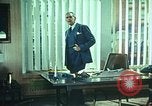
Description of North American Air Defense system components and operation
Actor Raymond Massey talks about the nation's need for defense against possible air attack. He walks to a large wall map depicting North America and discusses joint efforts of Canada and the United States to establish an effective air defense system for North America. On the map, lines of radar stations are shown: The DEW line;Mid Canada line; and the Pine Tree line. Other radar installations are highlighted along East and West coasts on land, on towers in the ocean, on picket ships and on picket aircraft. Sites of the SAGE (Semi-Automatic Ground Environment) network of radars, computer systems, and aircraft command and control equipment are depicted on the U.S. part of the map. The headquarters of NORAD (North American Air Defense Command) at Colorado Springs, Colorado is highlighted. Massey points to models of intercepter missiles and long range bombers, on his desk, and discusses their employment. He then speaks of an intricate communications system to tie everything together. This is depicted on the animated map. Views of men laying telephone cable. Underground view of telephone cables. View of telephone microwave tower. Telephone poles and lines along a rural road. A mother and child telephoning the father long distance. Office workers using telephones. Teletype machines and television communications. A ship laying telephone cable at sea.Map depicts lines of communication provided by undersea cables. views of emergency supplies and equipment available in times of disaster. Downed power lines being repaired. Men at a large emergency diesel generator. Underground communication cables being installed by team of tracked vehicles. Remote lines of communication away from possible targets are depicted.
Mexicans take a last look at Russian revolutionist Leon Trotsky during his funeral in Mexico City, Mexico.
Russian revolution leader Leon Trotsky's funeral in Mexico. The casket with the body of Trotsky is placed in a car. Leon Trotsky's funeral procession on the streets of Mexico City. A group of men carries his casket. At a public viewing of the open casket, Mexican citizens take a last look at the body of Leon Trotsky in the casket. Members of the Mexican section of the Fourth International stand in honor near the casket. Mexican people stand in a long line to take a last look and pay their last respects to Trotsky. Views of the long queue for the viewing, stretching down a main street of Mexico City.
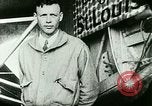
Charles Lindbergh takes off from Roosevelt Field in the "Spirit of St. Louis," on a solo flight across the Atlantic Ocean
Charles Lindbergh's poses next to his airplane, the "Spirit of St. Louis." Ground crew push the airplane, tail first, out of a hangar on Roosevelt Field, Long Island, New York. Its engine and nose are covered in canvas. Lindbergh shakes hands with an official. Ground crew top off the aircraft's fuel, by pouring several gallons into its tank from atop the wing. A man helps Lindbergh don his heavy flying coverall. The aircraft engine starts. Crowd surrounds the aircraft. Lindbergh climbs aboard and the "Spirit of St. Louis" starts its takeoff roll surrounded by group of people. Lindbergh makes a long takeoff roll, bouncing several times (once, quite hard) before breaking ground in a shallow climb.
Monitor Flame Boats enter the well deck of USS Catamount and fire streams of flame in the South China Sea
Monitor Flame Boats underway in the South China Sea. Flooded well deck of USS Catamount (LSD-17). Monitor Flame Boats enter the well deck. Bow view of the Monitors entering USS Catamount's well deck. Two Monitors in the well deck. Two crewman in a catwalk in the foreground working with lines. USS Whetstone (LSD-27) behind USS Catamount. The tail gate on USS Catamount is closing. One Monitor Flame Boat at sea fires a long stream of flame. A Monitor fires a long spout of flame. Smoke and fire on water. The Monitor in the background fires a stream of flame.
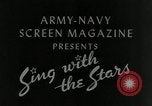
Bob Burns plays bazooka and Shirley Ross sings 'Clementine' on the 'Sing with the Stars' show.
'Sing with the Stars' features Bob Burns as 'Bob Bazooka Burns'. Begins with scene showing a bazooka being fired. Bob talks about the bazooka and shows the audience his humorous musical instrument, for which the weapon was named. Then, he and American Hollywood actress and singer Shirley Ross sing 'Clementine' together. For part of the song, Bob Burns actually plays his bazooka as one would play a trombone. The lyrics of the song are displayed for audience sing-a-long. Bob and Shirley joke about Clementine.Cartoon artwork of funny characters are shown on screen along with the lyrics, and a bouncing ball over the words for sing-a-long.
CRITICALPAST.COM: About Us | Contact Us | FAQs - How to Order | License Agreement | My Account | My Lightboxes | Shopping Cart | Advanced Search | Featured Collections | Website Terms & Conditions | Privacy Policy ©2026 CriticalPast LLC.
License Agreement |
Terms & Conditions |
Privacy Policy
©2026 CriticalPast LLC.