


 Francais
 Deutsch
 Italiano
Refine Your Search
Long Binh Vietnam 1967 stock footage and images
- Showing 2245 to 2250 of 5994 results more
more Hide
Hide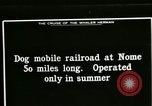
The whaler Herman at Nome and Port Clarence on its way to the Arctic.
Cruise of the whaler Herman to the Arctic. A dog mobile railroad at Nome in Alaska. Dogs pull the rail car with people seated in it. The 50 miles long railroad. Herman in the docks. Crew waves to the natives as they depart. Herman arrives at Port Clarence. A fishing camp on the beach. Natives near tents at the camp. A native woman seated.
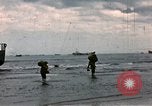
Allied troops and war correspondents landing and digging in at Utah Beach in Normandy, France, after D-Day, in World War II
Allied troops and war correspondents arriving at Utah Beach in Normandy, France not long after D-Day Invasion in World War 2. War correspondents Pete Carroll and Wes Hanes carry equipment across the beach. A ship grounded on the beach in the background. Allied troops, military vehicles and tanks on the beach. Bulldozers clear the road for the troops. Ships anchored and grounded at beach. Barrage balloons in the sky. Soldier drinks water. Military Police personnel dig trenches and fox holes behind a concrete wall. Banner reads: 'Green Beach HQ'. Troops and vehicles at the camp. German soldiers taken prisoner,with hands above their heads. Soldiers and war correspondents at their first Command Post in Normandy. Soldiers seated under a tree. One stands near a stream. U.S. General Joseph Collins talks to his officers. War correspondents including Larry LeSueur and Bob Landry eat and drink at the command post.
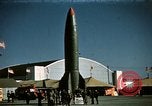
U.S. Army Air Forces Fair at Wright Field in October, 1945
Views of the U.S. Army Air Forces fair hosted at Wright Field, near Dayton, Ohio, in October, 1945.The highlights of the event were exhibits of captured German and Japanese aircraft, rockets, and equipment. A German V-2 Rocket Motor on display. Soldiers observe the rocket. A German Junkers Ju 388 Störtebeker multi-role aircraft on display. A German Messerschmitt ME-262 Schwalbe fighter on display. A German pilot's victories recorded on the side of a plane. Two soldiers take a look at a Japanese Kamikaze bomb. One of them gets into the bomb seat. American officers and soldiers view the exhibits. 'Alles Kaputt' written on the side of a German Junkers Ju-290 bomber (one of the candidate aircraft, with further development, in Germany's Amerika Bomber project for a long-range bomber capable of striking the United States). Soldiers walk under the plane. 'Transient Aircraft' written on the control tower building in the background. (World War II period).
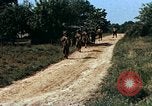
United States Army soldiers advance under camouflage during World War II
World War 2 United States soldiers demonstrate individual concealment and camouflage. Soldiers advance under individual concealment. They walk on a dirt road with grass and flowers on wither side. They walk such that their shadows are thrown off road. An enemy air observer amidst the clouds in the sky. The soldiers are spotted, they jump into the trees by the road. They take cover in a thickly wooded area. Soldiers in camouflage with guns. Guns fired. Soldier in prone position fires. A soldier takes cover in a slight depression in the ground and works his way forward. They spread out and advance. Run among long dry grass in groups. Soldiers take cover, camouflage themselves and lie low among bushes, trees and other foliage. An observer emerges from behind a hill and runs. A soldier in prone position fires. Another one runs and takes cover in a shell hole. Soldiers use trees and their shadows for camouflage. One looks over a bush. Enemy fire. Soldier observes through a bush. Soldiers run out from behind a bush amidst enemy fire. They move across an open stretch in. A soldier runs, hits the ground and throws a grenade. One looks through binoculars to survey the surroundings.
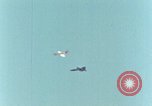
X-15 lands after first high powered flight.
X-15 lands after first high powered flight using XLR-99 engine. Chase plane accompanies X-15 as it maneuvers to land at Edwards Air Force Base, California. Parachute seen as lower ventral fin is jettisoned prior to landing. X-15 comes to stop on runway after long ground roll on landing.
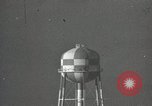
First powered flight of an X-15 Rocket Plane. Also scenes of several other X-15 powered flights.
X-15 first powered flight on Thursday, 17 September, 1959. (X-15 No. 2, tail number: 56-6671 with LR-11 engines. Scott Crossfield flew this mission at mach 2.11 and altitude 52,341 feet.) Scenes of several other X-15 powered flights are also shown. View of the water tower at Edwards Air Force Base, california. Overhead, NASA NB-52A, No. 003 and an F-100D chase plane, are seen at high altitude, with contrails behind them. The X-15, cradled under the B-52's right wing, drops clear, starts its rocket engines and begins its first independent powered flight, climbing rapidly away from the B-52. NASA camera tracks it, appearing as a moving white dot against the sky. The next sequences show later powered flights. View of NASA B-52 and three chase planes leaving contrails overhead. X-15 drops, its engines are running and falls behind the B-52, before accelerating rapidly, passing to its right, and continuing upward. Another scene shows brief glimpse of NASA B-52 overhead (no contrails). In final scene, X-15 is seen moving rapidly, leaving a long contrail behind it. Cloud then obscures the image somewhat.
CRITICALPAST.COM: About Us | Contact Us | FAQs - How to Order | License Agreement | My Account | My Lightboxes | Shopping Cart | Advanced Search | Featured Collections | Website Terms & Conditions | Privacy Policy ©2026 CriticalPast LLC.
License Agreement |
Terms & Conditions |
Privacy Policy
©2026 CriticalPast LLC.