


 Francais
 Deutsch
 Italiano
Refine Your Search
Long Binh Vietnam 1967 stock footage and images
- Showing 2755 to 2760 of 5994 results more
more Hide
Hide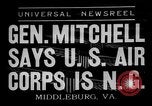
American General William D Mitchell speaks on importance of air power and demands the construction of airbase in Alaska.
American General William D Mitchell (aka Billy Mitchell) at a desk in his office in Middleburg, Virginia. General Mitchell points out the loopholes in air support at Long Island for New York. He urges that America must build up its strength in building more bomber aircraft. General Mitchell says that air power is the prime strength of any nation for directly attacking the enemy's key installations. The General demands the construction of an air base in Alaska.
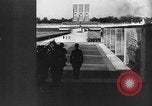
Nazi Party ceremonial grandeur is contrasted to the horrors perpetrated under the 3rd Reich
6th Nazi Party Congress at Nuremberg, in 1934, featuring a "Totenehrung" ceremony, honouring dead. Nazi SA ( Sturmabteilung) and SS (Schutzstaffel) troops in precise formations fill the Zeppelin Field Luitpold Arena, leaving only a wide pathway to the Ehrenhalle war memorial. View from behind honor guard standing at the Ahrenhalle, as Adolf Hitler, flanked by SS leader, Heinrich Himmler (in Black) and Viktor Lutze, head of the Sturmabteilung (SA), approach. Three huge banners with swastikas are seen in the far background. Scene shifts to 1945. American troops are now assembled at the main grandstand (Ehrentribüne) of Zeppelin Field. The American flag covers the wreathed swastika sculpture at the top of the Grandstand. View of German soldiers, who have been mustered out, mingling with civilians in a town. Some speak with an American soldier, who is part of the U.S. occupying force. Scene shifts to the Yalta conference in February, 1945. Winston Churchill, Franklin D. Roosevelt, and Joseph Stalin are seen seated while their most senior military staff members stand in the background. Allied leaders sit around a large conference table. U.S. Secretary of State James F. Byrnes, sits near Prime Minister Winston Churchill. Scene shifts back to Nazi era. Joseph Goebbels, Reichminister of Propaganda is speaking and haranguing a crowd. In contrast, German soldiers are seen conversing with occupying American soldiers. This is contrasted with more scenes of Nazi leaders giving impassioned speeches to a hall filled with Nazi faithful. German soldiers, prisoners of war are seen directed by U.S. military police, behind a barbed wire enclosure. Large numbers of German prisoners of war in an open holding area. Closeups of some. Bucolic scenes of farmers working in fields and herds of sheep and cattle. Hitler speaking in a forceful, animated way and haranguing an audience of rapt listeners. German civilians standing quietly in a group. (Narrator refers them being the people of Beethoven, Goethe, and Martin Luther, as statues of those iconic Germans are shown.) In dramatic contrast, numerous dead bodies of victims are being shown to German citizens by American troops, at Nordhausen, Buchenwald, and Bergen-Belsen concentration camps. This is contrasted against views of German people folk dancing in traditional costumes, German contributions to science (view of Albert Einstein speaking) and industry (view of professional glass blowers at work). Glaring contrast shows German civilians moving the body of a concentration camp victim; several civilians being shot dead by a firing squad (unseen); Rudolf Himmler; and an image Germany being destroyed, as result of the Nazis. American soldiers are loosely assembled in an open field. by the Elbe River at Torgau, Germany on 26 April 1945. American and Russian officers greet each other at the site, where their armies have met in World War 2. American and Russian soldiers mingle and greet one another. Views of Allied forces entering Germany. Another scene of victims' bodies stacked at a concentration camp. French soldiers examine stake where prisoners were tied and executed in the Gestapo headquarters on Paris France. Other views of the Gestapo prison, where victims were buried. Examples of torture devices used to coerce information from prisoners. More views of stacked bodies of victims. Germans carrying bodies from a concentration camp. General Dwight Eisenhower and General George Patton visiting the Ohrdruf Concentration Camp. Burned remains of victims. Closeup of General Patton. German officials and citizens confronting horror as they are compelled to walk through the camp. A huge wagon loaded with bodies of the dead. German women appalled and repelled by the sights. Countless numbers of dead victims covering a large courtyard. German citizens compelled to carry body of a victim from the yard. Others carrying bodies of victims. Large numbers of German citizens, seemingly shamed and remorseful at the revelations. A group of German men carrying shovels and others carrying crosses to commence burying the victims appropriately. Men carrying victims bodies in open wooden caskets along a road lined with spectators. Coffins of victims laid out in a cemetery. (Narrator alludes to them never forgetting.) German men gently place covered coffins in a long mass grave.
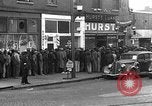
Needy Americans are given free coats, overcoats and gloves by a merchant Ben Hurst in Kansas City, Missouri.
Distribution of overcoats for unemployed in the U.S. during the Great Depression. People stand in a long queue outside the shop of a philanthropic merchant, Ben Hurst in Kansas City, Missouri. The needy are given free coats, overcoats and gloves by the merchant in a gesture of charity.
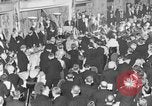
U.S. Democratic Victory Dinner. Washington, D.C. March 4, 1937
A large crowd of the Democratic Party faithful, in formal dress, gather for a Victory Dinner, in the Willard Hotel, Washington, DC, to celebrate Franklin D. Roosevelt's reelection in 1937. An orchestra plays "Happy Days Are Here Again." The President stands at a table (with a man assisting him) as Mrs. Eleanor Roosevelt is escorted to his side. A battery of news photographers take their pictures. Mrs. Roosevelt speaks to President Roosevelt and then leaves. Scene shifts to banquet hall with guests seated at a long table, surrounded by others at round tables. The orchestra plays smooth dinner music. Waiters move among the guests. Reelected President Roosevelt chats with his Vice President, John Nance Garner, seated to his left.
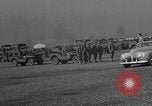
President Franklin Roosevelt review U.S. Army troops and vehicles at a base in the United States during World War 2.
Entourage of President Franklin Roosevelt passes by troops assembled at attention. President Roosevelt seen seated in front seat of his car, atop drivers seat to view as U.S. Army soldiers and equipment pass in review. Soldiers carrying full equipment march past the President. Horses carrying supplies follow the troops. Trucks carrying equipment and long boats pass. Next are armored trucks & weapons carriers lined up for inspection. Camera view alternates between troops being reviewed and view of the President as he watches and talks to military and civilian staff around his car. Jeeps pass in review with mounted machine guns. Barracks and buildings of the military base seen behind the President's car. President Roosevelt's doctor, Naval officers and aide in conversation. At end of clip is a view from a moving car passing by U.S. Navy sailors assembled and at attention during President Roosevelt's visit.
Production of petroleum at oil refineries and its transportation in United States, before and during World War II
Documentary titled, ' Oil Is Blood ' on production and transportation of petroleum and its by products in United States. Crude oil in a pit. Man takes samples from the pit. View of derricks at an oil drilling site. Derricks at sea. Exteriors of a building near the derricks. Service station attendants, pumping gas and cleaning the windshield, on a 1942 Lincoln Continental convertible, at a "Tydol Flying A" gas station. Scenes of busy highways and plenty of fuel give way to empty roads, closed gas stations, and restricted hours for obtaining fuel, as it is rationed during World War 2. Views of persons obtaining ration stamps and books. Various gasoline ration books including the "A" books (allowing the smallest amounts) and "B", "C", and other books allowing larger rations to more essential users. Oil rig "roughnecks" inserting new sections of pipe and proceeding to drill. Closeup of a "gusher" before it is capped. Men filling railroad tank cars with petroleum products. A long train of tank cars pulled by a steam locomotive. Animated map illustrates the ocean shipping lanes that formally served as means to transport fuel and oil, before the German U-Boat threat made them too dangerous for general use. Drums of fuel and oil being loaded aboard a ship to supply the Allies during the war. A convoy of ships heading to the war zone of North Africa.
CRITICALPAST.COM: About Us | Contact Us | FAQs - How to Order | License Agreement | My Account | My Lightboxes | Shopping Cart | Advanced Search | Featured Collections | Website Terms & Conditions | Privacy Policy ©2026 CriticalPast LLC.
License Agreement |
Terms & Conditions |
Privacy Policy
©2026 CriticalPast LLC.