


 Francais
 Deutsch
 Italiano
Refine Your Search
Long Binh Vietnam 1967 stock footage and images
- Showing 2761 to 2766 of 5994 results more
more Hide
Hide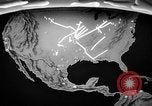
Laying of the Big Inch petroleum pipeline network between Texas and Illinois in the United States during World War 2.
A map shows pipeline network for the transportation of oil and its by-products in the United States, largely for the war effort during World War 2. Shows the laying of the Big Inch petroleum pipelines in Arkansas, Texas, and other locations. Tractors and explosives being used to clear the ground for laying the pipelines. Oil pipeline being laid across a river bed. A welder welds the joints. Pipelines being laid in trenches. Men operate valves to turn on the flow of oil in the new Big Inch pipeline. High octane aviation gas is filled in an aircraft at an airfield. Soldiers fill gas cans all lined up in a lot. An oil tanker in the background. Troops load gasoline jerrycans on trucks. B-17, B-26, and B-24 Bomber aircraft in refueling operations on various airfields. B-17 taking off and formation of aircraft in flight. Long lines of jerry cans being filled with gasoline by personnel near a railroad track. Close up view of gasoline dispensing nozzle in top of Jerry Can and a hand opening the next jerry can in line. Jerry cans loaded into trucks, transported, and unloaded by U.S. Army soldiers. Motor oil being poured into funnels for use in vehicles. Narrator declares, "Oil for freedom. American oil. The blood of the mechanized legion!" A formation of tanks and military vehicles move along a wide field. Narrator encourages sacrifice of American people giving up home comforts of goods and fuels made from oil so that they can be directed to the war effort.
An oil camp and a casinghead gasoline extraction plant in the United States.
Oil fields in the United States. An oil camp for oil workers. Stacked pipes at the camp. Houses of the workers in the background. Children on a path in front of the houses. A board reads ' Sinclair Oils Power'. Pipes are carried on a long trolley pulled by a tractor. Casinghead gas which is rich in gasoline escapes out from an oil well. Derricks in the background. A part of a casinghead gasoline extraction plant. Machinery at the plant. Compressors which are run on diesel engines at the plant.
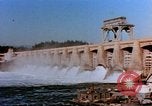
Promotion to buy U.S. Saving Bonds in the United States to contribute towards the development of the country.
A public service announcement (PSA) depicts industrial development in the United States and urges the purchase of savings bonds to preserve American heritage and way of life. Water flows through the Bonneville Dam on the Columbia river between Oregon and Washington for hydroelectric production of electricity. A power house for power transmission. Views of transmission towers and electricity is supplied to houses and industries. A glass tumbler factory. Robot machines using electricity in operation to make drinking glasses. A line of finished articles and items being made in factories using new materials like plastics. A man mixes a color in an industrial mixer. A scene with lightning flashing. A worker moves a large breaker handle in a power transmission facility. Neon lights of Times Square, New York City, at night, with many lit sign boards using electricity. Exterior view of U.S. Capitol on a clear day. View of traffic and pedestrians in front of New York Public Library. View of exterior of Trinity Church Wall Street in New York City. A boy with a dog on a long driveway in front of a nice house. Farmers harvesting crops, a mechanic operating a large wrench, a professor in front of a chalk board in a class room, overhead view of a surgical operation underway by doctors, a business man at work in an office typing a paper. Hands of a banker spinning large wheel to open a bank vault. Scenes of busy traffic on streets of New York City. View of Empire State building skyscraper panning from ground to top of building. Welders working at a job site. Women shoppers or office workers in 1940s fashions walking on sidewalks of a city with a double decker bus in background. View of streets of a small town. A line of people to buy U.S. Saving Bonds. View of United States Savings bonds of various denominations being placed on a table. Overhead view of women office workers filing items in a business office. View of a skyscraper in New York City. Wide view of Manhattan New York City skyline from water. A view of Mount Rushmore. Two women serve food and drink to young children seated in chairs. View of Bill of Rights document. Statue of Abraham Lincoln inside Lincoln Memorial in Washington DC. View of a U.S. flag being raised on a flag pole and fluttering in breeze.
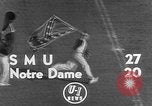
The Southern Methodist University Mustangs defeat the Notre Dame University Fighting Irish by a score of 27-20 in South Bend, Indiana.
Highlights of college football game between Southern Methodist University Mustangs and the Notre Dame Fighting Irish. The film opens with a glimpse of a Southern Methodist band member leading several others as he runs across the field carrying a Confederate battle flag, just before the football game begins. Next, Mustang quarterback, Fred Benners (No.47) is seen throwing a long pass to Benton Musselwhite (No. 21) who runs for a touchdown. View of crowd cheering. Notre Dame is seen next in their "I" formation from which John Mazur (No.1) falls back before successfully passing to Bill Barrett (No. 37) for a gain. The Irish follow this with a play by running back Paul Reynolds (No.18) who takes the ball over the goal line to close the point gap. Notre Dame supporters cheer. Then, with SMU in possession, Quarterback Benners is rushed and gets off another pass, this time to Russell (No.24). On the next down, Benners and Russell repeat another pass to score and SMU leads 13 to 6 in the first period. SMU supporters cheer wildly. The next highlight shows a Notre Dame 4th down punt that results in a fumble recovered by Notre Dame. Next, Mazur of Notre Dame throws to Chet Ostrowski (No. 63) in the end zone to tie the score. The next highlight shows Benners throwing to Russell, again, for a 45 yard gain. He follows this with a pass to Ben White in the end zone to put SMU ahead 20 to 13 at the half. View of cheering crowd and the Notre Dame team standing on the sidelines. The next scene shows SMU executing a running play with Jerry Norton (No. 44) carrying the ball until he is tackled near the 40 yard line. Then, Norton carries again for another 20 yards. This is followed by another pass by Benners to White, to win the game, with final score SMU 27 to Notre Dame 20.
Army beats Penn 61-0 in Philadelphia, Pennsylvania.
Defending national champions Army beats Penn in Philadelphia with a score of 61 to 0. Halfback Glenn Davis, number 41, is seen scoring three touchdowns. Doc Blanchard, number 35, is seen scoring a long touchdown run.
Electric operations at the Hoosac Tunnel, Massachusetts. in the United States.
A film concerning railroad electrification in the United States. A westbound Boston and Maine Railroad steam train at East Portal, Hoosac Tunnel, where the railroad was electrified in 1911. An electric locomotive approaches the steam engine. ( Note the carbide headlamp on the electric locomotive--which were outlawed by the ICC circa 1918. ) The motor pulls the steam engine and its train West. Next: a 'cab ride' from North Adams, Massachusetts to West Portal and subsequently exits the East Portal of the 4.75 mile long Hoosac Tunnel.
CRITICALPAST.COM: About Us | Contact Us | FAQs - How to Order | License Agreement | My Account | My Lightboxes | Shopping Cart | Advanced Search | Featured Collections | Website Terms & Conditions | Privacy Policy ©2026 CriticalPast LLC.
License Agreement |
Terms & Conditions |
Privacy Policy
©2026 CriticalPast LLC.