


 Francais
 Deutsch
 Italiano
Refine Your Search
Long Binh Vietnam 1968 stock footage and images
- Showing 61 to 66 of 5711 results more
more Hide
Hide
Views of mini guns and rocket launchers mounted on VNAF UH-1H helictoper at Binh Thuy Air Base, Vietnam
Slate mentions about secretary-Seaman's upcoming visit at Binh Thuy. Board depicting dimensions about Rocket and Miniguns. Gatling guns and mini guns seen at the side of a VNAF UH-1H helicopter. Vietnamese airmen seen by the side of the helicopter. Views of two UH-1H helicopters and their armament.

Tracer fire and flares at night in Binh Phuoc, Vietnam during the Vietnam War.
U.S. 47th Infantry Brigade, 2nd Battalion in Vietnam during the Vietnam War. Tracer fire and flares at night.
A political advertisement critical of Democratic nominee Hubert Humphrey during the 1968 presidential campaign
A political advertisement from the Nixon campaign or Republican party during the 1968 Presidential election campaign portrays Democratic party challenger Hubert Humphrey in a negative light. Still images show Democratic presidential nominee Hubert Humphrey at the party's convention in Chicago, Illinois. Riots in the United States following assassinations of prominent leader in the African American civil rights movement, Martin Luther King, Jr., and Senator from New York Robert F. Kennedy, in 1968. U.S. soldiers battling the enemy in Vietnam during the Vietnam War. A picture depicting poverty shows a poor family. Images of Humphrey are interspersed throughout, portraying him as disconnected from the issues of the day.
Soldiers of the U.S. 2nd Battalion 47th Infantry (Mechanized) and 4th Battalion 39th Infantry clearing a hamlet during the Tet Offensive in Vietnam
Elements of B Company, 2/47th Infantry (Mechanized) and C Company, 4/39th Infantry, clearing North Vietnamese Army regulars from "Widows' Village" (a hamlet of housing provided by the government of the Republic of Vietnam for widows and children of fallen ARVN soldiers). The action occurs January 31st, 1968 (on "Tet", the Vietnamese Lunar New Year holiday). U.S. troops firing small arms as they proceed across tall grass into the hamlet. Several M 113 armored personnel carriers (APCs) are seen accompanying the troops. A soldier, who has been hit, lying prone between two other soldiers, tries to get up. Flames consuming huts. Riflemen moving cautiously. A slightly wounded soldier, lying on the ground, smiles as he points to his leg as another soldier helps him. APCs advance, firing 50 caliber machine guns. Riflemen staying close behind. Views of a number of huts, in the hamlet, that have not been destroyed. (Note: According to Colonel Sonny Craven, then leader of a combat photo team on the scene, these combat sequences was filmed by soldiers of the 221st Signal Company [Pictorial]). Craven and another photographer, were both wounded in the engagement.) (Vietnam War period).
632 Combat Support Group Unit Mail Room, Officer's Club, NCO Club and Clothes Store at Bnh Thuy Air Base in Vietnam.
An orientation film for United States Air Force personnel assigned to Southeast Asia. USAF airmen at the Binh Thuy Air Base near the city of Can Tho in Vietnam. U.S. Air Force 632 Combat Support Group Unit Mail room on the Base. A sign board with the mail room timings. Airmen collect their mail at the counter and leave. Officers and airmen enter and leave the Officer's Club. A sign for the club near the door. Airmen emerge from the NCO Club, sign on a wall. A plaque amidst benches and plants. The plaque reads: 'Lest We Forget' in memory of AIC Millard W Lehman, 652 Air Police SQ, Arizona. An airman passes a huge sandbag bunker. 'Binh Thuy' written on lined barrels. Clothes lines outside barracks. An airman dries clothes on the line. Sandbags outside the barracks. An airman climbs stairs leading to the USAF Clothing Sales Store. A sign states the store's timings. A sign reads: 'R&R Office, Base Library, Tape Recordings, Personnel Services Office'. (Vietnam War period).
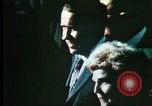
Republican nominee Richard Nixon express his views about the presidential race before U.S. Presidential Election of 1968.
Self-portrait of Richard Nixon aired during his 1968 presidential run against Hubert Humphrey and George Wallace in the United States. An interviewer asks Richard Nixon what did he think when he made a decision to run for the President of the United States in 1968. A picture showing Richard Nixon and his wife Pat Nixon. The interviewer asks if he felt any strain on the family. Nixon says he thought of his family first. A picture showing his wife Pat Nixon and daughters Julie Nixon and Tricia Nixon. Nixon calls this presidency more of a challenge in terms of America being involved in the Vietnam War and in the Cold War with the Soviet Union. A photograph shows Richard Nixon with his wife Pat Nixon, daughters Julie and Tricia and Julie's husband David Eisenhower at a beach. He says that present time is different from World Wars I and II because now America is a great power and there should be a best possible leader to lead the nation. Nixon states that America needs a kind of leadership that would obtain peace and avoid war and surrender. A picture of Mr. and Mrs. Richard Nixon.
CRITICALPAST.COM: About Us | Contact Us | FAQs - How to Order | License Agreement | My Account | My Lightboxes | Shopping Cart | Advanced Search | Featured Collections | Website Terms & Conditions | Privacy Policy ©2026 CriticalPast LLC.
License Agreement |
Terms & Conditions |
Privacy Policy
©2026 CriticalPast LLC.