


 Francais
 Deutsch
 Italiano

Refine Your Search
Long Binh Vietnam 1968 stock footage and images
- Showing 1507 to 1512 of 5721 results more
 Hide
Color Sound
Member of the U.S. Army Parachute Team demonstrates free-fall (sky diving)
A U.S. Army AT-19 aircraft seen in flight, as viewed from another airplane. Scene shifts to cabin of the AT-19, where a soldier in helmet and parachute leans out of the doorway. He steps from the aircraft and begins a long free-fall, photographed from several different viewpoints. Narrator states such free-fall activity is routine for members of the U.S. Army Parachute team. The parachutist opens his chute and maneuvers skillfully. View, from camera on the parachutist, shows rapid approach of the ground.
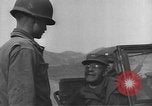
U.S. 3rd Infantry Division engages enemy around the Chowan Reservoir during the Korean War
Opening scene shows Major General Robert H. Soule, Commander of the Third Infantry Division, in Korea, speaking to a soldier, from a a jeep. His jeep moves past a U.S. tank. A U.S. Chaffee tank (named "Belle") drives past the camera. (Narrator notes that the enemy opened the gates of the Chowan Reservoir to flood the area, after U.S. forces secured the southern edge of the "Iron Triangle".) Two Patton tanks are seen at water's edge. Another is making way through the water. Three U.S. soldiers atop a hill. One looks through a pair of binoculars. U.S. infantry walking downhill beside a dry culvert. One examines an area of straw, that might hide enemy soldiers. He throws a grenade into it, that explodes raising smoke and noise. UN forces moving easily across roads and paths in the valley. (Narrator notes that in the meantime enemy forces infiltrated into the surrounding hills and then attacked with ferocity.) UN forces firing a 155 mm long tom howitzer to counter the enemy. Artillery barrages continuing through the night. U.S. troops firing 105mm howitzers, and a 60mm light field mortar. More views of various pieces of artillery being fired by crews of African American and white U.S. Army soldiers. Smoke rising from the surrounding hills as artillery shells explode.
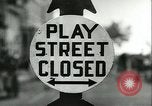
Children play games and receive instructions in handicraft during WPA supported play programs in New York City
Great Depression era Works Progress Administration (WPA) projects in New York City. A sign reads: 'Play Street Closed'. Children play various games and sports on a street in New York City that has been closed to traffic, under the supervision of WPA employees. A man instructs them. They play checkers, jacks, and a small court tennis game using ping pong paddles. They play round games holding hands and moving together. Children seen entering the toyery, an experimental program at the Heckscher Foundation For Children. A boy smiles as a woman in the toyery hands him a truck toy to borrow from the lending library of toys. Several children are shown trading in a toy for a different toy. Children seated in a room show each other flashcards to improve their reading skills, during remedial instruction time. Women in a Long Island City kitchen prepare school lunches for 800 needy children. A woman cook prepares a sandwich and a group of women wrap up batches of sandwiches. View of a day nursery, with a nap or rest area with small beds. A nurse in the nursery examines a child's mouth with a tongue depressor. Young children play with blocks in the nursery. They sit at tables in a dining room. Children drink milk and eat food.

Japanese families at a beach resort in Japan before World War II
In opening scene prior to World War 2, camera pans across a building complex that might be a resort hotel. Scene shifts to hundreds of bathers on shallow water at a beach. Life guards occupy a structure in the shallows. Families with small children fill the shoreline and shallow water. some of the small children use flotation devices. Actual swimmers are seen farther out in deeper water. Closeup of three small children playing with a pot as they sit in a protected area that seems to be surrounded by seaweed or other vegetation. A boy behind them works to build the surrounding wall. Change of scene shows another area of beach with a long pier extending out into the water. The shore is completely hidden by families seated on the beach under huge umbrellas and tents. The next scene is of a downtown commercial district festooned with numerous banners overlooking the street. There are no vehicles evident. The entire area is filled with pedestrians. At another section of the town, the street is more densly crowded with pedestrians.

New U.S. Army recruits arrive for military training; officer addressing uniformed new recruits at training camp
View of 2 long parallel lines of American men in civilian clothing, carrying suitcases, and arriving at a U.S. Army training camp in the United States during World War 1. The new recruits or draftees heading into camp. Next scene shows a large field area filled with newly uniformed American soldiers. An officer stands on a platform above the soldiers. The soldiers all take seats on the ground for an address. The officer addresses the soldiers. The soldiers stand again at the end of the address.

Electrified wire fences, guard towers and steel gates at the concentration camp in Flossenburg, Germany.
Liberated slave labor camp in Flossenburg, Germany during World War II. U.S. Army soldier walking on light cover of snow approaches a sign at the gate of the Flossenbürg Concentration camp. The sign reads: "Prisoners Happy End. Welcome" (setup after liberation). Electrified wire fences. Guard towers and steel gates. Stone plaque on gate with German text "Arbeit macht frei" (Translation: Work sets you free). Another nearby sign on a fence reads, "Vorsicht - hochspannung lebensgefahr" (Translation: Caution - High voltage. Will cause death.) Close-up view of electrified razor wire fence. Long view inside gate looking up toward edge of camp. Soldiers stand at the gate of the building. A horse-cart arrives.
CRITICALPAST.COM: About Us | Contact Us | FAQs - How to Order | License Agreement | My Account | My Lightboxes | Shopping Cart | Advanced Search | Featured Collections | Website Terms & Conditions | Privacy Policy ©2026 CriticalPast LLC.
License Agreement |
Terms & Conditions |
Privacy Policy
©2026 CriticalPast LLC.