


 Francais
 Deutsch
 Italiano

Refine Your Search
Long Binh Vietnam 1968 stock footage and images
- Showing 547 to 552 of 5721 results more
 Hide
Mexicans take a last look at Russian revolutionist Leon Trotsky during his funeral in Mexico City, Mexico.
Russian revolution leader Leon Trotsky's funeral in Mexico. The casket with the body of Trotsky is placed in a car. Leon Trotsky's funeral procession on the streets of Mexico City. A group of men carries his casket. At a public viewing of the open casket, Mexican citizens take a last look at the body of Leon Trotsky in the casket. Members of the Mexican section of the Fourth International stand in honor near the casket. Mexican people stand in a long line to take a last look and pay their last respects to Trotsky. Views of the long queue for the viewing, stretching down a main street of Mexico City.
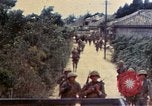
U.S. Marines of 'F' Company, 2nd Battalion 22nd Regiment come through village hunts in Okinawa.
U.S. Marines of 'F' Company, 2nd Battalion 22nd Regiment advance through a town in Okinawa. Marines in two long files come through village huts in background. Long line of Marines at different intervals, march down a winding road. All Marines in combat gear with weapons slung over shoulders. 30 caliber machine gun crew behind a stone wall. Grassy terrain in background.
Cold War commences in Europe and UN takes military action against North Korean aggression
Opening scenes show people of East Germany escaping from the Soviet-controlled zone, to the West, through forests. Whole families are seen carrying whatever they could in back packs and suitcases. Early in Korean War period: An animated map is inserted showing a map centered on Korea, with the 38th Parallel dividing Communist North Korea from South Korea. View of a line scratched in a dirt road, designating the 38th Parallel, leading to a temporary border with guard post, established for administrative purposes. View of Ducksoo Palace, in Seoul, Korea, headquarters of the United Nations (UN) Commission on Korea. Diplomats inside its chambers, trying (in vain) to negotiate the withdrawal of Soviet forces from North Korea. United States troops are seen evacuating from South Korea, after the establishment of the Republic of Korea. Carrying duffel bags and all their gear, they board trains to evacuation ports. General scenes of landscape and South Korean people going about their normal activities, under the new government. Smoke rising from surprise attacks by North Korea against the South. Republic of Korea (ROK) troops march to defend against the North's aggression. ROK troops in trucks and trenches fire small arms against the invaders. Huge numbers of refugees are shown fleeing the North. Soldiers raise international flags at the headquarters of the United Nations, in Lake Success, Long Island, New York. Inside, diplomats meet to deal with the crisis. View of empty place at the table labeled "Union of Soviet Socialist Republics." Warren Robinson Austin, U.S. Ambassador to the UN is seen as well as other UN representatives. (Narrator states that after its cease fire order had been ignored by the Communists, the Security Council voted for united military action against the aggressor, and provided for a unified command of United Nations forces.) View of the delegates voting with raised hands. U.S. General Douglas MacArthur is seen receiving the first UN battle flag. Aerial views of the Port of Pusan, Korea. The U.S. Navy transport ship, USS Pickaway (APA-222) is seen being moved by tug boats in the port. View of the troop ship loaded with American troops headed to the port of Pusan, Korea. Color guards waving flags of the UN, the U.S. and the Republic of Korea, as they lead a military brass band marching along the pier. Change of scene to American troops marching along opposite sides of a road in Korea, as jeeps drive in the middle. Troops, including ROK soldiers, engage North Koreans with small arms, mortars, machine guns and artillery field pieces. Back in America, troops parade along Constitution Avenue in Washington DC, with capitol building seen in background. American soldiers boarding a train. Camera focuses on shoulder emblem of a Canadian officer boarding a train and then shows Canadians marching to a port of embarkation. Turkish troops pass in review on their way to Korea. Troops of the Netherlands on the march. Australian troops assembled before sailing to Korea. Swedish doctors and nurses boarding a ship to Korea, where they will set up hospitals to treat the wounded. British sailors boarding ships for action in Korean waters. Glimpse of a British Colossus class aircraft carrier, underway in Korean waters. Views of other UN forces headed to Korea. The UN General Assembly building in Lake Success, Long Island, New York. View of delegates inside the building. Film ends showing a rotating globe of the world, with flags of Nations participating in UN actions in Korea, being shown as the globe passes their respective countries.

Demonstration of Campbell Model F flivver airplane at Bolling Field, Washington DC
View of a Campbell Model F airplane from rear, at Bolling Field in Washington DC. It is a pusher propeller "flivver" airplane, costing $1500, with tricycle landing gear and twin tail design, powered by a stock Ford V8 engine, with single ignition. View of engine running and long transverse central elevator, as well as side being moved. View of steerable nose gear. Pilot and inventor Hayden Campbell in the cockpit. Aircraft taxis out and takes off (view of Capitol dome in distance). Views of the airplane's Ford V8 engine, with one spark plug for each cylinder. Removing and replacing the engine cowling. Interior of cockpit, with ignition key, conventional yoke flight controls, basic instruments in panel and long push-pull throttle control.
Role of the Jeep in U.S. military operations during World War II.
A U.S. Army Air Forces (USAAF) Waco CG-4A-WO glider is seen descending and landing in a grass field. Upon touchdown, its front pops open and and an army jeep drives out. USAAF C-47 aircraft are seen next, offloading jeeps pulling small artillery pieces, and infantry who move rapidly from the parked aircraft. Jeeps traversing a high hump in a dirt road. A jeep towing an M-3 Antitank Gun 37mm, and others driving through underbrush and bouncing over rough road while towing 37mm guns and trailers. Soldiers stepping from jeeps to set up machine guns. American soldiers playing a game of horse and rider, during a break in duties. Soldiers setting up mortars. Jeeps driving through bodies of water. Two M4A1 (76)W Sherman tanks, with cast steel hulls, drive into a stream. Troops setting up several 37mm guns on a river bank. Two soldiers in a communications jeep. Army officers perusing a map laid out on the hood of a jeep. U.S. field artillerymen using periscopic binoculars on tripods, to spot and direct gunfire. Military vehicles, including jeeps, moving across desert terrain. Artillery crews firing M59 (M2 Long Tom) 155mm guns. A Douglas A-26 Invader aircraft flying overhead. Jeeps in various roles, bouncing along in the desert and laying smoke screens. Jeeps equipped with M3 anti-aircraft guns and others with stretchers for wounded affixed to their sides. U.S. Army Ford GPA "Seep" amphibious jeeps plunging into water and continuing on as boats. A jeep production and assembly line in a U.S. factory showing stages of assembly and finished jeeps driving out of the plant into yards containing hundreds of them. A convoy of jeeps driving over a bridge, and others carrying a U.S. military brass band in a parade in England. A Hollywood actress (Gloria Swanson?) being lifted into a jeep by several men. Glimpse of an unidentified actress with an American soldier, in a jeep. Hollywood stars, Stan Laurel and Oliver Hardy clowning in the front seat of a jeep with Desi Arnaz and two women riding in the back. Several jeeps carrying these and other Hollywood personalities during a war bond parade in Washington DC. The Capitol looming in the background as the jeeps move away from it toward the camera. Jeeps being prepared for transport to overseas destinations. Jeeps being partially disassembled and loaded into wooden crates and placed on rail cars for transport. Jeeps being hauled by cranes and placed aboard ships. Landing crafts mechanized (LCMs) transporting infantry and vehicles, including jeeps. An M4A1 Sherman tank driving out of a landing craft into surf. A jeep being driven onto beach at Adak,in the Aleutians,from a landing craft of the USS J.Franklin Bell (AP-34), in 1942. In 1943, this transport ship was reclassified as APA-16.) American troops with jeep on a South Pacific island in World War 2. A soldier on motorcycle, skids in mud on road in North Africa, and jeeps drive past him. American soldiers ride camels and some drive in a jeep near the Great pyramid and Sphinx in Egypt. Jeeps seen in China, with Generals Joseph Stilwell and Claire Chennault. One parked next to a Flying Tiger P-40 airplane. Soldiers in a jeep in Alaska, next to a tent and sign pointing to "Tokyo." Local tribesmen literally carrying a jeep, on long poles, across a river in Timor. General Douglas MacArthur, accompanied by staff officers, being driven in a jeep along a jungle road in New Guinea, past a line of local tribesmen. Wendell Wilkie, serving as Ambassador-at-large, during the war, speaks to U.S. officers in a jeep. Britain's King George VI in a jeep followed by another carrying Queen Elizabeth. President Franklin D. Roosevelt riding in a jeep to review troops. He removes his hat as they pass the American flag. Sign on a building in North Africa reads "Bizerte." General George S. Patton, standing in a jeep during a victory parade in North Africa. Soldiers at an outdoor religious service during the war with the hood of a jeep serving as a make shift altar.Various views of jeeps driving with soldiers in them.
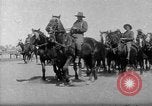
Australian Imperial light horse infantry regiment encampment during World War I.
Australian Light Horse Infantry men (with characteristics of both infantry and cavalry) at a home base in Australia, during World War 1. They move their horses, in groups of three, on a dirt track. Long Low wooden hitching rail is installed along the side of the dirt track. In the next scene, the horses are seen eating from feed bags all tied to a common rope line. The horsemen monitor them as they feed. One large horse stands alone and is petted by a horseman. Camera pans to reveal another long line of horses also feeding. Their feet are confined by rope tethers. Permanent camp buildings and some tents are seen in the background. Several of the horsemen kid around with each other. Two engage in a mock fist fight for the camera.