


 Francais
 Deutsch
 Italiano
Refine Your Search
Long Binh Vietnam 1969 stock footage and images
- Showing 2521 to 2526 of 5714 results more
more Hide
Hide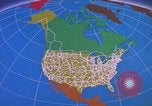
Animated map of Canada and the United States showing principal communications networks.
An animated map of Canada and the United States. Radio communications Tower over hilltop. Workers installing underground communications cables. Telephone communications in everyday life. A woman homemaker in a house holding a young child and talking on a corded telephone. The little girl also talks on the telephone. A business man talking on corded telephone. Men and women working in an office. Man in suit in a business office talking on a yellow corded telephone. Teletype machines of United Press International and other news agencies operating on a long table. Man looks at a screen and speaks over the phone. A cable ship laying communications lines at sea. An animated map showing the undersea cable connections to various places.
Franklin D. Roosevelt helps Americans to recover from the Great Depression in the United States.
Great Depression scenes and recovery efforts in the United States. U.S. President Franklin D. Roosevelt inaugurated as President on March 4, 1933. Scenes of Roosevelt and outgoing President Herbert Hoover leaving the White House together in a top-down convertible limousine before the ceremony. Roosevelt at the U.S. Capitol building during the inauguration ceremony as President of the United States. Roosevelt delivering the famous line in his speech, "The only thing we have to fear is fear itself." Jobless American men wait in unemployment relief lines to get work or jobs. Men in a bread line. Unemployed man with a large sign "Will take any job." Scenes of families migrating in the United States, with vehicles filled with belongings. Families and children suffering poverty and in makeshift camps and tenement dwellings during migration (usually migration west). Troops and bands march with American flags on Constitution Avenue during the Roosevelt Inauguration parade. Exterior view of U.S. Capitol Building framed by tree limbs. Men in an office empty heavy mailbags filled with letters (presumably to congress and senate). Government officials at a long table working on emergency banking laws in March of 1933. Scene of people flooding into a bank and making a run on the bank to retrieve deposits. President Roosevelt signs Emergency Banking Act in his office on March 9, 1933. View of White House lawn and White House. The CCC (Civilian Conservation Corps) is created to put unemployed young men to work on various conservation projects. CCC boys and men working on planting trees with pick axes and mattocks. Men and women in line to sign up for Emergency Work Relief programs. Officials write down the information for each worker as they are put to work in a variety of projects. Women and men, including white and African American men are seen getting assigned to work projects. A sign "USA Work Program WPA" advertising a suspension bridge work project of the Works Progress Administration in Los Angeles, California. People build roads, bridges and post offices. Cable fed out of a large spool as construction of a suspension bridge is shown. People work in factories. Four steam railroad locomotives preparing to run on parallel tracks. Close up views of railroad train locomotive wheels as they start moving and the train on tracks near factories. Various factory scenes including smokestacks, groups of workers entering factory for work shift and two different closeup views of a steam whistle blowing to mark the start or end of a work shift. A coal mining operation. Automated tools dig coal in shaft. Two coal miners take a break and eat. Crane hoists material at mine. A steel factory and hot molten steel pouring from a ladle.
Japan extends its empire into Manchuria, Mongolia, and China in 1931 and 1932
Brief opening scenes show ships being engulfed in flames and smoke from Japanese attack on Pearl Harbor, December 7, 1941 in World War 2. Focus is primarily on the USS Arizona. Scene shifts to Japanese troops assembling on a pier and boarding troop transport ships bound for Manchuria and China, following the Mukden Incident of September, 1931. Japanese troops are then seen marching into Manchuria on September 18, 1931. A formation of Japanese soldiers presents arms. In another formation, they shoulder swords. Closeup of a Japanese soldier in a steel helmet with chin strap in place. A steam locomotive pulls a train into the Chin Hsien station on the South Manchurian Railway. A Japanese train on that line had been dynamited, triggering a Japanese push into Mukden. View from behind a train leaving Chin Hsien on the South Manchurian Railway. Japanese battalions place bundles of straw across a stream to facilitate troop crossing. A column of Japanese troops is seen crossing the water on the makeshift straw crossing. Japanese troops advancing along with supplies carried by pack animals. Troops traverse a sandy berm past an abandoned two-wheel cart. A formation of 12 Japanese G3M bombers flies overhead in a "V" formation en route to bomb Mukden. View of Chinese population running for shelter from the bombing. Chinese walk past some civilian casualties lying in a street. The League of Nations headquarters in Palais Wilson, Geneva, Switzerland. A memorial to Woodrow Wilson at the Palais Wilson reads: "A La Memoire De Woodrow Wilson President des Etats-Vnis,Fondatevr DL La Societe Des Nations, La Ville de Geneve." A car driving away from the entrance of the League Headquarters. Closeup of doorway with sign identifying it as the entrance for delegates and members of the Press. League delegates are seen inside its meeting hall. Japanese warships are seen next, attacking 15 miles from Shanghai with naval gunfire.Three Mitsubishi 2MR4 (Type 10)Reconnaissance biplanes are seen in flight above the barrel of a large naval gun. Japanese troops marching into Shanghai, as people on the roadside wave Japanese flags. Next, they are seen marching out of Shanghai at the insistence of the League of Nations. After signing a truce with China, on May 4, 1932, Japanese troops are seen entering Mongolia, in September, 1932, which they reconstituted as the Puppet State of Manchuko. A Japanese soldier standing atop a building waving a Japanese flag. Japanese statesmen resigning and leaving the League of Nations in protest after it labeled Japan an aggressor. Japanese forces fire a long barrel Type 89 cannon (150mm) as they push into China proper. Group of Japanese artillerymen use range finders, Periscopic viewers and binoculars to guide the gunners. Shell explodes raising large amount of earth. More views of artillery firing and infantry advancing. Infantry crossing a bridge and raising siege ladders to scale a fortress. Engines running on Japanese Ki 30 Type 97 airplanes, as pilots get final briefing and orders. They salute, board their aircraft, and are seen in formation aloft, dropping bombs. View from the air of bombs striking below. View from a bomber of its bombs dropping from the aircraft (bombs away view) and exploding on the ground. A column of Chinese soldiers moves along a section of the Great Wall of China heading into the interior of China. Civilians moving all manner of equipment and machinery into the interior.
Events leading to World War II in Europe and German attack on Poland in 1939
Adolf Hitler and Hermann Goering walk together up the steps of Hitler's Berghof residence in Berchtesgaden, Bavaria, Germany. Inside the two walk about and converse. Views of them in several different rooms of the building. Hitler and Goering silhouetted against the large windows in one room, containing a long table and a world globe. Change of scene showing Nazi foreign minister, Joachim von Ribbentrop, being greeted by Soviet Union Minister of Foreign affairs, Vyacheslav Molotov, in Moscow, Russia, where they negotiated the signing of the German–Soviet non-aggression pact (also called the Molotov–Ribbentrop Pact) in August 1939. Von Ribbentrop is seen seated with Soviet negotiators. Various newspapers reflect mixed world wide views. Some question whether war or peace is ahead. Another notes that the Reichstag supports the diplomatic initiative. Another suggests that England and France must decide. One headline says Chamberlain will want war. Next, Polish forces are seen on parade being reviewed by General Władysław Bortnowski. Among forces parading are mounted cavalry, marching infantry, a formation of PZL P.11 fighter planes, Tk-3 tankettes (Tankietka), 120 mm wz. field guns, CP7 Ursus artillery tractors pulling wagons, antiaircraft guns mounted on trucks, and army trucks carrying soldiers. Scene shifts to German airmen loading bombs on aircraft; arming machine guns; refueling; and testing functionality of aircraft elements, such as turrets. Pilot in cockpit as engines start on a Dornier Do 17 bomber. Ground crew pull chocks and aircraft taxis out. A Heinkel He 111 bomber taxiing. Two of them take off. A Do 17 takes off, followed by more He 111s. Closeup of one flying low over the camera on takeoff. A mixed formation of German aircraft aloft, including several fighters flying top cover; nine Dornier Do 17s; and other bombers. Aerial closeup of a Do 17 seen from adjacent wingman. Closeup of several He 111s in formation. Closeup of gunner in turret. View from above of three camouflaged Do 17s flying far below. Closeup of pilot in cockpit of He 111 with wingman off to left side. More views of Do 17s flying over patchwork of farmlands. Gunner preparing in his turret. Clouds from antiaircraft fire seen from plane cockpit. Bombs falling and exploding on city below. Succession of bomb craters in a line across a flat area of land. View from aircraft of damaged Polish aircraft on an airfield. Scenes of devastation on the ground including destroyed buildings and Polish aircraft. Waves of German Junkers Ju 87 (Stuka) dive bombers taking off; in formation; and peeling off to dive on targets. View from cockpit of one, through rotating propeller, as it dives to bomb a railroad marshaling yard, and view back as it pulls out, showing clouds of smoke rising in its wake. Several German officers peruse damage at rail site. Destroyed Bridge and shipyard. The German battleship, Schleswig-Holstein bombarding the Polish base at Danzig's Westerplatte on September 1st, 1939. German artillery firing in Poland. Formation of Do 17 bombers overhead. Damaged and abandoned wooden wagons at side of road traveled by Polish civilians evacuating in a horse-drawn wagon and herding their cattle to safety. Destroyed Polish artillery and equipment and horses during German invasion. Men dig graves and bury dead Polish soldiers. Vies from air of bombed out part of Warsaw. Polish citizens gathered in places seeking assistance. German forces on parade in Warsaw, including German soldiers goosestepping. Closeups of Adolf Hitler reviewing them.
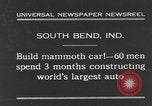
A mammoth Studebaker "Giant Car" roadster is seen in South Bend, Indiana.
In South Bend, Indiana, views of a "Giant Car" Studebaker roadster built by a group of 60 craftsmen working under Studebaker's Paul Auman. This giant scale version 1931 model 80 Studebaker Four Season Roadster was used in the film "Wild Flowers." The Giant Car is 41 feet long with a wheel base of 325 inches. It is 13 1/2 feet high, 15 feet wide, and weighed 5 1/2 tons. Men drive up beside the giant President roadster in a normal vehicle. Some use a rope ladder to climb up into the giant car and others climb up the wheel fender and then onto the hood. A boy is shown trying unsuccessfully to climb up a giant wheel of the car (each wire wheel was 6 feet 8 inches in diameter and weighed 600 pounds). The boy's small pedal car is seen beside the Giant Car tire. A police officer in a motorcycle rides up beside the giant car. He places a board-style 'Police Ticket' on the running board and then climbs up onto the running board to present the ticket to a woman who is behind the wheel of the giant roadster.
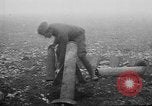
A member of the American Expeditionary Force disarms a German 105 mm gas shell in France during World War I.
Chemical warfare activities of the AEF (American Expeditionary Force) in France during World War I. A member of the American Expeditionary Force disarms a German 105 mm gas shell. A U.S. soldier places gas cylinders into long pipes on the ground. A number of pipes facing upwards.