


 Francais
 Deutsch
 Italiano

Refine Your Search
Long Binh Vietnam 1969 stock footage and images
- Showing 2527 to 2532 of 5714 results more
 Hide
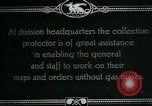
U.S. soldiers at Division Headquarters and in the field train for defense, disposal, and clean up of chemical warfare agents
A United States Army training film about defense against chemical warfare during World War I. The "Collective Protector" enables a general and the staff to work on their maps and orders without gas masks at the Division Headquarters. Two soldiers outside the headquarters wearing gas masks. They guard a low entrance doorway and enclosed tunnel with a heavy, flexible door designed to keep out gas. A soldier lifts the flap of the door and enters. Officers converse with each other while looking at a map on a wall. Soldier stands by rotating a handle on a device continuously. It has a long wide pipe connected to it, perhaps managing fresh air intake or air exchange. U.S. soldiers wearing gas masks load ammunition onto trucks. "Enemy" aircraft flies overhead throwing a cloud of poisonous gas that quickly envelops the area. A soldier wearing a gas mask fires his rifle into the air at the aircraft, through the heavy smoke screen. Gas sentries neutralize the gas around a dump. They dig in the ground with pick axes and mattocks, and then spread a white powder over the area. They then cover the area with a thin layer of the dirt they had dug up.
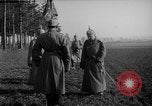
German Kaiser Wilhelm II meets with officers and reviews German troops in a forest area of Europe during World War I.
Scenes of German Kaiser Wilhelm II with German troops in a forest area of Europe. The Kaiser stands with a number of officers and talks to them. He is seen smiling and laughing while talking to one officer. He reviews long lines of troops as they march with rifles in hands. He salutes. Officers standing next to the Kaiser salute, as battalions march past them.
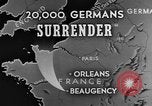
German General Erich Elster surrenders 20,000 troops and equipment to General RC Macon at Beaugency, France (WW2)
20,000 German soldiers surrender to Allied forces in France during World War II. German General Erich Elster surrenders himself and 20,000 troops to Major General Robert C Macon of the U.S. Ninth Army and to Major General OP Weyland, Commanding General of the XIX Tactical Air Command, on September 16. The formal surrender took place at the Beaugency Bridge on the Loire River. Long columns of Germans file into the city and lay down their arms. Numbers of items like trucks, civilian carts, horses, weapons and bicycle surrendered. View of surrendered rifles, pistols, machine guns, tucks and bicycles. 19360 Prisoners of War come down. View of Prisoners of War Camp and surrendered equipment.
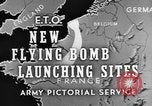
Canadian troops occupy a German flying bomb launching site and describe launching apparatus in Flanders, France.
Canadian troops occupy a German flying bomb launching site in Flanders, France. Map of France. Long rocket launching ramp. View of pistons that propel buzz bomb during take off. Allied pilot takes photographs. Canadian troops inspect the ramp mounted with a 400 pound piston. Canadian troops carry V-2 bombs and load them on to piston. The operation of the V-2 and launching apparatus: Man operates remote control boxes for launching. Soldier handles jet nozzle assembly. Jet propulsion engine is used for fire piston set off explosives. Compressed air bottle supply power for gyro pilots. Servo motors moves radar and elevator. Unexploded head contains explosives for bomb. Diagram shows flying bomb and its parts. View of a bomb site. (World War II period).
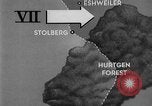
U.S. 4th and 8th infantry divisions enter Hurtgen Forest and 5th and 8th Inf. divs enter into Kleinhau to attack in Germany.
Activities of American first Army in Germany, advancing eastward in late 1944 during World War 2. Animated map shows: 4th and 8th infantry division move out from Stolberg and enter into Hurtgen Forest . U.S. 4th Infantry attack with field guns and artillery. Field gun amidst pile of shells fires toward Hurtgen Forest. 4th Infantry Division troops crawl up a hill in the Hurtgen Forest, sometimes pinned down under enemy German fire. Armor comes to their aid and casualties are treated by medical corps personnel. U.S. Army tanks arrive to support the infantry and they continue forward, where footage shows U.S. mortars and artillery bombing Grosshau, and point of view shot of a U.S. Army machine gun firing at a target in the town of Grosshau. Animated map shows: 5th and 8th Inf. Divisions enter into Kleinhau. Kleinhau is bombarded by a heavy volley of U.S. Army rockets and artillery from units of the 5th and 8th Infantry Divisions. Allied fighter bombers in flight over the area. Artillery is loaded and fired at close-range on target of Kleinhau which was then captured. U.S. Army Soldiers around the ruined buildings of Hurtgen, eating and drinking during a break. Infantry division move towards another towns. U.S. Army soldiers take a moment to relax during the long drive eastward. U.S. soldiers fire mortars from positions along the west bank of the Ruhr.
Battle of the Ardennes and Battle of the Bulge, in World War II
Film starts showing silhouettes of British tanks on the move, including one with a bulldozer blade. View from Allied warplane as bombs explode on the ground below. In November, 1944, infantry of the First Canadian Army, with Polish and British units fire Bren guns as they advance in Belgium and secure the Scheldt Estuary, to open a shipping route to Antwerp for the Allies. They traverse a river and cross rail lines while advancing. View of destroyed steel bridge across the Maas (Meuse) river with several British troops wading in water nearby. Silhouettes of German prisoners of war marching single file. View from rear of German prisoners walking under guard with hands resting on their heads. British troops running beside the Scheldt river at Antwerp on September 4, 1944, as huge explosions occur in the river behind them. A column of British troops, marching on tree-lined road, enters outskirts of Antwerp, as local people cheer them. Views of the troops being greeted in the city itself. Columns of Belgian refugees are seen returning to their homes. One,injured, is carried by friends in a wooden cart. A contingent of British troops marching in the city. Glimpses of derricks in the Antwerp port and a ship under construction in a shipyard. An animated map shows German counter offensive through Belgium and Luxemburg on September 4, 1944. Refugees leaving again, ahead of the returning German forces. View of a road sign reading: "Bastogne." American military police checking credentials of some refugees as they leave. American soldiers jammed together atop a Sherman tank parked at a checkpoint. After delaying further German advance, through the Ardennes, on September 16th, American troops are forced back and seen leaving , in trucks and Sherman tanks, from Bastogne, past a road leading to Martelange. As weather cleared on September 22nd, a formation of British Hawker Typhoon ground attack aircraft are seen in flight and diving to attack lines of communication with machine gun fire and rockets. Several different views of the aircraft firing and smoke rising from the ground. Animated map of German advance depicts the so-called "Bulge" extending 60 miles into Allied territory. Captured German films show German troops,one carrying a rifle and another a Sig 44 machine gun, as they pass columns of burning Allied trucks, other vehicles and armor. Closeup of German soldier waving to others to follow him, as he runs ahead past burning Allied equipment. Several German soldiers hunker under a knocked out Allied tank, as a German Jagdpanzer 38(t) Hetzer light tank destroyer passes their position. Closeup of German soldier smoking captured American cigarette. German infantry, walk past barrel of destroyed Allied tank. Several gather and smoke American cigarettes. One of them, with a belt of ammunition around his neck, is Hans Tragarsky aka Walter Armbrusch, of German Kampfgruppe Hansen, a battle group formed during the Battle of the Bulge from SS-Panzergrenadierdivision Regiment 2, an infantry regiment of SS Pz Rgt 2 "Das Reich". (This image is well known but his identity is subject to debate.) Glimpse of German officer walking with a soldier at the front, with background engulfed in flames.. Scene shifts to a formation of U.S. Army Air Forces C-47 transport planes seen, in flight, dropping food and ammunition to beleaguered American troops caught in the Battle of the Bulge. Change of scene to German Jagdpanzer IV tank destroyer moving; Panzer IV tanks firing 7.5 cm KwK 37 L/24 guns; and troops riding on a Tiger tank ( Panzerkampfwagen Tiger Ausf. B). German soldiers riding in a streamlined Volkswagen Kübelwagen. German soldier in an open single seat courier car spattered with mud. Close-ups of him smoking a cigar. German soldiers looking at formation of American C-47 aircraft overhead. A U.S. Army Air Corps B-25 bomber in flight. View from Allied bomber dropping bombs that strike ground with many explosions. View from above of a B-24 Liberator bomber in flight. View on ground of shells and bombs exploding in wooded area and low level black flak clouds. Captured 88mm gun being fired by Allied forces. British soldiers in a Landing Vehicle Tracked, cross a stream and climb up a steep bank. View from British "Wasp" flame-throwing Bren-gun carrier, as it fires and resulting inferno of fires. Views from a long distance of other flame-throwers firing across the stream. Closeup view of one firing with fires burning on the opposite shore.
CRITICALPAST.COM: About Us | Contact Us | FAQs - How to Order | License Agreement | My Account | My Lightboxes | Shopping Cart | Advanced Search | Featured Collections | Website Terms & Conditions | Privacy Policy ©2026 CriticalPast LLC.
License Agreement |
Terms & Conditions |
Privacy Policy
©2026 CriticalPast LLC.