


 Francais
 Deutsch
 Italiano
Refine Your Search
M4-training stock footage and images
- Showing 655 to 660 of 8248 results more
more Hide
Hide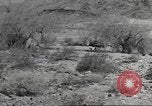
Camouflaged guns and equipment, soldiers with bazookas while other load land mines at a IX Corps camp in California.
U.S. Army IX Corps maneuvers at desert training centers in California. Half-track mounted with 50 cal Machine Gun moves. A tank moves on. A soldier on truck and another soldier on ground. Many camouflaged tanks move ahead. Soldiers on the barbwire boarder. A soldier in a trench. Another soldier with a gun inside a foxhole. A soldier digging trench. Two soldier in trench aims M1 Bazooka. Soldiers on the barbwire boarder. Anti tank mine field. Three soldiers unloading mines from a truck. 155 mm Howitzer camouflaged. Four soldiers take stance with 75 mm AA (anti aircraft) gun in preparation for firing. A soldier sees through binoculars. Some more soldiers near a camouflaged trench. A soldier making calculation on the map using drafting instruments. Another soldier sights through transit.. (World War II period).
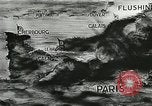
Allies decide that Normandy, France, is the best location for an invasion in World War II. Workers mobilize to build weapons of War in the U.S. and Britain.
Map shows coast of Europe with discussion of various places for a possible Allied invasion of France during World War 2. Normandy was chosen. German coastal defenses on English Channel and Atlantic shore (Atlantic Wall). German officers inspect defenses. Map highlights Cherbourgh, Le Havre, and Caen in Normandy. American workers building war machinery in defense plants and shipyards. Huge numbers of workers are seen in the yard of a U.S. defense plant. View inside a U.S. factory where numerous M3 Lee tanks are being manufactured on production lines during 1941-42. A welder at work. A woman using a saw and many other workers in a busy machine shop. B-17 bombers being built in a Boeing factory. Liberty ships under construction at a shipyard. A lookout watching the skies above a city, for enemy aircraft. A man and woman working together on a plumbing job. British women in Army uniforms working with typewriters. An American woman driving a forklift and loading a piece of ordnance on a railroad freight car. A rail yard filled with stream locomotives and freight trains. A line of trucks carrying war time cargoes. An army truck being loaded into the hold of a cargo ship. Ships underway in a harbor.
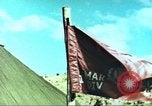
U.S. 1st Marine Division soldiers are decorated and get ammunition and other supplies in Korea.
1st Marine Division in Korea during the Korean War. The flag of 1st Marine Division. U.S. Marines are decorated by a General at base camp. The General decorates a Marine, awarding him the Silver Star. General Oliver Smith presents an award to a Marine. Honor Guard marches in formal ceremony. Flashback to summer of 1950 with Marines marching with rifles, advancing north in Korea following landings at Inchon. M46 Patton tanks driven on a road. The tanks and the marines pass through a village. A train loaded with supplies for the front passes over a nearby railroad bridge. The Marines pull a 75mm tank gun. They carry a 30 caliber machine gun. Marine Commander of 1st Marine Provisional Brigade, Brigadier General Edward A. Craig talks to an officer while reviewing a map or chart.
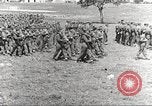
A battalion of uniformed Yugoslav Partisans march as a group during World War II
A battalion of uniformed Yugoslav partisan soldiers marches across uneven ground during a training exercise. They reform into a large square formation and parade across a smoother field. A number of women are included in their ranks. Next, all are seen marching, with some carrying Zastava M84 Medium Machine Guns, slung over their shoulders. They halt and stand at attention, and then resume marching. They break into two formations and march as the camera focuses on the space between them. The two formations pass on either side of the camera.
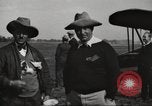
The Ford Reliability Tour of 1929
Ford Commercial Airplane Reliability Tour at the Ford Airport in Dearborn, Michigan on October 5, 1929. Film opens showing two aviators in ten-gallon hats standing next to some airplanes parked on the Ford Airport in Detroit Michigan. The pilot on the left is E. W. Cleveland, known for his ten-gallon hat, which is filled with autographs and other written memorabilia pertaining to aviation. Camera shows several formations of biwing training airplanes flying over the field, and then focuses on the Texaco number 13 aircraft with pilot Frank M. Hawks in the cockpit shaking hands with someone seeing him off. Closeup of Hawks sitting upright in the cockpit. Next, his wife Edith Bowie Hawks is seen standing next to his airplane. He playfully touches her cheeks. Next a man is seen wearing a heavy fur coat with hood. He smiles for the camera and then heads into an airport building. The wind (natural or from propellers turning) causes some of the men to hold onto their hats. Views of several men and women and a child gathering in front of the corrugated fuselage of a passenger airplane. Film ends showing two men smiling and chatting with May Halzlip, one of the three women pilots in the tour, who is dressed in flying gear with helmet and goggles on top.
American soldiers and Australian soldiers arrive in Buna, New Guinea during the Battle of Buna-Gona.
A film on the Battle of Buna-Gona in New Guinea during World War II. A map showing distance of Buna from Australia and Port Moresby. Thick jungles in Buna-Gona. American soldiers arriving in aircraft. The troops in trucks. An aircraft in flight. The soldiers inside the aircraft. Men trained in Australia. The aircraft arrives at a field. Australian soldiers get out of the aircraft. The soldiers and Papuan natives in the field. The natives carrying supplies move across a marshy area in the jungle. The soldiers holding guns crossing a water body. The soldiers moving across a bridge. The soldiers among the trees. The soldiers and the natives working to build a log bridge in the jungle. An M-3 tank moving on the bridge with a soldier atop the tank. Other soldiers watching the tank. Engineers building another bridge in the jungle. The Papuan natives carrying the supplies move on a path in the jungle. The natives wading through a water body. The 114th Engineers building a native-type hut. Wounded soldiers are carried on stretchers on the bridges by the natives and are evacuated. The soldiers and the natives beside the hut drinking from cups. The natives watch the soldiers. Several soldiers seated on the ground. A few soldiers inside the hut planning their action.
CRITICALPAST.COM: About Us | Contact Us | FAQs - How to Order | License Agreement | My Account | My Lightboxes | Shopping Cart | Advanced Search | Featured Collections | Website Terms & Conditions | Privacy Policy ©2026 CriticalPast LLC.
License Agreement |
Terms & Conditions |
Privacy Policy
©2026 CriticalPast LLC.