


 Francais
 Deutsch
 Italiano
Refine Your Search
M4-training stock footage and images
- Showing 661 to 666 of 8248 results more
more Hide
Hide
Officer students in auditorium,classroom and are addressed by officers at Air University in Alabama, United States
A film 'The squadron officer school' about training of a USAF officer student attending Squadron Officer School at the Air University on Maxwell Air Force Base in Alabama, United States. A USAF Lieutenant Colonel and a man seated at a desk talking to each other. The officer praises a report of a Captain. A officer in car stops and enters gate at Air University. USAF officers enter and leave Air University buildings. A large group of USAF officers in auditorium. An officer addresses the group. USAF officer looks at book in Air University library. Officers perform physical exercise. USAF officers and families in chapel during a service. Editor and Publisher of Flying Magazine Gil Robb Wilson speaks to the USAF officers in auditorium. Commander of Air University Lieutenant General Walter E Todd speaks. Dr. M H Sharlemann of the Concordia Theological Seminary addresses group. Football coach of University of Illinois Ray Elliot addresses group. Small group of USAF officers in classroom. USAF officers in auditorium attend lectures and discuss. They perform a skit. View of a missile hangar opening and a CIM-10 BOMARC missile of the United States Air Force being raised into firing position.
Captain and Colonel behind sand bags,airmen with rifles in thicket,and Major General Robert Lee in Europe.
A film shows training and alert drills for the Martin TM-61A Matador First Tactical Missile Squadron in Europe. A Matador convoy moving along a road. Warhead on trailer being hooked up to a truck at storage area and moving out. A Captain and a Colonel behind sand bags using a field communication system. A loudspeaker. An airman signaling his arm in circular motion. A zero-length launcher in the background. The Captain and the Colonel talk into field telephone behind sand bag revetment. A hand flipping switch on engine control box. The missile in launch position. A hand flipping switch on the control box. Sand bag revetment of TM-61A on launcher. A small box with hand flipping switches. TM-61A in launch position. The missile installation squadron in Germany. A dish-shaped antenna atop a van. Airmen with rifles in thicket. An officer picking up telephone, launching, hanging up the phone and relaxing. Major General Robert M. Lee, Commander of 12th Air Force in office.
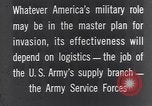
Commanding Generals of U.S. Army Services Forces and their missions are reviewed in this World War II film
Film starts with view of the U.S. military headquarters Pentagon building in Virginia, as seen from Columbia Island, across the lagoon, in World War 2.. Closeup of the building. Inside, Lieutenant General Brehon Burke Somervell , Commander of the Army Service Forces (ASF) is seen presiding over a staff meeting that includes seven Major Generals, who head the ASF technical services. Flag of the Quartermaster Corps seen in closeup. Officers of that organization are seen meeting. Scene shifts to a warehouse where military supplies are being moved on trailers pulled by small tractors. Carts filled with equipment are seen. Men prepare some for transport to America's allies overseas. Men fill packages with articles of clothing. A sign reads: "Maj. Gen. Reybold, Chief of Engineers." Engineers officers at a conference table rise as their Commander, General Reybold, enters. He sits and they begin their meeting. Closeup of staff officers in the meeting. Officers walk through a section of the Army Map Service, where cartographers, draftsmen and others are busy at tables creating maps. One of them is seen fitting several aerial photographs together to form a detailed map. A cartographer at the mapping service is seen annotating a map of the Marseille area of France. Views of high speed offset presses printing large scale maps for the military. A sign identifies the office of the Chief of Ordnance. Staff officers of that office are seen at work. Closeup of small arms being placed in a shipping box. An open yard filled with M24 Chaffee light tanks. A vast yard at a railroad siding, containing countless tanks on one side and building materials on the other. Sign inside the Pentagon at office of Major General H.C. Ingles, Chief Signal Officer. Closeup of General Ingles at his desk. Members of his staff consult with him. Sign at office of the Chief, Chemical Warfare Service. Major General William N. Porter, the Chief, looks over maps with several staff. Troops training under gas attack and smoke screen conditions. The entrance to the office of the Surgeon General of the U.S. Army. Inside, Major General Norman Thomas Kirk , Surgeon General, confers with a Colonel. Maps of areas where disease poses a threat to U.S. military forces. Office of Major General C.P. Gross, Army Chief of Transportation. Inside He holds a meeting with members of his staff. View of a pier where military supplies are being offloaded by means of derricks.

U.S. recruits being classified for assignments and being informed about the progress of World War II and why they fight.
New U.S. army recruits seated at benches in the classification center, taking notes, as an instructor at a blackboard tells them how to fill out their classification questionnaires, during World War 2. View of machines processing the questionnaires. Hollerith 88 column punch cards being sorted by machine. Newspaper article about the Air Force efforts to improve classification and assignments of new airmen. A recruit being counseled. An Airmen in barracks, filling out a post card form to complain about his assignment. Servicemen working with sewing machines and at long cobbler's benches repairing shoes. U.S. soldiers in pith helmets, laying communications cable from a truck. A soldier recording information about a shipment of supplies. Soldiers filling 5-gallon "jerry cans" with fuel from a hose. Others serving at a communications center in woods. A soldier fastening a cable to a tank. Soldier standing on a truck. Large group of soldiers gathered to listen to a lecture about explosives. Army draftsmen at their work tables. Soldiers using information and training materials.(Narrator states these materials are often ignored.) An army newsmap for Monday, August 31, 1942 posted on an Army office wall. A sergeant points to July, 1943, on a current calendar next to it, illustrating that the newsmap is long out-of-date. View of another news map and narrator notes they are produced weekly. An officer speaking to an auditorium of soldiers. A soldier arranging his personal gear. Infantry on field maneuvers, firing rifles as they advance across a field. Soldiers firing a Browning water-cooled machine gun; a mortar; and a 105mm M101A1 howitzer. The sergeant using a newsmap to brief his staff about the progress of the war. Opening frames of a War Department Film Bulletin, and soldiers in a theater, watching the film. Opening frames of the film,"Why We Fight," that goes on to show animated map of the German advance across Europe in World War 2. Scenes of German forces on the move, towing artillery, riding on tanks, and entering towns as they invade countries of Europe. Women and children running in streets under bombardment, and civilians fleeing from their homes during aerial bombing. A Bombed out city and civilian corpses lying on the ground. Women in Poland, identifying their dead and grieving over them. German Heinkel He 111 aircraft dropping bombs. Norwegians evacuating the city in trucks, and other vehicles and on foot, during the German invasion. A squadron of German Messerschmitt Bf-109 aircraft in flight. German Ju-87, Stuka dive bombers diving on targets. Civilians rushing to a bomb shelter, and other refugees boarding a truck to evacuate. More He-111 bombers dropping bombs. A Ju-52 trimotor transport (type used to transport German paratroopers). Buildings ablaze in a town. Large formations of German aircraft of various types flying overhead. Building destroyed and burning from bombing. Ju-87s flying close past the camera.
Imperial Japanese Army invades and bomb Mandalay, Burmese refugees flee for India, British soldiers destroy supplies during WW2
Imperial Japanese Army marches towards Mandalay, Central Burma (present-day Myanmar) during World War 2. They pass sign post reading, "Mandalay 82, Rangoon 348, Hanza 6" Imperial Japanese Army Mitsubishi G3M1 Model 11 Land-based Attack Aircraft bombers drop bombs on Mandalay. Explosion from dropped bombs as viewed from air. Children run away. Japanese bombers drop more bombs. Bomb explosion at ground level. Buildings on fire in Mandalay. A train full of evacuating Burmese locals, some holding on to railings of rail cars. Animated map showing Japanese capture of Burma. British troops in retreat driving a crowded truck. POV driving down road past long line of refugees fleeing Burma for India. Refugees in ox carts. British Army demolition squad destroys equipment and materiel, burn oil supplies to prevent Japanese Army usage. Oil derricks burning. British soldiers retreat at a running pace to small boats. British soldiers retreat on boats as oil supply burns. Huge fire from oil supply. Refugees carry their belongings, flee on foot. Line of Chines soldiers retreating. Burmese and British soldiers lead refugees on foot on elephant trails, jungle, across river and mountains, to India. Camp for Burmese refugees in India. Soldiers carry an injured patient on a stretcher. United States General Joseph Stilwell talks to a Chinese colleague. “We got run out of Burma, that's humiliating as hell. I think we ought to find out what caused it, go back and retake the place.” General Joseph Stilwell says.
Japanese troops at Marco Polo Bridge in Peking and city of Nanking (Nanjing) during Second Sino-Japanese War
Explosion from bombing during the Marco Polo Bridge Incident at the start of the Second Sino-Japanese War. Sign at Marco Polo Bridge reads “Lu Know Kiao”. A train station near Marco Polo Bridge in Fengtai District, Peking, China. Imperial Japanese Army soldier uses binoculars while hiding in trench. A Japanese Sumida M.2593 (Type 91) armored car. Japanese troops fighting around Marco Polo bridge. The Japanese flag on mast of a battleship. Japanese battleship sailing to China. Japanese troops enter Nanking (Nanjing) after the Battle of Nanking. Soldiers in back of truck. Japanese biplane aircraft in flight. Japanese planes drop propaganda leaflets over Shanghai. Japanese planes dropping bombs. A Japanese newspaper with news on the Second Sino-Japanese War. Naval artillery crew firing guns. Japanese warships firing their guns in China. Japanese soldiers advance in battle. More bombers in flight.
CRITICALPAST.COM: About Us | Contact Us | FAQs - How to Order | License Agreement | My Account | My Lightboxes | Shopping Cart | Advanced Search | Featured Collections | Website Terms & Conditions | Privacy Policy ©2026 CriticalPast LLC.
License Agreement |
Terms & Conditions |
Privacy Policy
©2026 CriticalPast LLC.