


 Francais
 Deutsch
 Italiano
Refine Your Search
M4-training stock footage and images
- Showing 6595 to 6600 of 8218 results more
more Hide
Hide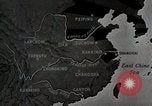
Chungking (Chongqing), new capital of China, is bombed by Japanese forces during Second Sino-Japanese war
The Republic of China establishes its wartime capital at Chungking (Chongqing), China during the Second Sino-Japanese War. Animated map depicts areas of Japanese occupation and highlights cities including Lanchow (Lanzhou), Chengtu (Chengdu), and Kunming. It highlights Chungking (Chongqing) as the new capital of Nationalist China. Generalissimo Chiang Kai-shek is seen leading a group of Chinese leaders as they walk through an arched gate in Chungking (Chongqing). A busy street with shops and apartment houses, in the commercial district. It is filled with pedestrians, cart traffic along the curbs, and automobiles in the road center. Boatmen on the Yangtze River are seen below long steep steps leading up to the streets above. Views of houses clustered along the cliffs, and workmen digging bomb shelters into the cliffs. View from inside a shelter being hollowed out of the rock. Back in the Japanese occupied area, a car brings a Japanese Air Force leader who addresses a large group of fliers at an airbase. Next, Japanese air crews are seen running to their airplanes from their camp on the airfield and taking off in their Mitsubishi G3M bombers, to attack Chungking (Chongqing). Nakajima Ki-27 airplanes take off from the field and join in large formations overhead. A formation of Chinese World War 1 era is seen inflight, ostensibly to engage incoming Japanese bombers. Japanese crew member in a bomber sees the Chinese fighters and gunners in the bombers get ready to fire on them. The Chinese fighter planes dive at the bombers but are intercepted by Nakajima Ki-27 airplanes flying cover. Aerial dogfights ensue with Chinese planes being shot down, and the bombers continuing their way. Air raid sirens sound in Chungking and people run to their shelters, including many school children. Views of bomber crews at their stations and then of bombs falling with the Yangtze River below. Bombs exploding along the riverfront and inland, along the cliffs. View of machinery operating, and Chinese workers occupied in underground factories in Chungking (Chongqing). Fires burning throughout the city, from the bombing, and Chinese fire fighters working to extinguish them.
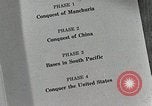
Japanese aggression in China and various events leading to Japanese attack on U.S. at Pearl Harbor (WW2)
A hand writes check marks beside “Bases in the South Pacific” and “Conquer the United States” on the summary report purporting to reflect phases of Japanese so-called "Tanaka Plan". Animated map shows pressure by German forces in offensive against Soviet Union and illustrates German air war against Britain. Scenes of bombing destruction in Britain, including overturned double-decker bus in ruins of buildings. A Nelson Class British battleship viewed from dead ahead. She is followed by the aircraft carrier HMS Illustrious. The U.S. Capitol building in Washington, DC. American newspaper headline reads: "Navy Bill Passes House." and "Huge Sum Voted for Two Ocean Navy." A line of U.S. Navy battleships underway, led by the USS Mississippi (BB-41). A field full of U.S. M3 Lee tanks moving in formation, as they are overflown by several Douglas B-18 bombers. Assembled Japanese leaders in a forum. Japanese Naval officers in a planning conference. Closeup shows Admirals Shigeyoshi Inoue and Raizō Tanaka pointing at a chart and conversing as other officers look on. Next, bomb bursts and black smoke rises as the attack on Pearl Harbor is underway. The USS West Virginia, USS Tennessee, and the USS Arizona, burning on Battleship row, during the attack. Generalissimo Chiang Kai-Shek with staff officers walks to a waiting car. Forces allied with China, including American troops marching; British troops marching; and Dutch Colonial troops marching (in Batavia, the Capital of the Dutch East Indies). Japanese troops continuing their conquest of China, firing a field piece, and infantry charging. Newspapers announce Japanese advances into Malay Peninsula and Hong Kong. Others cite the Fall of Singapore and the Fall of Corregidor in the Philippines (6 May, 1942). Animated map shows Japanese occupation encompassing Indochina, Thailand, and Burma (with loss of the Burma Road) all of which compounded China's war efforts.
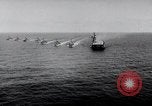
U.S. military on alert during the Cuban Missile Crisis
U.S. Naval ships at sea. Sailors look at a map. U.S. troops walk out of plane. M-42,self propelled, twin-40mm gun, on field. Jets on airfield. U.S. military on alert during the Cuban Crisis.1962.
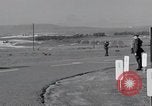
President Kennedy and official party watch Atlas 134D Launch,US
President John F Kennedy arrives in his bubble limousine. President Kennedy, Secretary of Defense Robert McNamara, Lt. Gen. Howell M. Estes, Maj. Gen. Joseph J. Preston, Brig. Gen. Seth McKee, and Dr. Harold Brown at Minuteman silo. President Kennedy and official party watch Atlas 134D launch at Minuteman silo.23 March 1962.
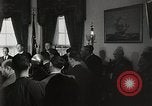
General Marshall is sworn in as the new United States Secretary of State
General George C. Marshall being administered the oath by Chief Justice Fred M. Vinson in the Oval Office of the White House, Washington DC. President Harry S. Truman and members of the cabinet look on. President Truman congratulating General Marshall. Former Secretary James F Byrnes congratulates General Marshall during the ceremony.
Allies capture great French Port of Brest, France (WW2)
Aerial view of French Port of Brest during World War II. Allied General Walter M Robertson commanding officer of 2nd Infantry Division accepts surrender from General der Fallschirmtruppe Hermann-Bernhard Ramcke commanding officer of German Afrika Korps. Allies take German troops as prisoners of war. Aerial view of destroyed French port of Brest.
CRITICALPAST.COM: About Us | Contact Us | FAQs - How to Order | License Agreement | My Account | My Lightboxes | Shopping Cart | Advanced Search | Featured Collections | Website Terms & Conditions | Privacy Policy ©2026 CriticalPast LLC.
License Agreement |
Terms & Conditions |
Privacy Policy
©2026 CriticalPast LLC.