


 Francais
 Deutsch
 Italiano
Refine Your Search
M4-training stock footage and images
- Showing 673 to 678 of 8248 results more
more Hide
Hide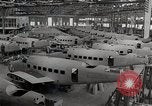
American aircraft industry and developments in 1940s. Manufacturing and radio navigation.
Development of aviation in the United States during 1940s. Transport and bomber aircraft under construction in factories staffed by World War II war production workers. P-38 lightning fighters under construction in a factory, in 1944. A train carries raw materials on railroad in arid area. A woman taps rubber trees in tropical area. Formation of C-47 aircraft with individual planes "peeling off" for landing. American C-47 transport aircraft being loaded. Soldiers load a jeep on one. Soldiers load an artillery gun on another. C-47 taxis for takeoff. Flight of 4 twin-engine bombers head-on view. The roof of a building reads 'radio range'. Interior cockpit view of aircraft instrument landing system (ILS) localizer and glide path needles moving toward center. A pilot in cockpit of a plane. A radio navigation transmitting tower. A ship in the ocean with a PBY Catalina flying over it. Flight engineer at his station in multi-engine aircraft. (World War II period).
Romanian Delegation departing from Moscow, Russia.
Romanian delegation headed by Romanian Prime Minister Petru Groza, foreign minister Anna Pauker, and Communist leader Gheorghe Gheorghiu-Dej is leaving from Moscow, Russia, Soviet Union, after signing a Mutual Assistance treaty on February 4, 1948. The delegation at a railroad train station is seen off by the Russian foreign secretary Vyacheslav Molotov and vice foreign secretary Andrei Vyshinskii. Prime Minister Groza gives the departing address on Russian-Romanian relations. February 1948.
Manufacture of the famed Liberty engine and U.S. Army Air Service in World War I
The Liberty L-12 engine. Scenes of its manufacture in American war plants. U.S. Air Service crews training in DeHavilland DH-4 aircraft. An airplane falling and crashed, with wreckage seen on ground. Head of the U.S. Army Air Service, General Patrick, and General Billy Mitchell, presenting medals to Captain Eddie Rickenbacker and other fliers of the U.S. Army 94th Aero Squadron, in France, during World War 1.
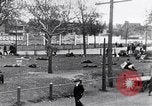
Homeless people and scenes of destruction after T. A. Gillespie Company Shell Loading Plant explosion
Displaced homeless people and refugees gather in grassy area near a railroad station, following explosion of the World War I shell loading facility. The T. A. Gillespie Company Shell Loading Plant explosion, sometimes called the Morgan Depot Explosion, occurred in October 4, 1918. The plant was one of the largest munitions facilities in the world at the time. Damage was extensive in the South Amboy and Sayreville area. Clip shows a refugee family posing together, sitting in the grass. Many billboard signs are on nearby fences and a grass and sidewalk area beside railroad tracks. The Perth Amboy Railroad Depot (train station) building on Smith Street is seen behind them (this building has since been moved to Lewis Street). With Martial Law imposed, the next scene shows a Coast Guard or Navy sailor on patrol to keep law and order and prevent looting in front of destroyed shopping area stores on Smith Street in Perth Amboy, including the Reynolds Brothers store (Reynolds Bros), at 134 Smith Street (also 136 Smith Street and 138 Smith Street), where the windows are blown out and debris are seen inside the store. The explosion of the Gillespie plant was one of three similar events in the New York-New Jersey area during World War 1: The Black Tom Explosion in 1916, the Kingsland Explosion in 1917, and then the Morgan Depot Explosion in 1918.

Top teams and players prepare for the 1958 baseball season
An overview of baseball teams preparing for the 1958 season in Florida. Views of New York Yankees' camp with manager Casey Stengel running onto field, pitchers Sal Maglie and Whitey Ford warming up. A smiling Mickey Mantle (#7) hits a ball far in batting practice. Yogi Berra (#8) and Hank Bauer (#9) take their swings. Scene shifts to the Dodgers' camp; this is the first spring after the team moved from Brooklyn to Los Angeles. Views of pitchers Don Newcombe (#36) and Johnny Podres throwing, and players Duke Snider (#4), Gino Cimoli and Gil Hodges (#14) swinging in batting cage. Announcer notes Dodgers have big problem at catcher after Roy Campanella was put "out of service." (He was permanently paralyzed in a car accident.) Al Walker, Joe Pignatano and John Roseboro are named as his possible successors. Scene shifts to St. Louis Cardinals training camp. Announcer predicts Cardinals will be pennant contender. Views of brothers Von and Lindy McDaniel, shortstop Alvin Dark and all-time great Stan Musial. Scene then shifts to Chicago White Sox camp. Outfielder Al Smith (#9) fields a ball; Jim Rivera (#7), Nellie Fox and Smith take swings in batting cage. Action moves to Detroit Tigers camp, where pitchers Jim Bunning (#14) and Frank Lary (#17) are seen warming up. Al Kaline (#6) hits a ball in batting practice.
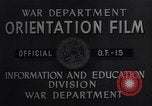
U.S. orientation film for Allied occupation forces, to provide background for understanding Japanese and their society
Background information for United States occupation forces in Japan after end of World War II. At start, the film shows sky filled with U.S. Navy airplanes flying in formations. They include Vought F4U Corsair aircraft, among others, and are seen overhead above the Battleship USS Missouri (BBB-63). Closeup of the USS Missouri with her crew in formation on deck wearing dress whites. Next, General Douglas MacArthur is seen and heard speaking from a podium on the Missouri's deck. He invites the representatives of the Emperor of Japan, and the Japanese Government, and the Japanese Imperial headquarters, to sign the instrument of surrender. The date is September 2, 1945, just after the end of World War 2. Closeups of the Japanese delegation, which includes envoys Foreign Minister Mamora Shigemitsu and General Yoshijiro Umezu, and of MacArthur. Japanese Foreign Minister Mamora Shigemitsu sits at a table. Closeups of him signing the surrender document. Change of scene to Japan, where camera pans over many thousands of Japanese people assembled to learn of their fate. Closeups of Japanese soldiers and family members, as Narrator asks how should the U.S. occupying force treat them. View of soldiers in plain non-military uniforms. Views of Japanese responding en masse to a leader, during World War 2. Views of child victims of the war. Closeup of Japanese soldier firing a short barrel light machine gun. Views of Japanese pedestrians including families, most in western dress. Japanese workers in an office. Film shows artists view of one worker's brain, and then many brains, as Narrator refers to need for reorienting Japanese thinking. View of learned wise Japanese leader at a podium. View of a Japanese soldier posed with his sword above the head of a war prisoner. Japanese mother feeding her baby. Closeups of Japanese babies. Closeups of Japanese school age children, in a group, and some doing things in school, and some at a playground. Group of uniformed Japanese students studying the art of Japanese calligraphy. Students doing artwork, studying nature outdoors, and paying attention to a teacher using a black board to explain how to calculate volumes of different shaped vessels. Students in classes of Geography and of geology. Japanese chemists, architects, and lawyers at work. Telephone switchboard operators at work. Electrified train moving on a track.
CRITICALPAST.COM: About Us | Contact Us | FAQs - How to Order | License Agreement | My Account | My Lightboxes | Shopping Cart | Advanced Search | Featured Collections | Website Terms & Conditions | Privacy Policy ©2026 CriticalPast LLC.
License Agreement |
Terms & Conditions |
Privacy Policy
©2026 CriticalPast LLC.