


 Francais
 Deutsch
 Italiano
Refine Your Search
M4-training stock footage and images
- Showing 7141 to 7146 of 8218 results more
more Hide
Hide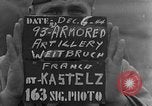
Gun crew of the U.S. 93rd Armored Field Artillery Battalion in Weitbruch, France, during World War II
Artillerymen of the U.S. 93rd Armored Field Artillery Battalion are seen carrying 105mm artillery shells in their stowage cases. They dump them onto the ground near their 105 mm Howitzer Motor Carriage M7 (aka Priest) parked under camouflage netting. Change of scene shows two soldiers removing shells from a parked delivery vehicle. Several other soldiers stand around a camp fire. Another vehicle and a couple of tents are seen. The horizon is clear and unbroken except for three widely separated trees and two pointed objects (possibly church steeples) in the distance. Four soldiers relax and converse around a campfire. One smokes a pipe.
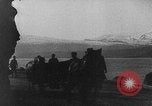
German invasion of Norway and Denmark in World War II.
Opening scene shows German infantry marching along a road next to a body of water. A horse-drawn wagon carries some supplies. A German Army soldier climbs atop a stone monument with a metal representation of the word, showing the North and South arctic circles. It is dated 1937. He attaches a ribbon to the sculpture. Views of Norwegian coastal defense guns. German Navy gunships underway in background. Closeups of some gunships. Aerial views of German Heinkel He 111 bomber aircraft flying in formation over snow-covered mountains in Bergen, Norway. View from co-pilot's seat in a bomber. The He 111s flying low over a body of water. A long steel bridge over a body of water. German soldiers standing guard on the bridge, with a bicycles, and a tripod mounted M42 machine gun, as German troops on motorcycles pass along the bridge. sign on bridge marking boundary between two administrative entities (counties). Troops on bicycles riding across the bridge. Glimpse of coastal defense guns in Denmark and a German Soldier sentry.
Sixth Marine Division tanks fire at caves on the side of a cliff and General Simon B. Buckner directs operations in Okinawa, Japan.
The Battle of Okinawa in Okinawa, Japan during World War II. A United States M5 tank with name "Amapola" painted on side is seen passing in the foreground. Two tanks advance and United States Army infantrymen follow behind. The tanks fire. Shells burst. The command post at the top of a ridge. The tanks firing. Smoke columns rise as the tanks fire. U.S. Army Lt General Simon Bolivar Buckner directing operations. United States 6th Marine Division tanks in a valley fire at caves on the side of a cliff. Smoke rises due to the firing, and U.S. infantry advance.
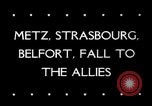
U.S. 7th Army and French FFI during the recapture of Metz, Strasbourg and Belfort in France during World War II.
U.S. 7th Army and French troops recapture French cities during World War 2. French troops parade in Metz. The troops march in formation through the city streets. U.S. Army Major General Walton H. Walker, who led the U.S. Army and the FFI (French Forces of the Interior) in the capture of the city from the Germans. General Walker with other officers walks out of a building. French soldiers stand in a formation during a ceremony in which the city is to be returned to the French. In the official ceremony, General Walker returns the city to French Lieutenant-General Andre-Marie-François Dody, acting for his country.The crowd cheers. The Generals walk away. Scene shifts to Strasbourg, where Provost Marshal McIntyre, of the U.S. 7th Army, accepts the surrender of Two German Battalions (5 thousand troops) from their commanding General. The surrendered German soldiers are lined up in the street. German officers waiting to get into trucks. In another sequence, a sign on a street in Belfort reads 'N.463 Montbeliard'. French 1st Army troops on tanks advance through the streets in Belfort. A sign showing the direction to Belfort Castle. French troops fire at the castle in Belfort. Soldiers behind a wall and an M-3 Stuart tank and an anti-tank gun fire from behind the Theatre Granit building at the Belfort Castle. Explosions occur at places in the castle. An underground tunnel of the Belfort Castle is inspected by a French General. Several officers walking with the General. The French flag hoisted on the castle. U.S.Major General Walker proceeding with officers over a bridge. The officers on a path on a hill. Aerial view of buildings.
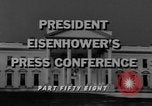
U.S. President Dwight Eisenhower answers queries of press men during his 130th press conference in Washington DC.
U.S. President Dwight Eisenhower's 130th press conference in Washington DC, United States. Newsmen from different nations arrive for President Eisenhower's 130th press conference. Men seated in a hall inside a building. President Eisenhower arrives with officials. The President speaks during the conference. Press and media representatives take notes. Chalmers M. Roberts, a pressman, asks the President that with the summit issues in the impasse between the U.S. and the Soviet Union, does the President see any initiative to break it or would the arms race go on indefinitely. President Eisenhower says that they should seek some common ground where there is a beginning made towards agreement in which they can work better co-operatively. The men gathered in the hall take down notes. View of the President speaking. Photographers taking pictures. The President unfolds a document and says that it is the list of subjects that the United States has proposed unilaterally with respect to the Allies. He cites the Baruch Plan - '46, the preparation of inspection and control measures, the Open Skies proposal, the peaceful use of outer space, the transfer of nuclear weapon stocks to peaceful use such as for power, freedom of travel and the limitation of the UN Veto. The President further says that he does not think he is being negative just by being firm and believing in what is right for the welfare of the United States.
U.S. 90th Infantry Division soldiers advance under cover near St. Jores, France during World War II.
Tank support for U.S. 90th Division, 359th Regiment, 2nd Battalion, Company F infantrymen near St. Jores, France during World War II. An aid man attends to a wounded U.S. soldier. A platoon moves cautiously along hedgerows firing M-1 Garand rifles and BARs (Browning Automatic Rifles) and rifle grenades. A tank fires, giving cover to the infantrymen.
CRITICALPAST.COM: About Us | Contact Us | FAQs - How to Order | License Agreement | My Account | My Lightboxes | Shopping Cart | Advanced Search | Featured Collections | Website Terms & Conditions | Privacy Policy ©2026 CriticalPast LLC.
License Agreement |
Terms & Conditions |
Privacy Policy
©2026 CriticalPast LLC.