


 Francais
 Deutsch
 Italiano
Refine Your Search
M4-training stock footage and images
- Showing 7147 to 7152 of 8218 results more
more Hide
Hide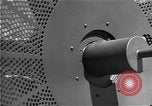
U.S. Army Anti-aircraft batteries respond to threat from unknown aircraft sighted near Alaska and the Eastern seaboard.
U.S. Army Air Defense elements respond to threats from an unidentified (possibly hostile) aircraft detected, near Alaska and over the Eastern Seaboard of the United States. Closeup of a rotating radar antenna. High altitude contrails (vapor condensation trails) seen overhead. Two U.S. Army technicians tracking aircraft and making notes in an anti-aircraft operations center. Two soldiers in a control center at positions labeled "Intelligence Teller" and "AAA Opns Off" respectively. A Lieutenant joins them and directs one to push an alert button. Soldiers respond from their barracks and take up positions at a large tracking map table. They move markers to positions corresponding to incoming reports. A Colonel joins the Lieutenant, already at the control center, and takes up a position labeled, "Deputy Defense CO," (Deputy Defense Commanding Officer). In the background, reports can be heard coming into the control center about five aircraft at 18 thousand feet. Two soldiers plot information on vertical plexiglass display, showing radial lines and distances. . A sign above the boards reads, "Early Warning Op." More reports in the background refer to three aircraft. The Lieutenant has now moved to the position of "AAA Opns Off." View of a soldier markiing grease pencil entries of aircraft sighting reports, on a plexiglass display, at his work station. More views of information being reflected by soldiers moving markers on the map plotting table and the large vertical display. Closeup of the aircraft position markers being moved on the plotting table. A Battery Attack light flashes on another display. The Lieutenant wearing a headset, announces to all units the change of readiness condition to "battle attack." (He also states, "this is not an exercise," and adds "alert all batteries.") An alarm bell rings at an aircraft battery. Soldiers are awakened in their quarters and scramble to their respective guns in a 120 mm Gun M1 anti-aircraft battery. Each gun crew reports being ready, as they raise their gun barrels. More views of aircraft positions being plotted. One appears to reflect a threat to New York City. Computers record data necessary to aim anti-aircraft batteries. Range and azimuth data being displayed. Gunners load shells and propellant charges into their weapons. Gunners looking up and awaiting further instructions. View of all battery guns pointed skywards. Apartment houses in the background. Changing firing and wind azimuth plus fuze information being displayed. A radar antenna turning at the battery location. Narrator states that the aircraft near Alaska has disappeared over the Pacific and the Eastern Seaboard sightings turn out to be commercial aircraft forced off course by strong winds. View of a Lockheed Constellation flying through some clouds, and then landing at an airfield. Alert lights go out in the Anti-aircraft control center, returning to normal status. View of soldiers manning their positions in the center begin wrapping up their activities. One lights a pipe.
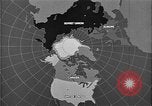
Cold War scenes: Soviet military on parade in Red Square; U.S. Army placing gun batteries in U.S. residential areas
Opening scene shows animated map of northern part of the earth, centered on the North Pole. It depicts the shortened flight paths between various parts of the Soviet Union, and the United States via polar routing, representing bombing threats. The Soviet Red flag flying on a flag pole. A large number of Soviet Tupolev Tu-2 bomber aircraft parked at an airfield. (They are equipped with four-bladed AV-9VF-21K variable pitch propellers.) Aerial view of several Russian Tu-2 aircraft in flight. Closeup of aircraft's twin tail showing dihedral angle between them, as viewed from tail of the aircraft. View of military parade in Red Square, Moscow. Numerous open army trucks, filled with Soviet troops, drive in formation. In a closeup, the Soviet State Museum building dominates the background. Closeup of Georgi Malenkov (who was named premier and first secretary of the Communist Party of the Soviet Union, upon the death of Joseph Stalin, in March 1953). He reviews the parade from the Kremlin. Soviet Secret Police Chief, Lavrentiy Beria, stands beside him. Army motorcycle troops pass in formation. Lenin Mausoleum and Kremlin Walls in background. Closeup of Soviet military veterans in civilian clothes, with medals, watching the parade. More troops in open trucks. They pass large posters of Lenin and Stalin. Closeups of Soviet civilians including women and children. A group of Asian persons watching the parade. View from a high point overlooking Red Square showing lines of army trucks snaking around both sides of St. Basil's Cathedral, as they leave the square, past Lenin's Tomb. Closeup of Soviet soldiers saluting with rifles as they pass reviewing stand. Their truck is towing a field howitzer equipped with two tires on each axle. Closeups of several towed howitzers. Scene shifts to Elizabeth, New Jersey, United States, where army jeeps and artillery pieces maneuver on the city streets, in preparedness exercises during the Cold War. A woman hanging laundry out to dry on a line. Artillery being placed in a vacant lot near a residential neighborhood. A woman looks out her apartment window at the gun being placed in the lot. Soldiers uncover it, revealing a 120 mm M1 anti-aircraft gun. Young boys watch the activity from a backyard, where clothes are on a line to dry. The soldiers erect a radar antenna on a fire control trailer. Two women watch the activity from their apartment window. Closeup of the gun installed and ready. A radar antenna rotating in the field. A battery of several antiaircraft guns installed in the field. Cars and pedestrians on busy streets and sidewalks in the city. Children playing on monkey bars in a park. Distant view of military temporary buildings and guns installed near apartment buildings. An alarm clock. A rotating radar antenna. A civilian asleep in his bed. A soldier steps from his unit's orderly room and blows a whistle. The disturbed civilian in bed looks at his clock reading 5:30 AM and expresses disgust. He is next seen with friends, registering a complaint with an Army Captain in his office, who agrees to resolve the matter. An Army Officer is seen standing at a large chalk board explaining how and why anti aircraft guns are being installed across the area, as civilians watch and listen to his explanation
American Air Defense activities during the Cold War
Film opens showing a U.S. Navy Gleaves-class destroyer in a bay. Closeup of radar antennas atop a U.S. Navy ship. A U.S. Navy submarine operating on the surface in icy waters. It has what appears to be a cylindrical shelter on its deck. The boat is covered in ice. Several men in foul weather gear are on its deck. Interior of a radar monitoring center, where a sailor, wearing a headset, monitors a plan position radar scope, where an unidentified aircraft is detected. Scene shifts to a U.S. Air Defense centers where such information is plotted on charts. Sign on table reads: "Supervisor GOC" (referring to the Ground Observer Corps) Civilian volunteer members of the Ground Observer Corps (organized by the U.S. Air Force in 1950) enter a room for a meeting. Narrator states that their mission is to operate 14 thousand observation posts and 49 filter centers. View shows predominately women volunteers in the group. Two uniformed Air Force men show silhouette diagrams of American military aircraft. Women connecting numerous phone callers at a large switch board installation. A barber serving a customer in his shop. A volunteer ground observer, at an outdoor post, watches as a flight of U.S. Air Force P-47 aircraft flies overhead in formation. A U.S. Army member of the Anti-aircraft Command, is seen at a desk. He receives a report of an unidentified aircraft and pushes a button to sound bells alerting soldiers who leave a dining hall in the midst of a meal to respond to their battle stations. They are joined by soldiers from elsewhere in the area. All rush to their assigned locations. View of them running across a field. A large suspension bridge in the background. Soldiers manning 120mm M1 anti-aircraft guns amidst views of rotating radar antennas. Soldiers loading shells into the guns. Soldier monitoring the unknown aircraft on radar equipment. View of hurriedly abandoned dining hall with uneaten meals on the tables. Soldiers lowering gun barrels and placing covers over them after the alert is cancelled.
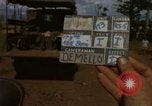
Officers addresses villagers in Vietnam during the Vietnam War.
The U.S. Army in Vietnam during the Vietnam War. Villagers gather outside a building. Captain M. Belenky addresses them. An interpretor translates what Captain Belenky is saying. The villagers applaud. A loudspeaker on the ground. A New Zealand officer speaks. A Korean officer at a microphone.

French aviator Louis Blériot flies his first monoplane aircraft in Calais, France, 20 years after his record Channel crossing
History of famous airplanes and aviators. French aviator Louis Blériot in Calais, France. The pioneer inventor of aircraft is greeted warmly by friends prior to taking off in his first monoplane aircraft, the Blériot XI, in which he was the first to cross the English Channel nearly 20 years earlier. Bleriot gets into the cockpit. The tail structure of the airplane. A flag of France on the tail. 'L Bleriot' written on the tail section. The aircraft taxis across a field past a parked French twin-engined Farman Goliath F.60 biplane airliner. The Blériot XI aircraft takes off. A large crowd of spectators watches the aircraft. The next scene shows a large Blériot Bl-127 ( powered by 2 Hispano-Suiza 12Hb, 550 hp, V-12 engines). As it taxis toward the camera, Its "V" configured engines are exposed and clearly visible. A group of spectators is gathered as the pilot and Louis Blériot emerge from a hatch in the airplane. An official greets M. Blériot.
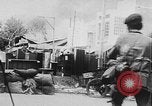
Soldiers fire rifles, machine guns and other weapons in Saigon, Vietnam during the Vietnam War.
A film on the 1968 Tet Offensive on Saigon, Vietnam during the Vietnam War. Damaged buildings and wrecked equipment in an area. Soldiers fire rifles. M113 APC. Smoke rises from firing and bombardment. Civilians are evacuated by the soldiers. A soldier talks over a phone. Soldiers fire rifles. They fire machine guns and other guns. 3rd Airborne Battle Group
CRITICALPAST.COM: About Us | Contact Us | FAQs - How to Order | License Agreement | My Account | My Lightboxes | Shopping Cart | Advanced Search | Featured Collections | Website Terms & Conditions | Privacy Policy ©2026 CriticalPast LLC.
License Agreement |
Terms & Conditions |
Privacy Policy
©2026 CriticalPast LLC.