


 Francais
 Deutsch
 Italiano
Refine Your Search
M4-training stock footage and images
- Showing 7189 to 7194 of 8218 results more
more Hide
Hide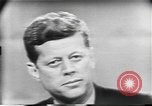
Kennedy states the reasons of failure of passing of Congress bills during a presidential election debate in Chicago, Illinois.
The first Kennedy-Nixon Presidential Debate in Chicago, Illinois. Sander Vanocur from NBC News asks Democratic candidate Senator John F Kennedy about the failure in passing the Congress bills on medical aid to the aged, minimum hourly wage bill and federal aid to education. Kennedy answers and states that his bill to provide a dollar twenty-five cent minimum wage failed because the House of Representatives did not pass it and the House failed by eleven votes. He states the reasons for the the failure of the federal aid to education bill and medical aid to aged bill in the Senate due to lack of votes and U.S. President's Veto power. Republican candidate U.S. Vice President Richard M. Nixon presents his views and disagrees with the statements made by Kennedy regarding action of the House Rules Committee and veto power of the President. He states that the majority of the members of the Congress agreement to the proposals leads to the clearance of a bill. He says that the reason for the failure of these bills was not the President but the people who were against it. He talks about his alternative proposals.
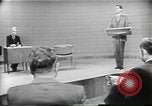
During a presidential election debate in Chicago, Illinois Nixon states that he hopes to control the House and get a majority.
The first Kennedy-Nixon Presidential Debate in Chicago, Illinois. Bob Fleming from ABC News asks Republican candidate U.S. Vice President Richard M. Nixon whether he could work better with Democratic majorities in the House and Senate than Senator Kennedy. Nixon answers and says that he hopes to control the House and to get a majority in the House in the elections. He states that the President cannot control the Senate and the President needs the support of the country and people to get his programs accomplished. He says that whenever a majority of the people are in favor of a program, the House and the Senate respond to it and it does not matter if the House and the Senate in the next session is Democratic or Republican. He disagrees with the reason of a presidential veto by Kennedy. Democratic candidate Senator John F Kennedy presents his views. Kennedy talks about the bill for minimum hourly wage system against which the Republicans voted. He then talks about the federal aid to education bill which failed because the Republicans did not vote for it. He talks about the third bill of medical care for the aged which is tied to Social Security, which is financed out of Social Security funds and it does not put a deficit on the Treasury. Kennedy concludes that these are three programs which are quite moderate and not extreme.
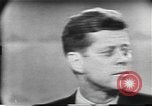
During a presidential election debate in Chicago Kennedy talks about the threats of Communism to the national security.
The first Kennedy-Nixon Presidential Debate in Chicago, Illinois. Charles Warren from Mutual News asks Democratic candidate Senator John F Kennedy about the threats of Communism to the national security of the United States. Kennedy states that matter of Communism should be given great care and attention. He states that the citizens should support the laws passed by the United States and they should sustain the Department of Justice and the Federal Bureau of Investigation (FBI) in its efforts. He further states that the Americans can meet any internal threat but the major threat is external. Republican candidate U.S. Vice President Richard M. Nixon presents his views and states that he agrees with Senator Kennedy's appraisal generally in this respect. He talks about the Cold War. He states that they could also fight Communism at home by moving against those various injustices which exist in their society which the Communists feed upon.
Presidential election debate in Washington DC. Richard Nixon, debating John F. Kennedy, speaks about the spread of Communism.
The second Kennedy-Nixon Presidential Debate in Washington DC, United States. Moderator Frank McGee introduces the candidates - Republican candidate U.S. Vice President Richard M. Nixon and Democratic candidate Senator John F Kennedy. The Moderator tells the rules to the candidates regarding questioning by the reporters. The reporters include Paul Niven, Edward P. Morgan, Alvin Spivak, and Harold R. Levy. Paul Niven asks Nixon to comment on whether Truman Administration was responsible for the loss of China to the Communists. Nixon answers and says that he disagrees with Senator Kennedy's statement that Cuba is lost and certainly China was lost because of Truman Administration. He talks about the decrease in the number of dictators in Southern and Central America in the past years. He speaks about Kennedy's book 'The Strategy for Peace' which prohibits the Americans from interfering in internal affairs of any other state. Kennedy presents his views and says that he never suggested that Cuba was lost. He criticized Nixon because in his press conference in Havana in 1955, he praised the competence and stability of the Batista dictatorship. He criticized the failure of the administration to use its great influence to persuade the Cuban government to hold free elections. He hopes that some day Cuba would rise if the U.S. changes its policies towards it.
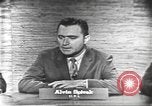
Richard Nixon and John Kennedy answer reporters' questions during a presidential election debate in Washington DC, U.S.
The second Kennedy-Nixon Presidential Debate in Washington DC, United States. Alvin Spivak of United Press International asks Republican candidate U.S. Vice President Richard M. Nixon to comment on his intentions in the field of civil rights. Nixon answers and states that progress is to be made in the field of employment by giving statutory authority to the Committee on Government Contracts. He states that in the field of schools, provisions should be laid whereby the federal government would give assistance to districts who want to integrate their schools. He speaks about presidential leadership. He concludes and says that the civil rights of the Americans should be recognized in order to protect the country from communist rule. Democratic candidate Senator John F Kennedy points that Nixon hasn't discussed what would be his policy on implementing the Supreme Court decision of 1954 and what would he do and what would be his leadership in providing fair employment, housing and education. He concludes by saying that the president must establish a moral leadership. Harold R. Levy of Newsday asks Kennedy to comment on what the President should do in racial discrimination events such as Little Rock Nine or the lunch-counter sit-ins. Kennedy says that he thinks that a president operates in different areas as a legislative leader, an executive leader and a moral leader and his functions differ in each area. He talks about the government contracts. He speaks about the standards set by the Americans which the Communists don't set. He comments on the case of Little Rock and says the U.S. President should go with the Supreme Court's decision. Nixon comments on the matter of the Committee on Government Contracts being mentioned by Kennedy. He talks about the functions of the Democratic Congress. He states that actions are required along with hopes. He concludes and says that in the field of executive leadership, U.S. president must lead and act as he talks.
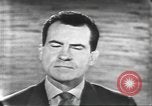
Nixon and Kennedy comment on the Cold War and Communist prestige during a presidential election debate in Washington DC.
The second Kennedy-Nixon Presidential Debate in Washington DC, United States. Edward P. Morgan of ABC News asks Republican candidate U.S. Vice President Richard M. Nixon to comment on whether the United States was doing well in the Cold War. Nixon states that they were not doing as well as they should have in the Cold War because of the presence of the Communists on the international scene. He says that the Communist prestige in the world is lower than the American prestige. He comments on cost cuttings on programs like mutual security and defense by the Democratic Congresses. Democratic candidate Senator John F Kennedy disagrees with Nixon's statement that the Congress has not provided funds for national defense. He also disagrees on the question of U.S. position in the United Nations. He mentions that various reports of Congressional committees indicate that the relative strength of the U.S. compared to that of the Soviet Union and the Chinese Communists together has deteriorated in the past years. Alvin Spivak of United Press International asks Kennedy how the losing prestige can be regained, and programs accomplished without damaging economy. Kennedy talks about the breaking off of the sugar quota with Cuba, passing of an authorization, and the development of the Inter-American Bank. He states that the U.S. has looked at the needs of Latin America. He states that instead of concentrating aid on surplus military equipment in Laos, the aid should have been concentrated in long-term loans. He concludes that Americans should identify themselves not only with the anti-Communist fight but also with the fight against poverty and hunger. Nixon presents his views and states that along with the necessity for economic assistance, the need for technical assistance should also be developed. Americans should not only think in terms of fighting Communism but also in terms of the interests of these countries. He concludes and mentions American ideals of independence, right of freedom and right of progress.
CRITICALPAST.COM: About Us | Contact Us | FAQs - How to Order | License Agreement | My Account | My Lightboxes | Shopping Cart | Advanced Search | Featured Collections | Website Terms & Conditions | Privacy Policy ©2026 CriticalPast LLC.
License Agreement |
Terms & Conditions |
Privacy Policy
©2026 CriticalPast LLC.