


 Francais
 Deutsch
 Italiano
Refine Your Search
M4-training stock footage and images
- Showing 7231 to 7236 of 8218 results more
more Hide
Hide
Boy Scouts visit the Pentagon building and meet U.S. Secretary of Defense James Forrestal during Boy Scout Week 1949.
Eagle Scouts from the 12 regions of the Boy Scouts of America visit the Pentagon building in Arlington Virginia during Boy Scout Week 1949 (celebrating the 39th anniversary of the Boy Scouts of America). The group of Boy Scouts on the steps of the Pentagon building. The Boy Scouts look around at the building and surroundings. The scouts walk up the stairs and enter the Pentagon building. U.S. Secretary of Defense James Forrestal seated in his office. The Defense Secretary meets with the scouts and talks to them. He shakes hands with various Boy Scouts. The 12 scouts in the group are: Alan Fritts of Troop 11 in Mankato, Minnesota; Andrew L. Clement, senior patrol leader of Troop 2 in Raleigh, North Carolina; George Barron of Troop 17 in Franklin, Virginia; Daniel Abbott of Senior Outfit 16, in Newtonville, Massachusetts; James Roswurm of Troop 31 in Huron, Ohio; Charles S. Wilson of Troop 3, in Bristol Tennessee; H. Cumings Johnson of Senior Outfit 230 in Traverse City, Michigan; Joseph L. Cox of Troop 98 in Trenton, Missouri; Howard M. Williams of Explorer Post 345 in Houston, Texas; James C. Vincent of Sea Scout Ship 232 in Brookings, Oregon; James E. Gill of Air Scout Squadron 234 in Berkeley, California; L. Drury Cathers of Troop 22 in Gouverneur, New York.
U.S. Army Brigadier General Prichard talking to Boy Scouts in his office at the Pentagon building in Arlington County, Virginia.
Eagle rank Boy Scouts representing the 12 regions of the Boy Scouts of America visit the Pentagon building in Arlington County, Virginia, during Boy Scout Week 1949. The interiors of the office of U.S. Army Brigadier General Vernon E Prichard. Boy Scouts arrive in the office and meet Brigadier General Prichard. A wall map in the background. Brigadier General Prichard speaks to the boys. The Vice Chief of Staff General Joseph Lawton Collins, talking to the boys in his office. The 12 Boy Scout representatives are: Alan Fritts of Troop 11 in Mankato, Minnesota; Andrew L. Clement, senior patrol leader of Troop 2 in Raleigh, North Carolina; George Barron of Troop 17 in Franklin, Virginia; Daniel Abbott of Senior Outfit 16, in Newtonville, Massachusetts; James Roswurm of Troop 31 in Huron, Ohio; Charles S. Wilson of Troop 3, in Bristol Tennessee; H. Cumings Johnson of Senior Outfit 230 in Traverse City, Michigan; Joseph L. Cox of Troop 98 in Trenton, Missouri; Howard M. Williams of Explorer Post 345 in Houston, Texas; James C. Vincent of Sea Scout Ship 232 in Brookings, Oregon; James E. Gill of Air Scout Squadron 234 in Berkeley, California; L. Drury Cathers of Troop 22 in Gouverneur, New York.
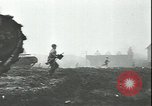
The U.S. Army Signal Corps in War and Peace. Descriptions and demonstrations of VT (proximity-fused) munitions
Opening scene shows troops of the U.S. Army 101st Airborne Division engaged at Bastogne, Belgium, during the Battle of the Bulge, in 1944, during World War II. They advance through fires and set up defenses in buildings, firing rifles from apartment windows. Outside, riflemen fire from behind a concrete barrier. Closeup of one firing his M1 Garand rifle. Glimpses of infantry firing mortars and walls falling to mortar fire. Gun crews firing heavy field artillery pieces, some under camouflage nets and others in the open. Intervening slate reads: "VT." and introduces postwar discussion of Signal Corps-developed proximity fuse, using animated cartoon. Shows how it proximity shells increase their explosive envelope compared to regular time fused munitions. U.S. Army gunner fire a number of proximity shells that burst above ground targets in the distance. A cartoon shows the proximity fused munition being used by a fighter aircraft. A Republic P-47 fighter plane is seen firing VT munitions from guns in its wings. Aerial bombs falling. A line of VT bombs exploding above ground.

U.S. soldiers of the 415th Regiment, 104th Infantry Division firing 60 mm mortar in Cologne, Germany (WW2)
The United States Army 415th Regiment, 104th Infantry Division in Cologne, Germany during World War II. Destroyed buildings along a street in Cologne. Soldiers advancing through the street. The soldiers fire rifles from inside buildings. The artillery crew firing 60 mm mortar. A U.S. soldier gently removing rings from hands of a wounded German prisoner. United States Army soldier places a captured German weapon on the ground directly in front of the tread on M10 tank destroyer which then rolls over it. Debris on the street. Prisoners of war marching on the street.
Allied patrol boats and ships underway and barrage balloons in flight overhead during the invasion of Normandy.
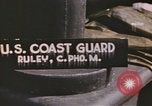
The Allied invasion of Normandy during World War II. A sign reads: 'US Coast Guard Ruley C.Pho.M.'. Coast Guard Cutter, Task Force and barrage balloons in the background. Men working on a ship. They hold up canned Vienna sausages on the main deck of the ship. Vienna sausages are taken out of can and put onto tray. Deep cliff that drops down to the sea. Landing Craft Vehicle Personnel (LCVP) underway in the background. Landing Craft Infantry (LCI) loaded with troops. Sunken ships in the background. Sunken boat with Landing Craft Mechanized (LCM) alongside. British trawler with two barges behind it. Patrol boat, sunken ships and another patrol boat in the background. LCI washed upon the beach at Normandy.
British and American landing craft and sunken ships underway at sea during the invasion of Normandy.
The Allied invasion of Normandy during World War II. A sign reads: 'US Coast Guard Ruley C.Pho.M.'. Coast Guard patrol boats underway. Sunken ship in the background. Bow section of the patrol boat. British LCT and two American LCTs underway. Sunken liberty ship in the background. Waves washing over the sunken ship. Landing craft in very rough water. LCT anchored. Waves breaking over the stern.
CRITICALPAST.COM: About Us | Contact Us | FAQs - How to Order | License Agreement | My Account | My Lightboxes | Shopping Cart | Advanced Search | Featured Collections | Website Terms & Conditions | Privacy Policy ©2026 CriticalPast LLC.
License Agreement |
Terms & Conditions |
Privacy Policy
©2026 CriticalPast LLC.