


 Francais
 Deutsch
 Italiano
Refine Your Search
M4-training stock footage and images
- Showing 745 to 750 of 8218 results more
more Hide
Hide
Depicts Korean suffering under Japanese occupation from 1910 through end of World War II
Korean propaganda film depicting suffering of the Korean people under Japanese occupation prior to and through World War 2. Korean citizens answering questions of Japanese civilian officials during period of Japanese occupation before World War 2. Japanese warship carrying Nakajima E4N bi-wing scout plane. Steel truss bridge being bombed. Koreans being forcibly recruited to fight for Japan. Koreans being tortured and imprisoned at hands of Japanese. Aircraft dropping bombs on ground targets. Slate announces August 9, 1945, marking the Soviet invasion of Japanese occupied areas, including North Korea, in World War II. Destroyers dropping depth charges. Battleships firing heavy guns. Soviet infantry rushing from a ship to engage Japanese forces. Soviet soldier offloading an M1910 Maxim Sokolov Machine gun onto a pier. Amphibious assault by Soviet forces. Artillery barrages. Explosions and smoke. Soviet infantry attacking industrial facilities and planting the Red flag on a hilltop in a rural area. Japanese troops surrendering to Soviet soldiers. Fallen Japanese gunner in gun position with shell in his hands. Numerous other fallen Japanese soldiers. Captured Japanese weapons and war materiel, including many swords. Japanese prisoners of war seated in an open area. Various destroyed Korean buildings and temples. Denuded trees in war zone. August 15th, 1945, shows Japanese citizens listening to a loudspeaker broadcast by Emperor Hirohito, announcing the surrender of Japan, and end of World War II. Shackles are removed from Korean prisoners. Koreans celebrate in the streets. The Korean flag flies from houses in a village. Korean people march, sing, and cheer everywhere in the country. A seated band of musicians plays. Scene shifts to the deck of the battleship USS Missouri, where Japanese Foreign Minister Mamoru Shigemitsu in formal attire sits to sign documents of surrender. General Douglas MacArthur, and other senior allied officers, stand nearby as Soviet Lieutenant General Kuzma Nikolaevish Derevyanko sits to sign for the USSR. Japanese civilians living in Korea, during the Japanese occupation, are seen moving with their belongings, to be relocated back in Japan.
President Coolidge welcomes the U.S. Army Air Service round-the-world fliers in Washington DC, United States.
Two Douglas World Cruiser airplanes land at Bolling Field, Washington, DC, to be welcomed by U.S. President Calvin Coolidge, in recognition of their round-the-world flight completed on September 28, 1924, at Seattle, Washington. Major General Mason M. Patrick, Chief of the Army Air Service, signals with his arm to guide them to a parking place, as they taxi in after landing. The two aircraft park next to one another. Next, a welcoming committee is seen standing, with the President (dressed in a rain slicker). Secretary of War, John W. Weeks stands to the President's left. To Coolidge's right, are 1st Lieutenant Leigh P. Wade (pilot);1st Lieutenant Leslie P. Arnold (co-pilot); 1st Lieutenant Lowell H. Smith (pilot, and flight commander); and SSgt. Henry H. Ogden (flight mechanic). Closeup of President Coolidge with Lieutenant Smith in front of one of the aircraft. Scene shifts back again to the larger group, with Lieutenant Wade and Coolidge shaking hands with the four flyers, starting with Lieutenant Wade. Secretary Weeks shakes hands with General Patrick, who has donned a flying coverall. Then Weeks shakes the hands of the flyers and they proceed away from the gathering. Change of scene shows Lieutenant Smith perched on the wing of his aircraft, the "Chicago,"conversing with the President and Secretary Weeks. He gets down and continues his conversation with Coolidge, who touches a propeller blade at one point. Final scene shows a two seater DH-4 airplane taking off from Bolling field.
Lieutenant Cyrus Bettis and Lieutenant Jimmy Doolittle win air races in 1925.
In October 1925, crowd gathered to watch the Pulitzer Trophy air races at Mitchel Field, Long Island, New York. VIPs arrive in various automobiles. Army Air Service Curtiss R3C-1 airplane is pushed onto the field. Air Service Chief, General Patrick , speaks with Lieutenant Cyrus Bettis as Lieutenant James Doolittle listens. A Navy crew works on their entry in the race, similar to the Army Air Service airplane. Navy Lieutenant Al Williams seen with a pipe upside down in his mouth. Lieutenant Bettis taxis out for takeoff in his airplane number 43. Then Navy Lt. Williams proceeds to take off in his aircraft, number 40. Lt. Bettis breaks ground and begins to fly the closed course, coming very close to the ground at times. He lands and climbs out of the cockpit, surrounded by spectators and officials who are convinced he has won, registering a speed of 249 miles per hour. Navy Lt. Williams lands shortly thereafter having averaged 242 miles per hour. He is greeted by several spectators, including a young woman. Two weeks later, the U.S. Army was represented by Lieutenant Jimmy Doolittle, who flew the Curtis R3C-1, again, but this time fitted with floats, at the Schneider Cup Seaplane Race in Baltimore, Maryland. He shakes hands with a young woman, just before the race. The Navy also entered with a similar seaplane, shown being pushed into the water. The British entry, a Glouster-Mapier IIIA is seen (replacing the Supermarine-Napier S.4, that was damaged). The Italian Macci M.33 is seen on a dock with engine running. The float planes taxi out over the Chesapeake bay waters to takeoff position. Doolittle is the first to take off and to return, logging an average speed of 232 miles per hour. He is seen smiling after the race.
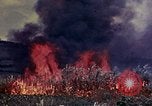
Japanese soldier catching fire in bushes which was burning due to attack by U.S. flamethrower tank in Okinawa.
Flamethrower tank burns bushes in Okinawa. Muzzle of tank flamethrower shooting flames on grass. U.S. Marines riding on M4A2 tank advance toward grass. View of Japanese soldier on fire. He crawls and runs through heavy grass trying to put fire out with hands over his head. Marines with Thompson Sub-Machine gun walks forward to search him. Japanese soldier lay on ground. Several Marines kneeling over him bandage cuts. Flamethrower tank moves in toward grass. (World War II period).
United States 6th Battalion tanks dig in at edge of large open area in Okinawa.
Marines of 6th Marine Regiment 22nd Marines advance in Okinawa. M4A2 tanks move along road. 6th Battalion tanks dig in at edge of large open area.
Artillery fire directed on hills on the far side of mud flats in Okinawa.
U.S. Marines destroy enemy fortifications in Okinawa. Fire directed on hills on the far side of mud flats. Dead horse in the mud. Mud flats as water begin to come in and cover them. Smoke from artillery fire directed on hills in the background. Water rises around an abandoned vehicle. M4A2 tank half submerged in water. (World War II period).
CRITICALPAST.COM: About Us | Contact Us | FAQs - How to Order | License Agreement | My Account | My Lightboxes | Shopping Cart | Advanced Search | Featured Collections | Website Terms & Conditions | Privacy Policy ©2026 CriticalPast LLC.
License Agreement |
Terms & Conditions |
Privacy Policy
©2026 CriticalPast LLC.