


 Francais
 Deutsch
 Italiano
Refine Your Search
M4-training stock footage and images
- Showing 7693 to 7698 of 8218 results more
more Hide
Hide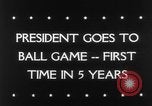
President Harry Truman attends baseball game between St. Louis Browns and Washington Senators in September 1945
U.S. President Harry Truman arrives at Washington's Griffith Stadium in a car flanked by several Secret Service agents. Announcer notes this is the first time a president has attended a baseball game since the start of World War Two. President Truman and first lady Bess Truman take seats. Truman signs an autograph. Truman, a lefty, receives baseball from Washington Senators' manager Ossie Bluege and throws out the ceremonial first pitch. Also in attendance is the commissioner of baseball, Albert "Happy" Chandler. Game begins as visiting St. Louis Browns take the field. The Senators' second baseman George Myatt gets a hit to advance George Case. Washington star Cecil Travis (playing in his very first game since returning from 3+ years military service) makes an infield out but drives in the Senators' first run. Washington goes on to win the game 4-1.
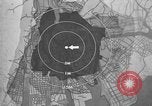
Damage in the range of 1 mile to 6 miles from impact in Hiroshima, following atomic bomb attack in Japan.
Damage in Hiroshima, Japan after the atomic bomb attack in August 1945. Views within 1 mile to 1.5 miles from center and 1.5 to 2 and 2 to 6 miles. Damaged wooden buildings in the 1.5 mile range. Damaged Hirosaki railway station. Damaged buildings. A steel beam twisted out of shape and a center wall stand undamaged. Building of a school with its north wall specially damaged. The school building is not damaged. A bent high school wall. Shattered glasses of a chapel on a hill 4 miles away from the center. (World War II period).
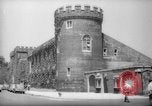
Dr. Enrico Fermi and assistants reenact experiments at site of the Chicago Pile-1 (CP-1) nuclear reactor, University of Chicago
Men walking towards the West Stands of Stagg Field, where the Institute for the Study of Metals, occupies the southern half of the abandoned stands. To the North, where the center of the building protrudes toward Ellis Avenue, is the squash court area in which the famous Chicago Pile number 1 was built, and achieved controlled, sustained nuclear fission, on December 2, 1942. Scene shifts to different area where a sign reads: "5655, Institute for the Study of Metals, Delivery Entrance." Scene shifts again, to Dr. Enrico Fermi and two assistants in front of a facsimile of the Chicago Pile 1. One assistant holds a simulated "control rod" that he "withdraws" from from the pile, while Dr. Fermi glances at a geiger counter and makes notes in a book. This is repeated for several takes, including one taken much closer. Dr.Fermi and his assistant smile as they take these actions. The second assistant, sits at a desk, where a slide rule is visible, and makes notes in a book. A large geiger counter is seen with lights flashing. Above the lights the counter is labeled "Interpolation," and the numbers: 1,2,4,16, and 32 appear above the lights, respectively. Dr. Fermi is then seen in another part of the lab, where he is making adjustments on some unseen device and annotating a book. Piping of various sizes is seen in background. He repeats these actions a number of times for the camera.
Vietnamese civilians in a village as children build a pen and men carry coconuts in Vietnam.
Civilian life in Vietnam early in Vietnam War. Animated earth revolves. Map shows area of Burma, Laos, Thailand, Cambodia and the Philippines. Terrain in Vietnam. Fishing boat up to the beach. Beach area. Bombed bridge over a river. Villagers walk on a pathway. Roadway leading through heavy foliage. Children build a pen towards the back of their home. Children who are 4-H club members and a boy. Two villagers carry coconuts.
Radar for establishing contact with the moon reflects rays back on the earth from the moon in United States.
U.S. Army radar equipment used to contact the moon. Steel structure of a radar. Men work at controls. Moon in the background of the radar. Animation shows distance of moon and earth being 238000 miles. Radar beam reaches to the earth in 2.4 seconds. Radar rays go to moon and comes back to earth after reflecting. Readings of radar shows signals. Picture of the surface of the moon. Narrator says, "no longer beyond men's dreaming is the possibility of reusable airplane-like space ships to commute between the two planets (the earth and the moon)" as animation shows an aircraft space ship flying from the earth to the moon (foreshadowing the NASA Space Shuttle program).
German Junkers JU-29 and U.S. P-80 shown on Air Force Day at Wright Field in 1945. Orville Wright attends the event
Celebration of the 38th anniversary of the U.S. Army Air Forces, dating back to establishment of the Aeronautical Section of the U.S. Army Signal Corps, in 1907. Airmen of the Army Air Forces march in formation on the flight line at Wright Field in Dayton,Ohio. Aviation pioneer, Orville Wright, is seen in the reviewing stand. A color guard marches past the the reviewing stand. A 4-engine German Junkers JU-290 transport aircraft is seen parked on the field. (It arrived on July 31, 1945, after being flown to Wright Field from Europe, by U.S. Air Forces Colonel Harold E. Watson and co-pilot Captain Fred McIntosh,who were delivering it to Air Technical Intelligence Headquarters.) The crew of the JU-290 (named "Alles Kaputt") pose in front of it. Colonel Watson, is seen holding a Dachshund dog. The JU-290 takes off on a demonstration flight. A new U.S. P-80 "Shooting Star" jet airplane (serial number 44-84995) is rolled out for all to see. It takes off in a demonstration flight. (Late in World War 2.)
CRITICALPAST.COM: About Us | Contact Us | FAQs - How to Order | License Agreement | My Account | My Lightboxes | Shopping Cart | Advanced Search | Featured Collections | Website Terms & Conditions | Privacy Policy ©2026 CriticalPast LLC.
License Agreement |
Terms & Conditions |
Privacy Policy
©2026 CriticalPast LLC.