


 Francais
 Deutsch
 Italiano
Refine Your Search
M4-training stock footage and images
- Showing 7723 to 7728 of 8218 results more
more Hide
Hide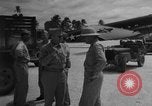
Marine Major General HM Smith and Air Force Major General Willis H Hale on Tarawa
After the battle of Tarawa in Pacific Theater. Marine Major General HM Smith and Air Force Major General Willis H Hale, commander of the 7th Army Air Force, talk to each other on a beach in Tarawa. Two Air Force officers talk to Army nurses. Officers enter R4D plane. (World War II period).
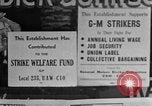
General Motors (GM) engages Detroit police to stop UAW-CIO picketing during strike. GM then obtains State Court injunction against picketing.
Film begins showing signs in business establishment window supporting General Motors strikers of Local 235 UAW-CIO. A siren in heard as the camera pans over a large group of uniformed Detroit City police officers, some on motorcycles. Across the street, several striking picketers carry signs, as another large group of police officers stand nearby. Closeup of a black maria police van parked next to a formation of mounted police officers. Closeup glimpse of an officers gun belt and cartridges. Camera pans over the congregation of police. Street filled with strikers carrying signs. Police allow only 4 picketers, who cross from the street in which they are gathered, to the city of Hamtramick at the Detroit border. Camera pans over Police gathered at the corner, as a line of striking women snakes around a telephone pold at the Detroit-Hamtramick border, to picket in the latter city. A group of 10 pickets is allowed by police to enter Hamtramick from the Detroit street. Next, a number of strikers' children challenges the police to cross the intercity boundary. Closeup of a father and small son. Men, women, and children are finally seen picketing in Hamtramick. Slate reads: "Steering Gear." (Narrator says: "Chevrolet Gear and Axle remains closed.") Next, a court proclamation is read in rapid fire declaration by a crier in front of a court building where some strikers stand on the steps reading the announcement. Closeup of the State of Michigan court order prohibiting picketing and union members discussing it. Scene shifts to a union meeting room where members ask about the injunction and discuss its impact.
Korean hardships under Japanese occupation and official Japanese annexation of Korea in 1910
Korean propaganda film depicting Japanese involvement in Korea, from end of Russo-Japanese war through post annexation in 1910. Landscape scenes of Korea. A 4-stacker Japanese troop ship, in a Korean harbor, flying the rising sun flag. Japanese troops disembarking, and marching off the pier. Japanese atrocities committed against the Korean people. Still pictures of Japanese officers. Slate highlights August 10, 1910, the date that Japan officially annexed Korea. Images show Korean flag being replaced by that of Japan. Panning views over rooftops of residential neighborhood and buildings in Nam San Dong, Seoul. Scene shifts to poorer rural area village with straw-roofed huts. Men till rice fields and irrigate fields by manpower alone. Views of various farm crops in the fields. Women are seen harvesting crops. In village, peasants thresh grains by hand. Officials arrive to weigh and take rice from village.Narrator states that the Japanese were everywhere and treated the Korean people very badly.Burlap bags of grain piled on cart. Korean workers load farm products for shipment to Japan. Various cargoes of Korean products being moved by rail to ports for shipment to Japan. Korean women and some children at work in fabric mills. Korean men at work in smelting plant. Many Korean men laboring on rock piles, and carrying heavy logs. One man collapses. Another collapses while working in surface mining. Supervisor chases others who try to assist him. (Note:This film, which contains some very old historic footage, is attributed to the War Department Military Intelligence Division, and was probably produced circa 1940. It is listed as 1910 because Japanese annexation and related events are included herein.)
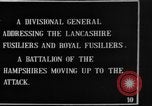
British General addresses soldiers before the Battle of the Somme in France during World War I
British Army at the Battle of Somme in France during World War 1. A Divisional General mounted on a horse addresses the Lancashire Fusiliers and Royal fusiliers and a Battalion of the Hampshire Regiment before the Battle of the Somme in France. British gunners firing 4.7 inch (120 mm) guns at very low elevation (almost point blank direct fire). As the guns fire, the recoil drives them back considerably on their heavy wheels, which are arrested by chocks.
Various Aircraft tow gliders during World War II.
Preparations for Allied invasion of Normandy, France during World War II. During Glider development programs, gliders come in for landing towards stake to which white flag is tied. B-25 takes off as it tows a CG-4A glider. P-38, PBY-5A, B-17 and C-54 aircraft take off as they tow gliders. C-54 takes off as it tows three gliders (a "triple tow") and aircraft in flight.
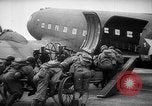
Equipment loaded in planes and gliders for Allied invasion during World War II.
Preparations for allied D-Day invasion of Normandy, France during World War II. United States Air Borne Aviation Engineers load equipment in a C-47 aircraft. An engineer backs a tractor in a glider. Men and equipment moved across a field and loaded into CG-4A glider. Men raise rear section of equipment up for loading into a ramp. Nose section of a glider raise for loading vehicles into front end. Men and equipment in preparation for fast loading. Jeep backed into front end of loading ramp of a glider. A trailer, small canon and a carriage loaded into a glider. A pilot walks into the plane and takes over controls.
CRITICALPAST.COM: About Us | Contact Us | FAQs - How to Order | License Agreement | My Account | My Lightboxes | Shopping Cart | Advanced Search | Featured Collections | Website Terms & Conditions | Privacy Policy ©2026 CriticalPast LLC.
License Agreement |
Terms & Conditions |
Privacy Policy
©2026 CriticalPast LLC.