


 Francais
 Deutsch
 Italiano

Refine Your Search
M4-training stock footage and images
- Showing 7939 to 7944 of 8248 results more
 Hide
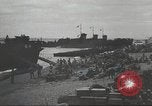
U.S. forces prepare for attack against Japanese forces on Munda, readying supplies, troops, and aircraft.
Planning and moving of U.S. equipment, supplies, aircraft, and soldiers in preparation for attack at Munda Point on New Georgia Islands, Solomon Islands during World War 2. U.S. Marines and infantry massed up on Guadalcanal beach prepare for the invasion of Munda Point. Gasoline barrels are rolled on the beach. Crated food in cargo nets hoisted aboard ships. Equipment is loaded onto ships. U.S. combat aircraft assemble for an aerial offensive. U.S. Army General Douglas MacArthur exits car and talks with another U.S. officer. General MacArthur, U.S. 13th Air Force Lieutenant General Hubert R. Harmon, U.S. Army Air Force General Nathan Twining and U.S. Fleet Admiral William Halsey plan the attack on Munda Point. United States Army Air Force P-40 Warhawk fighters taxi and take off from an airfield. U.S. aircraft including P-40 Warhawk, P-39 Airacobra, U.S. Navy F4F Wildcat, TBF Avenger, B-25 Mitchell and B-24 Liberator aircraft in flight heading to destroy enemy positions on Munda. Japanese aircraft seen taking off and in flight.
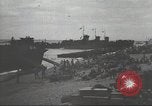
General MacArthur, General Hubert R. Harmon, Nathan Twining and Fleet Admiral William Halsey plan an attack on Munda.
The U.S. Army plans an attack at Munda Point on New Georgia group of Islands, Solomon Islands during World War II. U.S. Marines and infantry massed up on Guadalcanal beach prepare for the invasion of Munda Point. Gasoline barrels rolled on the beach. Crated and canned foods in cargo nets hoisted aboard ships. Equipment is loaded onto ships. U.S. combat aircraft assemble for an aerial offensive. U.S. Army General Douglas MacArthur gets out of car and talks with another U.S. officer. General MacArthur, U.S. 13th Air Force Lieutenant General Hubert R. Harmon, U.S. Army Air Force General Nathan Twining and U.S. Fleet Admiral William Halsey coordinate the attack on Munda Point. U.S. Army Air Force P-40 Warhawk fighter aircraft taxi and take off from an airfield. U.S. planes including P-40 Warhawk, P-39 Airacobra, U.S. Navy F4F Wildcat, TBF Avenger, B-25 Mitchell, and B-24 Liberator aircraft in flight head to destroy Japanese enemy positions on Munda. Japanese aircraft take off and in flight.
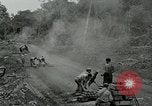
Vapor effects of persistent gas munitions are examined during various U.S. chemical warfare tests in San Jose Island, Panama.
Tests of persistent gas munitions during U.S. chemical warfare tests on San Jose Island, Panama during World War II. Chemical warfare tests shows U.S. troops firing 4.2 inch mortars and 105mm howitzers laying down a mustard gas barrage. Smoke rises from shell fire in the jungle. A technician examines a bombed area in the jungle. Vapor effects of persistent gas munitions are examined. Bodies of captured Japanese soldiers who were in the bombardment area are examined within three hours of the bombardment. U.S. troops without any protective clothing advance through the jungle area 48 hours after the bombardment. The troops fire mortars and howitzers.
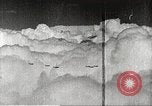
Montage of Japanese military aircraft used during 2nd Sino-Japanese War
Opening scene shows formation of Japanese Mitsubishi Ki-21 bombers in flight over altocumulus clouds. Change of scene shows several Kawasaki Ki-10 Biplane fighter directly overhead. Next, a Japanese Kawasaki Ki-10 engages a Chinese Fiat CR.32, in a dogfight, and shoots it down. The Fiat spirals down. Change of scene shows bombs or shells bursting on the ground followed by a Kawasaki Ki-10 climbing in cloudy sky. A Japanese single-engine high-wing liaison airplane in flight, displaying "28" on both wings. Another high-wing monoplane (this one with radial engine and wheels partly tucked into fuselage) flies past some trees. (Views of munitions exploding on the ground appear occasionally throughout the film between shots of aircraft.) A Kawasaki Ki-10 dropping bombs. Formation of Mitsubishi Ki-2 trimotor bombers in flight. Views of Chinese city with smoke rising from Japanese bombing. A formation of Japanese high wing monoplanes with radial engines and fixed landing gear, in flight, viewed from what might be gondola of an airship. A Formation of Navy Yokosuka B4Y (or Aichi D1A) biwing dive bombers in flight, viewed first, from the side, and then head-on from the tail of another airplane. Men's chorus sings martial songs in background during entire film.

Entire crew of the battleship Oklahoma in formation on deck during World War I.
A U.S. Navy commander and a Lieutenant Commander pose with a number of other officers on the deck of an anchored U.S. warship during World War 1. Low mountains and hills in the background. Aerial views of the U.S. Navy Battleship USS Oklahoma (BB-37) showing the entire ship's company on deck on deck in dress uniforms. Aerial view of the Oklahoma's stern clearly shows five 14 inch guns, three mounted in a turret on deck and two in a turret above. (The main armament of the Oklahoma consisted of ten 14inch guns mounted in 4 turrets - two forward and two aft. ) A U.S. Caldwell-class destroyer, in camouflage paint, underway in the harbor, at very slow speed, leaving practically no wake. (Note: The USS Oklahoma was one of three U.S. oil burning battleships stationed at Berehaven, Ireland, to guard trans-Atlantic troop convoys against a possible breakout of the German Battle Cruiser Force.The other ships were the USS Nevada and the USS Utah.)

United States battleship maneuvers near a Pacific ocean port
Rearward view from ship departing the scene, of U.S. warships in a Pacific harbor . Several commercial vessels moving about off the coast, including a 4-masted ship in the far distance. Sea condition is choppy, with whitecaps. View from stern of a large ship underway, with heavy wake behind. Two battleships maneuvering. Three warships maneuvering and a float plane descending to land near one. A battleship underway at high speed with heavy dense black smoke billowing from both stacks. The battleship (USS Oklahoma BB-37?) overtakes and passes the ship from which photos are being taken. Footage date is unknown; circa 1921.
CRITICALPAST.COM: About Us | Contact Us | FAQs - How to Order | License Agreement | My Account | My Lightboxes | Shopping Cart | Advanced Search | Featured Collections | Website Terms & Conditions | Privacy Policy ©2026 CriticalPast LLC.
License Agreement |
Terms & Conditions |
Privacy Policy
©2026 CriticalPast LLC.