


 Francais
 Deutsch
 Italiano
Refine Your Search
M4-training stock footage and images
- Showing 799 to 804 of 8223 results more
more Hide
Hide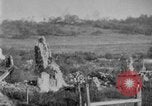
United States Army troops load shells and fire artillery on the Western Front during World War I.
U.S. artillerymen firing 155mm Howitzers M1917A4, in World War 1. The pieces are set up in several locations and conditions. Some are placed at edge of fields; others against berms; and several in ruins and rubble of buildings. Troops fire 155mm GPF heavy field gun, under cover of camouflage canopy.
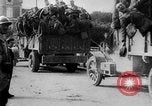
United States Army troops arrive in France ready for combat during World War I.
United States Army troops arrive and join with French forces during World War I. Open troop Trucks filled with American soldiers arriving in French town during World War 1. One of the soldiers clowns around, hanging off the truck. U.S. troops, armed with rifles, in a deep trench, watching one of their comrades firing his rifle over the top. Soldiers firing a Hotchkiss Model 1914 machine gun and a Vickers Mark I .303 water-cooled machine gun. French troops firing 320 mm railway guns. Artillery shells bursting on ground. Mortar Crew puts on gas masks and fires mortar. Artillerymen firing 155mm Howitzer M1917A4. Shells bursting on target in distance.
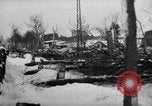
U.S. infantrymen search for German prisoners and soldier advance with bayonet rifle in St Vith,Belgium during World War II.
United States Army infantry soldiers attack St Vith,Belgium during World War II. View of the damaged buildings in town. Soldiers of the United States 7th Armored Division ,48th Infantry Regiment,3rd Battalion,search for German prisoners. Prisoner wears U.S. soldier's clothing and shoes. Captured German officer under guard. Soldier in a prone position fires Browning M1919A4 30 caliber air cooled machine gun. Soldier advances with bayonet rifle. Tank destroyers fire in support of advancing infantrymen.
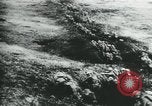
Numerous scenes showing evolution of mechanized warfare emphasizing World War I. but including footage as late as 1934
Montage of scenes illustrating development of mechanized warfare beginning with American Expeditionary Forces (AEF) engaged in World War I. U.S. Army infantry soldiers moving out of trenches going "over the top" into "no man's land" and advancing on battlefield. U.S. troops firing Browning M1917 machine gun,1903 Springfield rifles, and Stokes mortar from trench positions. Soldiers firing mortar are wearing gas masks. AEF trucks and other vehicles ostensibly an improvement over horses, but seen having difficulty in mud. A truck pulling a large artillery gun. A German 80cm K (E) rail gun (developed in 1934) shown at the Rugenwalde Test Range in Germany. It moves along curving rails and is elevated to its maximum elevation (65 degrees). Two World War 1 rail guns firing. An American World War I Naval 14-inch rail gun firing. Allied heavy howitzers firing in World War 1 (one with gun crew in gas masks). American gunners with a French 75 field piece and caisson. French soldier advancing in no-mans-land. The Wright brothers brought warfare into the air with their Wright Flyer airplane, seen being maneuvered on the ground by U.S. Army personnel at Fort Myer, Virginia in July 1909. A De Havilland DH-4 airplane taking off in World War I. A German Fokker D.VIII aircraft in flight. Three U.S. Army Air Service Curtiss P-1B Hawk pursuit aircraft in flight, circa 1926. Aerial dogfight scene including view from behind a pilot in open cockpit biplane (from feature film, circa 1927). Brief view of Renault FT tank maneuvering in World War I. Narrative and clips shift to historical perspective of warfare, showing use of horse and chariot, starting in ancient Assyria and use of elephants in later years by Hannibal. Pictures of mounted soldiers, in the middle ages, waging war in armor, and being transported in a wagon. Shift to World War I showing British Mark IV tanks maneuvering in a field.
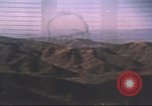
Montage of scenes from the Korean War
Montage of Korean War scenes. View of mountainous terrain in Korea, 1950. African American soldier yells, holding phone left hand, as gun crew fires a 240mm howitzer. American soldiers, in heavily sand-bagged position, firing 4.2 inch mortar. Gunners firing a quad .50 machine gun and others firing a 155mm howitzer and an M2 .50-caliber machine gun. American soldiers in sandbagged and camouflaged bunkers. An army patrol heading out from their defensive position. Barrels of artillery pieces silhouetted against the sky. Numerous bursts of artillery fire flashing in the black of night. Weary soldiers returning from a patrol.
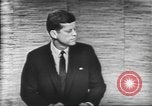
During a presidential election debate in Washington DC, Kennedy comments that its proper to express regrets to nations.
The second Kennedy-Nixon Presidential Debate in Washington DC, United States . Edward P. Morgan of ABC News asks Democratic candidate Senator John F Kennedy about sending apologies or regrets to General Secretary of the Communist Party of the Soviet Union Nikita S Khrushchev over the U-2 reconnaissance aircraft incident. Kennedy answers that if it could save the summit conference it would have been proper to express regrets. He speaks that the U-2 flights were proper from the point of view of protecting their security. But they were not in accordance with the international law. He speaks about the regrets expressed to Castro, to Southern Russia and to Eastern Germany under the Eisenhower Administration during the past years. He mentions the regrets expressed by the Soviet Union and the Chinese Communists to the U.S. over incidents. He states about they should have a stronger military force and should increase their strength all over the world. Republican candidate U.S. Vice President Richard M. Nixon presents his views and states that Senator Kennedy is wrong in thinking that Khrushchev might have continued with the summit conference if the U.S. had expressed regrets. He disagrees with Kennedy's analogies that the U.S. is a strong country and can express regrets for any wrong doings. He also disagrees in expressing regrets to anybody for doing things which has the support of the Congress and which is right from point of view to protect the security of the U.S. (This 4 part debate is sometimes called the Great Debate)
CRITICALPAST.COM: About Us | Contact Us | FAQs - How to Order | License Agreement | My Account | My Lightboxes | Shopping Cart | Advanced Search | Featured Collections | Website Terms & Conditions | Privacy Policy ©2026 CriticalPast LLC.
License Agreement |
Terms & Conditions |
Privacy Policy
©2026 CriticalPast LLC.