


 Francais
 Deutsch
 Italiano
Refine Your Search
M4-training stock footage and images
- Showing 793 to 798 of 8218 results more
more Hide
Hide
Allies bring reinforcements and supplies following the succesful establishment of beachheads during the invasion of Normandy, France, in World War II
Beachhead at Normandy, France, following the Allied invasion in June, 1944 during World War 2. Numerous supply ships are in the water offshore. Landing craft are all along the beach. Military vehicles fill the beach itself. British and American troops, ashore, observe ship maneuvering near a floating dock. British infantry pour from the open ramp of large British landing craft, behind some American troops already landed and walking along the shore. American soldiers aboard a landing craft next to a transport ship. Closeup of one of the soldiers in the craft, who wears "Screaming Eagle" patch of 101st Airborne Division. The open deck of an exceptionally large landing craft is seen jammed with U.S. troops, ready to depart from a transport ship. They wave for the camera. An American army truck driving out of British Landing Ship Tank (HM 415) onto a floating dock. It makes its way behind others headed toward the shore. Closeup of soldier wielding a sledge hammer to secure pierced steel plank (Marsden Matting) onto the beach. A DUKW (duck amphibious truck). German prisoners of war, disarmed and under guard, marching casually toward the beach. Closeups of some passing the camera. View from the beach of some wading out to a waiting landing craft. View on the beach of others approaching the beach for evacuation. View shifts to captured German film depicting German coastal defenses and structures of the so-called "Atlantic Wall." German Field Marshal, Erwin Rommel, accompanied by Field Marshal, Gerd von Rundstedt, as they inspect the fortifications. Views of coastal guns. Several German soldiers, using a 4-wheel dolly, roll a huge shell and powder charge out of a bunker. They roll it toward a camouflaged railway gun. German soldiers climbing steel stairs up to the railway gun and hand-cranking the barrel into firing elevation. Marshal Rommel accompanied by a Navy admiral and a soldier, walks up to the twin barrels of a coastal defense gun. the pause directly in front of the barrels and converse. The Admiral and the soldier both salute, perhaps acknowledging a comment or order from Rommel. Extreme closeup of the gun barrels.Next, back on the beachhead, Briitish soldiers are seen walking along the beach past knocked out German fortifications and standing near other abandoned ones. A British soldier swings a sledge hammer a reinforced concrete structure on the beach. A French man and woman waving at American troops passing them. British soldiers riding in a British Universal Personnel Carrier, MK II. Two Frenchmen wave at the troops. In nearby town, British soldiers are happily greeted by local inhabitants, including a woman with a baby on the sidewalk; children looking out a window; and people gathered at a street corner. A British soldier holds a French boy and offers him a piece of candy. An American M7 ("Priest") self-propelled 105mm howitzer and armed with a 12.7mm anti-aircraft machine gun. It moves through an intersection controlled by an MP (military policeman). Another one named "Apache" follows it. Local French inhabitants cheering the Americans as they pass through the town. An American soldier stands near several children as a DUKW amphibious truck veers somewhat, to avoid them while passing. He bends down to talk to the children and shares some candy with them. Infantrymen walk into a town, keeping close to buildings on both sides of the street. French men,women, and children wave and show "V for Victory" signs as some military policemen walk past.
Explosions and smoke rise as U.S. soldiers fire artillery and dead soldiers in Guam.
American soldiers in Guam during the Battle of Guam. U.S. soldiers move into action. They fire artillery. M-4 tanks fire. Dead soldiers lying on ground. Explosions and smoke rise due to firing. Soldiers watch through binoculars. Explosions occur near Chamorro homes. Soldiers advance through ruins to atttack. (World War II period).
Japanese delegates reach Ie Shima, Ryukyu Islands and then advance towards Manila, Philippine Islands in the South East Asia.
Japanese surrender in Southeast Asia during World War II. Airplanes in formation flight. Two Japanese Mitsubishi G4M-1 'Betty' twin-engine bombers painted white with green crosses on their wings, fuselage and tail land at Ie Shima Ryukyu Islands near Okinawa carrying Japanese delegates. The planes land at Nichols Field at 1813 hours. The planes are dubbed 'Bataan number 1' and 'Bataan number 2.' Lt. Gen. Torasirou Kawabe, the vice chief of the Japanese Army's General Staff and his surrender party disembark from the airplanes. Members of the surrender party include Rear Admiral Ichiro Yokoyama Representative, Imperial Japanese Navy Staff., Colonel Yashima Terai General Staff, Colonel Orato Yamoto General Staff, Mr. Morio Yakawa Secretary, Japanese foreign office. Kawabe leads the surrender party. Army C-54 transport airplanes parked. Japanese surrender delegates board the airplanes which take off for Manila, Philippines. United States Army General Douglas MacArthur speaks to his troops from a balcony at the war damaged Manila City Hall (Padre Burgos Ave, Ermita, Manila, 1000 Metro Manila) on 20 August 1945. He notes that he is hopeful that they will all be able to return home soon.
United States Army troops load shells and fire artillery on the Western Front during World War I.
U.S. artillerymen firing 155mm Howitzers M1917A4, in World War 1. The pieces are set up in several locations and conditions. Some are placed at edge of fields; others against berms; and several in ruins and rubble of buildings. Troops fire 155mm GPF heavy field gun, under cover of camouflage canopy.
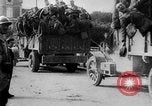
United States Army troops arrive in France ready for combat during World War I.
United States Army troops arrive and join with French forces during World War I. Open troop Trucks filled with American soldiers arriving in French town during World War 1. One of the soldiers clowns around, hanging off the truck. U.S. troops, armed with rifles, in a deep trench, watching one of their comrades firing his rifle over the top. Soldiers firing a Hotchkiss Model 1914 machine gun and a Vickers Mark I .303 water-cooled machine gun. French troops firing 320 mm railway guns. Artillery shells bursting on ground. Mortar Crew puts on gas masks and fires mortar. Artillerymen firing 155mm Howitzer M1917A4. Shells bursting on target in distance.
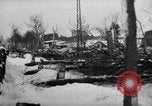
U.S. infantrymen search for German prisoners and soldier advance with bayonet rifle in St Vith,Belgium during World War II.
United States Army infantry soldiers attack St Vith,Belgium during World War II. View of the damaged buildings in town. Soldiers of the United States 7th Armored Division ,48th Infantry Regiment,3rd Battalion,search for German prisoners. Prisoner wears U.S. soldier's clothing and shoes. Captured German officer under guard. Soldier in a prone position fires Browning M1919A4 30 caliber air cooled machine gun. Soldier advances with bayonet rifle. Tank destroyers fire in support of advancing infantrymen.
CRITICALPAST.COM: About Us | Contact Us | FAQs - How to Order | License Agreement | My Account | My Lightboxes | Shopping Cart | Advanced Search | Featured Collections | Website Terms & Conditions | Privacy Policy ©2026 CriticalPast LLC.
License Agreement |
Terms & Conditions |
Privacy Policy
©2026 CriticalPast LLC.