


 Francais
 Deutsch
 Italiano
Refine Your Search
M4-training stock footage and images
- Showing 1333 to 1338 of 8223 results more
more Hide
Hide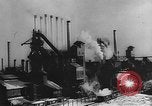
Events of 1947: Marshall plan aid; Communists demonstrating in Europe; meeting of the Big Four foreign ministers; the Freedom Train touring America
Industrial scenes in America with a factory with smoke from chimneys, a steel factory in operation, views of the tops of railroad train coal cars filled with coal. Secretary of State George Marshall speaks about providing European countries with material and money (Marshall Plan). He is seen speaking to legislators in Washington DC on November 10, 1947, asking for funds for Austria, Italy, and France "to provide the supplies necessary to permit the people of these countries to continue to eat, to work, and to survive the winter." Truman signs an interim aid bill, S 1774 on December 17, 1947. View of Eiffel Tower in Paris and communists marching and demonstrating in France. Communist demonstrations across Europe. French police monitor communist protestors in France and then disperse a crowd of communists. Narrator notes of similar communist demonstrations in Italy. Winston Churchill arrives for peace conference meeting of the Big Four foreign ministers in London in December 1947. Vyascheslav Molotov attends the conference. George Marshall talks with Molotov. View of the Friendship Train railroad train in the United States approaching on railway tracks during its tour. Also a view of the 1947 special exhibit Freedom Train traveling. Citizens board the Freedom Train at one of its train station stops, to view artifacts and exhibits about American democracy, including a 1823 facsimile of the U.S. Declaration of Independence. Exterior view of U.S. Supreme Court building. Statues at the Supreme Court building. The base is inscribed 'The Heritage of the Past is the Seed that Brings Forth the Harvest of the Future'. A group of American boys and girls are seen reciting the Pledge of Allegiance. A larger group of children reciting the pledge of Allegiance (from before the 1950s when "under God" was added) and viewing an American flag fluttering in the wind. View of Mount Rushmore National Memorial, and then another view from the top of the steps of the U.S. Supreme Court building looking outward.
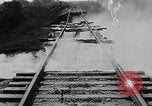
Scene following train attack by Mexican Bandits led by revolutionary Luis De la Rosa, near Olmito, Texas.
Smoke rising from burning timbers on a collapsed wooden railroad trestle bridge near Olmito Texas on the U.S.- Mexican border. (This is during a period of Mexican bandit attacks leading up to those by Pancho Villa and the subsequent Mexican Expedition AKA the "Punitive Expedition, U.S. Army.") The rails on the trestle bridge remain intact but are severely bent and twisted by the heat of the fire. They continue, with fragments of railroad ties, still attached, to extend across the span of the bridge, over a deep river bed. The next scene shows the aftermath with several men standing near a train with about six derailed cars. They wave when the camera focuses on them. In the background, next to two passenger cars, still upright, a man and two women are looking at the wreck. The men in the foreground are retrieving items from the train's mail and cargo cars, and have some piled up nearby. On man is writing notes. Closeup of what appears to be a policeman, in a cap, as he walks past men retrieving items from a partly overturned rail car. Camera focuses on wheels ripped from the bottom of the car. The officer in the cap, and a man in shirt and tie, who appears to be a business executive, converse briefly and the businessman leaves the scene. Next, are shown numerous articles, retrieved from the train wreck. They are laid out on a field near a train station and other buildings. Two box cars are parked on a track nearby. Two men are sorting through the articles on the ground. A small boy watches as a man briefly sprays water on some of the items laid out in the field. A train station is seen in the background along with numerous low buildings. Camera jumps to closeup of a steel door on the train station building. It shows three holes in the door, two of which seem to contain remnants of bullets or larger size ordnance, presumably fired by Mexican bandits trying to break into the high value storage room at the station. The bandits also burned a bridge at Tandy's Station to thwart responders.
Trainees learn practical exercises in the Kent County Emergency Medical Training Program in the United States.
Highlights of the Kent County Emergency Medical Training program in the Grand Rapids and Kent County area of Michigan, United States. Men gathered at an accident site. They open a medical aid box and give emergency medical treatment to a road accident victim. Innovative program of Emergency Medical Training is developed at Grand Rapids, Michigan and surrounding Kent County. Civilians walk through the streets. A Chevrolet ambulance drives on snow covered streets with lights and sirens on. Professors give classroom training about emergency medical treatment to students. Technicians bring a patient who needs emergency treatment. They contact a nurse in the emergency room of a city hospital. The nurse instructs the technicians how to provide immediate life saving treatment to the patient. In the training program: trainees learn how to diagnose heart rhythms, how to treat cardiac victims and to access patient's breathing system. They learn how to clear the air passage. The trainees receive an advanced training to become EMTs "Emergency Medical Technicians". They learn about life support exercises. They are taught to treat fractures, cuts, electrical shocks and radiation injury. Apart from practical exercises they receive basic instructions in physiology. Teachers and drivers learn how to evacuate victims from vehicles after road accidents. Doctors discuss about the Emergency Medical Training Program during a conference.
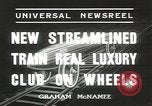
People eat and drink aboard the new streamlined luxury Mercury Train in Chicago, Illinois.
The New York Central Mercury locomotive and train designed by Henry Dreyfuss is seen in Chicago, Illinois. The modern, futuristic Mercury luxury railroad train moves down a track. Exterior views of the moving train as seen from another moving train and from stationary viewpoint. Interior view of the rear observation car. Passengers on board the Mercury train read newspapers while they are served by African American waiters. An African American bar tender shakes a flask to prepare cocktails at the bar. A man smoking a cigar on the train.
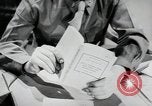
Demonstration of how and when U.S. military instructor should select and present training films to troops, United States.
Film based on advantages and procedures of using U.S. Army training films. A U.S. military instructor reads from Field Manual 21-7 which contains list of several training films and their brief descriptions. Instructor makes notes at his desk. Instructor makes a phone call and screens a film, he selected. He makes notes while watching the film. Instructor speaks to a group of men seated in class who are to watch the training film. He outlines the significant points of the film. Men watch the film as general introduction of subject. It is explained why and the how the film is reviewed. Men at work carry out actual procedures they were shown in the film. It is explained when not to show the training film to troops. Troops march through heavy mud. Tired soldiers yawn. A soldier takes a nap while watching a film. An instructor in a training class. Trained troops march on a field. (World War II period).
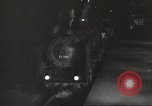
The Orient Express passenger train leaves a railroad station in Europe.
The Orient Express luxury passenger railroad train in Europe. The Orient Express passenger train at a railroad station. Seen in the station is steam locomotive with running number: 01 089, which was built by the Bossig Company of Germany, in 1930. The locomotive belches steam and makes noises as a dispatcher on the platform signals for it to depart. It gradually moves away with a roar, and gains speed. Passenger cars comprising the train, are seen as it leaves the station. A white uniformed train attendant is seen standing above train steps of a car, as train pulls away.
CRITICALPAST.COM: About Us | Contact Us | FAQs - How to Order | License Agreement | My Account | My Lightboxes | Shopping Cart | Advanced Search | Featured Collections | Website Terms & Conditions | Privacy Policy ©2026 CriticalPast LLC.
License Agreement |
Terms & Conditions |
Privacy Policy
©2026 CriticalPast LLC.