


 Francais
 Deutsch
 Italiano
Refine Your Search
M4-training stock footage and images
- Showing 4141 to 4146 of 8218 results more
more Hide
Hide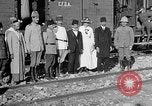
American Military Mission to Armenia is greeted in Mardin, Turkey.
Camera pans across welcoming delegation of local officials lined up in front of the railroad train of the so-called American Military Mission to Armenia, aka the Harbord Commission. (Some U.S. soldiers can be seen in and near the train.) It was arriving in Mardin, by rail, from Adana and Allepo. (Reportedly, the gentleman in black, standing to the right hand side of the lady, in the welcoming delegation, is Abdurrahman Kavvas, a descendant of the Ortoqid family that ruled Eastern Anatolia, Northern Syria and Northern Iraq in the eleventh and twelfth centuries.) In a change of scene, the camera pans over a large group of local people who pose standing side-by-side. A contingent of Turkish cavalry ride past, followed by a squad of marching Turkish infantry.
U.S. Admiral Mark L. Bristol, U.S. High Commissioner in Turkey, arriving in Constantinople, Turkey.
U.S. Admiral Mark L. Bristol arrives in Constantinople, Turkey by train. Admiral Bristol, the U.S. High Commissioner in Turkey during the partitioning of the Ottoman Empire, talks to Turkish officials at the train station. Officials approach a parked car.
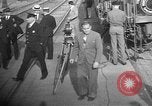
U.S. President Franklin D. Roosevelt speaks to a crowd during his drought inspection trip to Bismarck, North Dakota.
President Roosevelt’s drought inspection trip to Bismarck, North Dakota, during the Great Depression. A motion picture cameraman sets up his camera at a railroad station. Crowd of residents stands by waiting for the President's arrival. A steam locomotive pulling the presidential train arrives at the station. President Roosevelt stands on the rear platform of his train, assisted by his son, Franklin Jr (Franklin D. Roosevelt Jr.), and accompanied by the Governor of North Dakota, Walter Welford, who introduces the President. The President's daughter, Anna, stands at back of the platform. President Roosevelt addresses the crowd and assures them that they will win over problem of drought very soon. He says that plan of cooperation with nature should be worked out. The crowd applauds. The President gives an example of the economic interdependency of the U.S. states, by noting that steel factories in Indiana and other eastern states could not run under full capacity unless the agricultural states bought farm machinery and other equipment from them.
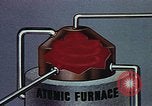
Modern turbine generators used to convert fuel into electric power in power plants in the United States.
Atomic furnace can be source of heat to drive turbine generator in a power plant in the United States. Conversion of fuel into electric power is explained by animation. Burning of fuel to transform water to steam. The steam is directed towards a turbine which converts heat energy into mechanical energy. This mechanical energy is converted into electric energy by a turbine generator. Exteriors of a power plant showing electric transmission towers and lines. Pedestrians and traffic along a city street with many 1940s cars and taxi cabs going by. A machinist and a welder at work. An electric powered railroad train with passenger cars approaching a train station. Telephone operators at a switchboard. Windows of building lit up at night. Evening scene at Times Square, Manhattan, New York City as sun is setting and neon lights are shining. A private home in the suburbs with window illuminated at night. A turbine generator in a power plant.
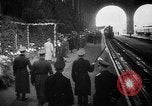
Premier Vyacheslav Molotov arrives in Berlin, Germany for German-Soviet Axis talks
Discussions between Germany and the Soviet Union in November 1940, about Russia joining the Axis together with Germany, Italy, and Japan. Diplomatic and military delegation stand at railway station in Berlin, Germany. A railway train arrives. Premier Vyacheslav Molotov of the Soviet Union arrives on the train at the railway station. German Foreign Minister Joachim Von Ribbentrop, German High Command and Japanese representatives greet Molotov. A band plays as the men come out of the railway station. German soldiers stand in lines and Molotov passes the troops in reivew. Delegation takes Molotov to the Reich Chancellery to meet Adolf Hitler, War Minister Hermann Goering, and other German officers.

Daily routine of German boys and girls in Bavarian camps.
German children leave Berlin and board train for Bavarian Camps early in World War 2. Children look out from the windows of the train and carry Nazi flags. A horse ridden carriage on road. A German officer with children sitting in his carriage arrives at a house and exchanges Nazi salutes with people there. A family sits in a dining room and a girl joins them enjoying food and drink. Life of Hitler Youth children in camps. Boys eat food in a mess. Boys go out for an outing. Boys sit on horses. Girls sleep on bunk beds. In the morning they get ready for the day. Girls wash their faces and take bath. Girls sit on benches and learn stitching. A view of a classroom. Girls eat food in mess and play table tennis. Children sleep on beds.
CRITICALPAST.COM: About Us | Contact Us | FAQs - How to Order | License Agreement | My Account | My Lightboxes | Shopping Cart | Advanced Search | Featured Collections | Website Terms & Conditions | Privacy Policy ©2026 CriticalPast LLC.
License Agreement |
Terms & Conditions |
Privacy Policy
©2026 CriticalPast LLC.