


 Francais
 Deutsch
 Italiano
Refine Your Search
M4-training stock footage and images
- Showing 5095 to 5100 of 8218 results more
more Hide
Hide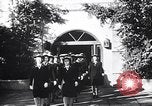
U.S. Coast Guard sailors and SPARS report to various Battle Station across the United States.
U.S. Coast Guard SPARS (US CG Women's Reserve) march at the Training Station. CG men and women recruits take their places at various Battle Stations across the U.S. U.S. CG men and women personnel report for duty on shore and at sea. SPARS arrive in Washington and New York. A sailor watches through binoculars, a SPARS with documents, sailor on cutter, SPARS drives a car, sailor by a plane. A radioman and woman operate the radio. Men and women gunner mates on cutters. A U.S. CG pilot in the cockpit, SPARS parachute riggers at work. A deck gun on a cutter. A crew of 8 sailors observe the gun. SPARS take their places at a shore station. The captain and his crew come aboard a cutter. U.S. CG cutters at sea. Includes narration by Ginger Rogers and James Cagney.

Dr. Hazel K Stiebeling talks about research in the field of food and nutrition.
'Research for Better Living': A Bureau of Human Nutrition and Home Economics Service (United States Department of Agriculture) film on research work performed by the Bureau. Chief of the Bureau Dr. Hazel K Stiebeling talks about research in the fields of food and nutrition, textiles and clothing, housing and household equipment, and family economics. The Beltsville Research Center in Maryland. Large colonial styled brick building. Technicians work on food preparation and preservation inside a laboratory. They process and can vegetables and run various domestic science experiments. A food specialist compares the braising of meat with and without water. She puts the meat into containers on the stove. A researcher prepares a braised turkey leg to be served for judging. Technicians peel potatoes and insert a device to measure temperature. Trained judges from the laboratory staff taste frozen strawberries and write their verdict. A technician measures the tenderness of a berry with an apparatus. In the kitchen, technicians work to improve large quantity recipes. Technicians chop and weigh carrots, puts them into an institutional cooker and stirs. The prepared food is tried by school children. Children serve themselves and eat the food seated at a table in the school cafeteria.
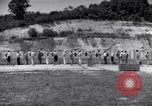
FBI Special Agent recruits take aim and fire at targets at a shooting range in the United States.
Special Agents in training of the Federal Bureau of Investigation (FBI) at a firing range in the United States. They take aim and fire at the targets. The bullet ridden targets.
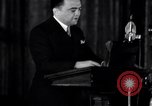
FBI Director J Edgar Hoover talks about youth criminal activity, Bureau statistics, and flaws in the parole system.
First Director of the Federal Bureau of Investigation (FBI) of United States, John Edgar Hoover delivers a speech in Washington DC. He talks about raids against the underworld by the Bureau. He states the use of training, hard work, courses and cooperation with local law enforcement agencies as the means to successful crime solving. He states statistics of FBI Agents and shoot to kill incidences. The attendees applaud. He lays emphasis on the Bureau's methods and youth criminal statistics. He talks about the need to eradicate flaws in the parole system that turn criminals loose.
Views of Lexington Main Street and University of Kentucky on 'By Request' program for American soldiers.
Women's Army Corps (WAC) Sergeant in broadcasting studio for the Army Navy Screen Magazine feature called: "By Request." She holds a letter received from 43 American soldiers ("foxhole buddies") in New Guinea. They ask "By Request" to show them scenes from the University of Kentucky, where they trained, and some shots of Lexington, Kentucky. The program continues with motion pictures of the requested scenes, beginning with the Phoenix Hotel and a theater on the Lexington Main Street. Pedestrians on the side walk and cars parked by the roadside. Keith's Bar and Chop House. Bartenders and waitresses serve beer. A roller coaster, known as the Wildcat (after UK's mascot) at the Joyland amusement park, located on Paris Pike north of town. The University of Kentucky campus. GIs and women soldiers on campus. A sign for the University. Soldiers take pictures by the statue of James Patterson on campus. (Given the lack of foliage on the trees, this film was obviously taken sometime between November and March. ) (World War II period).
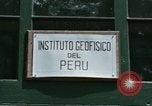
Construction begins on the Jicamarca Observatory site for the Scatter Radar antenna as staff families settle down in Peru.
Space research from the ground with a Scatter Radar. Scientists outside the Instituto Geofisico Del Peru, scientific research organization of the Peruvian government. A train of the Ferrocarril Central Andino (FCCA) on its way to the Institute's observatory. It travels through the Rimac Valley in the Andes, including Ticlio at nearly 16,000 feet. It is the highest elevation railway junction in the world. View of a snow-covered mountain (possibly Yuraqqucha on border of the Lima and Junín regions). Llama graze and move about high up in the mountains. Huancayo (Wankayu) Village: Local Quechuan Indians trade in the weekly market. Shops in the street, street vendors with their goods. The Jicamarca Observatory, new National Bureau of Standards facility near Lima. Scientists work at scopes and other instruments. Aerial view of the Peruvian coastline. The valley 17 miles from Lima. Rocks on the arid coast. Green vegetable fields and broad flat plane in the arid valley. The site for the antenna. Bulldozers prepare the site for construction. A diversion dam constructed on the site. Gully in the valley floor. Peruvian workers lay wire to sound an alarm in case a mudflow should come. Men mark ground and align places for post holes, lay wood posts to support the antenna dipole. They assemble inserts, connect the antenna, and lay bricks. The workers collect their pay. Bureau of National Standards staff and their families in Chaclacayo community. The families gather with locals for a Anticuchos barbecue (Peruvian beef kabobs). The wives of the U.S. scientists shop for fruits and vegetables in the local market.
CRITICALPAST.COM: About Us | Contact Us | FAQs - How to Order | License Agreement | My Account | My Lightboxes | Shopping Cart | Advanced Search | Featured Collections | Website Terms & Conditions | Privacy Policy ©2026 CriticalPast LLC.
License Agreement |
Terms & Conditions |
Privacy Policy
©2026 CriticalPast LLC.