


 Francais
 Deutsch
 Italiano
Refine Your Search
M4-training stock footage and images
- Showing 5101 to 5106 of 8218 results more
more Hide
Hide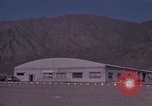
Dr. Kenneth Bowles and his team of scientists work at the Jicamarca Observatory near Lima, Peru.
Space research from the ground with a Scatter Radar. Completed construction at the Jicamarca Observatory near Lima, Peru. Hills in the background. Engineers and technicians inside the Observatory. Local Peruvians with technical skills are trained in class. A technician inspects the Observatory transformers. Men make final wiring check in the Condenser Bank. Two men work on an amplifier in the Amplifier Room. Technicians work at pumps and heat exchangers for the water purification and cooling system. Men work with blowers that circulate cool air throughout passage ways in tunnels. Cables and piping in the tunnels. Scientists direct transmitter energy into the antenna. They monitor every function of the operation. Coaxial aluminum piping conducts transmitted and received radio signals through a spark gap and mixer. A man operates the system outside. Energy for the radio signals flows through coaxial piping in trenches. Dipoles in a modular section of the antenna to probe the upper atmosphere in order to measure electron densities. Open wire lines connect two rows of elements. Dr. Kenneth Bowles conducts scientific observation in the Screen Room. He measures the electron density with a transmitter, holds a record of the trace of electron densities. Electron density observations on a monitor. Antenna at the Observatory, hills in the background. A globe rotates.
Communication waves and the relation between power transmitted and received in Space Communications
United States Air Force training film about Space Communications and the related problems and developments. Animation: Planets, remotely controlled unmanned space research vehicles in space. Space communication links between the vehicles and Earth. Radio waves are reflected, refracted and absorbed. An antenna radiates waves that are dispersed. Communication and light waves on the frequency spectrum. Groundwave and Skywave transmission explained. Skywave transmission reflected back to Earth by the ionized layers in the Earth's upper atmosphere. Bouncing of signal in optimal conditions. Spacewave travels from transmitting to receiving antenna, and travels unaffected through the ionosphere into outer planetary space. Depicts laws that govern Line of Sight transmission: Relation between power transmitted and power received, and ideal and regular conditions. Explains the factors involved in the relation between the power transmitted and received. Comparison of communication and light waves. Inverse Square Law explained. The law applied to Space Communication: Signal generated from point source, energy dispersed in shape of sphere, energy spreads over expanding spherical area. Outlines a practical approach to strengthen received power: Directing the radiating energy, and enlarging area of the receiving antenna.

German civilians and famous skier Christl Cranz donate coats, woolens, and ski equipment for German soldiers
Response of the German people to the appeal for winter clothing and skis for German soldiers on the Eastern front. A large crowd of German people on a street in Germany outside a donation station. Inside the donation station, a woman holds warm fur coats in her arms. Woman volunteers collect and organize the woolens donated by civilians. A man removes his coat and hands it over to a German soldier while others await their turn in a line. Many citizens hand over woolens and skis and ski poles to the soldiers. Some exchange nazi salutes as they give donations. Famous German World Cup skier Christl Cranz is seen donating her skis and shaking hands with the collection worker. Large number of boots collected. The clothes and equipment are loaded onto trucks by German troops and then into trains to be taken to the troops on the Eastern Front. A soldier closes the railroad car door after the car is filled with skis. (World War II period).

A large crowd awaits aviator Charles Lindbergh in Mexico City, Mexico.
Aviator Charles Lindbergh due in Mexico City, Mexico. A large crowd awaits his arrival. Policemen among the crowd. People on the roof. Roads from the city to the air field jammed with people. People atop a train on the tracks.

Life in a Steelmill town. Smoke, steam, smog, from locomotives, mills, steam shovels and use of coal for cooking
A sad looking boy stands near steep iron stairs of a run-down tenement in a poor, blue-collar mill or mining town during the great depression. Workers with lunch buckets descend steep steps. Steam locomotive belches smoke and pollution. A woman stands on porch of house and watches as boys run across railroad tracks to school, in front of oncoming steam locomotive and train. The boys run back across the tracks again. A man with a peg leg breaks up coal in his back yard and brings some into his dwelling in a bucket. An African American man enters his shack. A woman throws dishwater from her back porch. Women and children on wooden stairs and porches Black smoke streaming from industrial mill stacks.Girl with doll and boy with puppy. Boy and girl at doorway. Huge amounts of smoke from mills and locomotives in nearby rail yard. Little blond girl with dirty face. A man washes his face and hands using a wash basin. A woman cooks food on coal stove. Smoke emitted by chimney in the house. Black smoke and smog from steam locomotive. Black smoke from steam shovel. Steam and smoke from numerous locomotives in rail yard.
German Air Force Test Center at Peenemunde-West. Test of rocket sled for launch of V-1 flying bombs
Responding to secret orders, The German Air Force Test Center at Peenemunde-West, tests mechanisms for launching the Fi 103 Fieseler (V-1 ) jet-powered flying bomb ("Buzz Bomb"). Plan calls for test of drive train rail with powder propellant rocket sled catapult having final speed of 100 meters per second. View of barren snow-covered land, test shack. and launch rail. View of test sled. Caption refers to test of Rheinmetal-Borsig catapult. Dummy V-1 missile is launched on an inclined plane. Missile plunges into water with a splash. (World War II period).
CRITICALPAST.COM: About Us | Contact Us | FAQs - How to Order | License Agreement | My Account | My Lightboxes | Shopping Cart | Advanced Search | Featured Collections | Website Terms & Conditions | Privacy Policy ©2026 CriticalPast LLC.
License Agreement |
Terms & Conditions |
Privacy Policy
©2026 CriticalPast LLC.