


 Francais
 Deutsch
 Italiano

Refine Your Search
M4-training stock footage and images
- Showing 517 to 522 of 8248 results more
 Hide

Imperial Japanese Army (IJA) soldiers commit war atrocities and murder during World War II
Atrocities committed by Imperial Japanese Army (IJA) soldiers in China and other parts of Asia during World War II. War workers in offices, factories, and mills shift their attention to the narrator. Smoke rises from factory smokestacks and chimneys. American workers manufacture war materiel in factories. Factory workers shovel coal to the furnace. Japanese soldiers abuse elderly Chinese women. A Japanese soldier toss an infant before striking with a bayonet midair. A Chinese woman watches with shock. IJA troops drag and bury Chinese civilians alive. IJA troops burn cities and shoot victims at close range. Soldiers place the remains of dead Chinese men, women, and children in truck. Japanese soldiers torture and kill Chinese civilians and are depicted killing American Prisoners of War (POW). Aerial views of San Francisco, Chicago, Pittsburgh, and New York. A dead Japanese soldier with flies covering his face. A newly built M4 Sherman tank moves inside a factory. Body of a Japanese soldier wearing round glasses. Dead Japanese soldiers seen with repeating American wartime propaganda message that every piece of wartime production "kills a Jap." Tanks, trucks, planes, shells, guns, and artillery are manufactured in United States factories and plants during World War II. Americans urged to take war jobs to help win World War 2.
Second Sino-Japanese War
Opening scene shows formation of Japanese Mitsubishi G3M bombers in flight. View of bombardier at bomb sight inside a bomber. Bombs falling from the aircraft, upon the Chinese city of Shanghai, on a day in September, 1937. Ground level view of bomb exploding and Chinese civilians running for cover. A huge explosion throwing earth up. Aerial view of smoke rising from bomb strikes below. More ground views of bombs destroying structures. Chinese people fleeing across a bridge. Cluster of bombs falling from a Japanese airplane. More explosions and destruction. view from a G3M bomber, of others with bombs falling from them. View from above of civilians filling a street as they run for shelter. People on the ground rushing in all directions. Some are in horse-drawn carriages with luggage on top and other in rickshaws, apparently fleeing the city altogether. Bombing victims lying on the ground near destroyed structures. Heavy dark smoke rising from the attacks. Scene shifts to Japanese army officers entering the Yasukuni shrine in Tokyo. Behind them is A Shinto Tori (Gate) and behind that, the monument (statue) of Omura Masujiro. Scene shifts again, to view of the Temple of Heaven, an ancient Imperial Sacrificial Altar in Peking (Beijing) China. Chinese agriculture. Crowds of Chinese people. Stone statue of traditional Chinese lion. Picture of 1851 oil-on-canvas painting by the German American artist Emanuel Gottlieb Leutze, of Washington crossing the Delaware. Drawing of 15th century ship similar to one in Columbus'1492 voyage to America. Drawing of Roman Empire era building. Michelangelo’s statue of Moses. Drawing of ancient Egyptian pyramid and statue. Drawing of Chinese city and environs representing 4 thousand years ago. Extant ancient Chinese shrines and statues. Animated Relief map of China and surrounding countries of U.S.S.R., India,Burma,Thailand, Indo-China, Philippines, and Japan. Animation outlines China Proper. It also shows Manchuria and scenes from there of desolate mountainous land, with miners at work extracting raw materials. Mongolia and Sinkiang are outlined. The Gobi desert is seen with a long camel caravan crossing it. Closeup of nomads transporting animal skins by camel. The last region outlined is Tibet. The ice covered Himalayan mountains are shown. Buddhist monks praying in the courtyard of a shrine in Tibet. The Yellow, Si Kiang, and Yangtze Rivers are shown on the map. Views of Chinese sailing vessels.
American Indian tribal council meeting to exemplify use of sign language
Representation of essentials of tribal sign language of Native American Indians of the great plains. Plan to recognize this dying language was suggested by Honourable Scott Leavitt, Chairman of Indian committee of the house of representatives. The plan was embodied in H R 4604 an Act of Congress authorizing Secretary of Interior Ray Lyman, through the instrumentality of Major General Hugh L Scott to make a motion picture on the sign language. The Act was executed under the supervision of Joseph M Dixon assistant Secretary of the Interior. The Council-A meeting of representatives of many tribes called to exemplify inter tribal use of the sign language.American Indian chiefs pose for a photograph.Joseph M Dixon and congressman Scott Leavitt to meet the Indians assembled for the council. All the people go inside a tent also known as a Piegan council General Scott commences the council with a brief statement of its object by using the sign language.Each American Indian delegate gives his tribal sign.Dick Washakie from tribe Shoshone.Indian tribal chief uses sign language.4 September 1930

U.S. marine armor and infantry advancing on Saipan in World War II
A U.S. Marine M4 sherman tank advancing across a field, rakes foliage to its left, with machine gun fire, during battle of Saipan in World War 2. Marine infantry follow quickly after the tank.
U.S. Army officer identifies remains of American soldiers killed in final days of World War II, in Hilden, Germany.
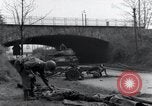
A U.S. Army Captain examines bodies of American soldiers of the 46th Tank Battalion, 13th Armored Division, killed when their Sherman M4 tank was struck by panzerfaust anti-tank weapons and 20mm fire, on April 17, 1945, in the final days of World War 2, in Europe. The wrecked tank and human remains are seen at the intersection of Ellerstraße & Hülsenstraße, in Hilden Germany. Closeup of the Captain looking closely at the dog tags of one dead soldier. Next, he is seen checking the dog tags of other dead tank crew members, as local German townspeople watch from nearby. He and another officer cover the bodies with a large tarpaulin.

Soldiers from the 8th Cavalry Regiment capture some North Korean prisoners during the Korean War in Chilgok, South Korea.
8th cavalry Regiment during the Korean War in Chilgok, South Korea. Two M4 Sherman tanks moving on the road. Soldiers from the 8th Cavalry regiment sit on tank top. Soldiers capture two North Korean prisoners and put them in the jeep and move away. Soldiers gather around the ambulance-jeep and one of the wounded soldiers lying on the stretcher attached to the ambulance- jeep. One South Korean soldier carries another wounded soldier on his shoulder. A captured North Korean prisoner with hands tied behind his back. Camouflaged net is seen on the captured prisoner. Several soldiers gather near the truck and discuss. Soldiers run on roadsides to hide. One soldier lights a cigarette, while others are lying on the ground in attacking position. Some soldiers sit and hide by the stream side.
CRITICALPAST.COM: About Us | Contact Us | FAQs - How to Order | License Agreement | My Account | My Lightboxes | Shopping Cart | Advanced Search | Featured Collections | Website Terms & Conditions | Privacy Policy ©2026 CriticalPast LLC.
License Agreement |
Terms & Conditions |
Privacy Policy
©2026 CriticalPast LLC.