


 Francais
 Deutsch
 Italiano
Refine Your Search
M4-training stock footage and images
- Showing 5905 to 5910 of 8218 results more
more Hide
Hide
U.S. soldiers cross a pontoon bridge constructed by them on the Kyll River in Birresborn, Germany.
United States soldiers in Birresborn, Germany during World War II. The soldiers cross a pontoon bridge constructed by them over the Kyll River. A train at a railroad station in the foreground. The soldiers seated in a jeep driven across the bridge.
Pre World War 2 scenes of Filipino colleges, schools, and military academy in the Philippines.
From a film created during World War 2, but before liberation of the Philippines. View of civilians in the Philippines before World War II. Distant wide view of the U.S. Capitol Building in Washington DC in early spring. Closer view of the U.S. Capitol and its dome in spring with flowers on tree branches in foreground. Scene changes to Manila, Philippines, and the grounds and exterior of buildings of The University of the Philippines. Vehicles on a street in the front of a building. Exterior view of University of Santo Tomas main building. Filipino students, both women and men, performing science experiments in a laboratory at the university. Next scene shows students in a laboratory of Silliman University in Dumaguete City, Philippines. Students in a class stand in turn, reading aloud from books. Views of younger Filipino children in high schools and grade schools in the Philippines, learning and studying in classrooms, including reading and writing of English. Students at the University of the Philippines in group callisthenic exercise classes on a field. Students in farming classes. Wide view of training of Filipino military cadets. General Douglas MacArthur at his desk in the Philippines before the war, while he was commander of the military defense of the Philippines. He talks on the telephone, attends a flag raising ceremony, and meets with Eisenhower (then part of his staff) and another officer. Filipino government officials meeting, including Elpidio Quirino and Manuel Roxas Japanese diplomatic delegation meeting with Filipino politician before the war. Filipino cadet soldiers at Military Academy at Luzon seen drill marching in dress uniforms. Regular Filipino Army soldiers gathered in a group at attention holding rifles, and then marking in columns in a parade, with horses and military trucks.
Peacetime activities and contributions by the U.S. Army in the United States.
Scenes from Army Day on April 6, 1934. Secretary of War George Henry Dern, in broadcast to the nation about importance of the Army, in peacetime. Brief glimpses of the Yellowstone River lower falls and Old Faithful and Beehive geysers erupting in Yellowstone Park, Wyoming. View amongst log buildings in Reproduction of Army Fort Dearborn, at the 1933 Century of Progress Exposition in Chicago, Illinois. A pioneer wagon; Native American Indians in ceremonial regalia; antique locomotives and trains at the Exposition. Army General Leonard Wood being sworn in as the Governor General of the Philippines. Closeup of General of the Armies, John J. Pershing, America's highest ranking Military officer. Headquarters of Walter Reed Army hospital, in Washington, DC, named for U.S. Army Major Walter Reed, who confirmed that yellow fever is transmitted by mosquito. Acting on this, the U.S. was able to complete the Panama Canal. View of French dredging equipment sitting idle in the water after Yellow Fever prevented them from completing the Panama Canal. Closeup of U.S. Army General William C. Gorgas, who, in 1904, headed the Sanitary Department that controlled mosquitoes and eradicated Yellow Fever, so the Panama Canal could be finished. View of alligator in swamp near the Panama Canal. Photograph of George Washington Goethals, Chief Engineer credited with making the canal happen. Explosives employed in Panama Canal construction. Earth and rocks being loaded into open rail cars. A steamship transiting the Panama Canal. The Washington Monument; U.S. Library of Congress; and the Lincoln Memorial, cited as examples of accomplishments by U.S. Army engineers. The Wilson Dam, under construction by Army engineers, in Muscle Shoals, Alabama and system of levees being built to control the Mississippi River. The raging Mississippi River during 1927 flood. Flood victims being assisted by U.S. Army soldiers, at a tent camp, receiving food and clothing. An Army airplane flying over a forest fire. Army personnel supervising men in the Civilian Conservation Corps or CCC. Mail being loaded aboard an Army airplane, as airmail service is being opened between Washington DC and New York City. President Woodrow Wilson talking with Army pilot Major Reuben H. Fleet. Mail being loaded into the nose of an airplane. U.S. Army Douglas World Cruiser airplanes in flight, returning from their trip around the world in 1924. A pilot sitting in front seat of a Douglas O-38 airplane, pulls a fabric hood over his cockpit to practice "blind flying". View of the aircraft in flight, with instructor pilot in the open rear cockpit. Army aviators taking a camera and a rifle aboard their airplane as they prepare to leave on an aerial mapping flight. Aerial view of skyscrapers of Manhattan Island, New York City. Army Signal Corps personnel working on communications devices. A cable laying ship operating at sea, in support of the U.S. Army's Alaskan cable and telegraph system. Men loading chemicals into hoppers on Army crop dusting airplane. Several views of Army airplanes crop dusting. Glimpse of boll weevil, the target of their efforts. Closeup of Karl Connell, who as a major in the AEF, in World War I, invented a superior gas mask known as the “Connell” or “Victory” mask. A group of miners wearing gas masks enter a smoky mine entrance. The Army invented tear gas, which is shown being used to thwart a bank robbery, in a staged demonstration. Brigadier General Hugh Johnson, appointed by President Franklin Roosevelt, as head of the Great Depression era National Recovery Administration, or NRA, is seen about to give a speech. Narrator cites him as an example of U.S. Army officers who also serve the country in civilian life. Scene shifts to cadets on parade at the United States Military Academy, West Point, New York.
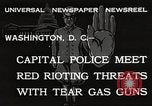
Policemen in the nations capitol stop communist activists' hunger-march truck convoy in Washington DC, during Great Depression
A hunger march by the communist activists in Washington DC. People gather on a street. Hunger march truck trains or convoys drive past on the street. Maryland State troopers on motorbikes drive past along with the vehicles. Posters and placards on the vehicles. A poster on a truck reads: 'Winter Relief Unemployment Insurance'. They are stopped by policemen. An officer with a tear gas gun on the street. People watch the vehicles. The policemen stand at attention on the street blocking the passage of the activists.

Men cut, bundle and ship firs from Shelton, Washington to various parts of country for the celebration of Christmas.
Preparations for Christmas in Shelton, Washington. Men cut and bundle firs for the celebration of Christmas. The bundled firs are loaded onto trains for their shipment to various parts of the country.
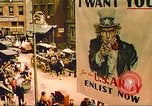
Men leave for Camp Upton in New York after their enlistment in the U.S. Army.
An American feature film depicts the life of professional dancer Jerry Jones enlisted in the U.S. Army during World War I. A poster on a wall reads: 'I Want You for the U.S. Army Enlist Now'. People walking and vehicles driving past in a vegetable market. Jerry Jones leaves for a training camp. He bids good bye to his mother. Buildings along the sides of a street. Two woman talk amongst themselves. A man plays a bugle in his house. His wife talks to him about his enlistment in the U.S. Army and cries. He leaves for the camp. Men enlisted for the U.S. Army at Camp Upton in New York. Men sleep on their beds at the camp. They wake up after a call at 5:30 am. A sergeant arrives and asks them to wake up. He scolds them. They get off their beds. The sergeant talks to two of the soldiers and scolds them. The soldiers holding rifles stand in formation on the ground.
CRITICALPAST.COM: About Us | Contact Us | FAQs - How to Order | License Agreement | My Account | My Lightboxes | Shopping Cart | Advanced Search | Featured Collections | Website Terms & Conditions | Privacy Policy ©2026 CriticalPast LLC.
License Agreement |
Terms & Conditions |
Privacy Policy
©2026 CriticalPast LLC.