


 Francais
 Deutsch
 Italiano
Refine Your Search
Mashhad Iran 1908 stock footage and images
- Showing 37 to 42 of 302 results more
more Hide
Hide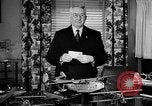
Early 1900s American aviation scenes; American flight pioneers speak about their associations with the Wright Brothers
Aviation pioneer, aircraft designer and builder, Glenn L. Martin, at his desk, stands behind a model of the Martin M-130 Clipper flying boat. He reads a 1910 postcard from the family doctor to his mother, warning that her son (Glenn) will kill himself if he persists in his aviation endeavors. Next, one of Martin's earliest employees and collaborators, Donald Douglas, Sr. is seen with his dog. He says his first memory of things in aviation, was seeing the first Wright airplane demonstrated for the Signal Corps in 1908, at Fort Myer. Period film shows the Wright Flyer airplane with twin rear propellers turning. Next view shows Orville Wright along with military officers and officials, standing near the launching tower (from which a propelling weight would drop). Orville Wright is seen climbing aboard the airplane, after the first flight demonstration, as Lieutenant Lahm joins him to be the first military officer to ever fly in an airplane. Next, the weight is seen falling from the launching tower, propelling the airplane along a single track to take off. It is seen flying above spectators at the Fort Myer drill field. View of a U.S. Army balloon in flight overhead. Scene shifts to pioneer Army balloonist, Roy Knabenshue, who was hired by the Wright Company in 1910. He holds a photograph of a balloon, and identifies Walter Brookins, in the photograph. (Brookins was taught to fly by the Wright brothers and became the first instructor for their Exhibition Team.) Knabenshue extols the skills of Brookins as a Wright Company pilot, along with Arch Hoxsey and Ralph Johnson. While Khabenshue is speaking, views of a Wright Flyer in the air at Fort Myer are seen.
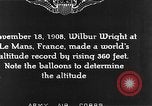
The Wright aircraft in flight over high snow covered mountains at Le Mans in France.
The history of aviation. The Wright aircraft at Le Mans in France on November 18, 1908. The aircraft in flight overhead. Three balloons in the background used to determine the altitude of the aircraft. A high snow capped mountain peak. The aircraft in flight. High snow covered mountains having pine trees vegetation.
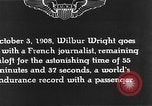
Pressmen watch the Wright aircraft as it flies carrying a French journalist in France.
The history of aviation. Wilbur Wright and a French journalist fly in an aircraft in France. October 3, 1908 headlines proclaim the event. Wilbur Wright and the journalist get into the aircraft. Launching of the aircraft. The aircraft in flight overhead. Pressmen standing on the airfield duck as the aircraft flies overhead. The Wright aircraft flies overhead.
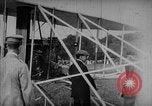
Frank Lahm and Orville Wright prepare for a take off, take seats and take off in Wright flyer during a test at Fort Myer.
Orville Wright and U.S. Army aviator Frank Purdy Lahm, the first army passenger, test the "Wright Flyer" at Fort Myer, Virginia. Preparations for the take off of the aircraft. Frank Purdy Lahm sits at the controls with Wright standing in the front and releasing the ropes. Lahm and Orville Wright take seats in the aircraft. Men standing beside a catapult in front of buildings. Good views of Fort Myer buildings of the era. They adjust the position of the catapult. The catapult as seen from the front of the aircraft. View of catapult from behind the aircraft. The Wright Flyer takes off. The aircraft in flight. It circles over a field and buildings. Headquarters building in the background. The aircraft in flight over the field. (This footage is a mix of July 1909 footage where the aircraft shows two half-rounds of canvas in the front elevator, and September 1908 footage, from the rear taking off, where the aircraft has a single half-round of canvas in the front elevator.)
Pennsylvania Railway Station, the Union Station Plaza and the National Academy of Sciences in Washington DC.
Sesquicentennial in Washington DC. Still image of snow covered railroad train tracks of the Pennsylvania Railway Station at corner of 6th and B streets, cutting across the Mall. Animation shows: a model of Washington DC made by McMillan Commission in the year 1901. Elevated view of the landmark Union Station train station from roughly the 1920s, and view of the Plaza and new city Post Office building. Model shows the location of the station. 1908 Officers Buildings and the building for members of the House of Representatives. The Treasury Department Building for the Bureau of Revenue and building for the Bureau of Printing and Engraving. Early view from 1920s of the West Wing of the White House. View of building housing the Corcoran Art Gallery. American National Red Cross building and National Headquarters building for the Daughters of the American Revolution. View of the Pan American Union building. National Academy of Sciences building exterior.
Awards given to the Wright Brothers by Aero Clubs of France and the United Kingdom for their contribution in aviation field.
Gold medals given to the Wright Brothers for their contribution to the field of aviation. Gold medals awarded to the Wright Brothers by Aero Club of France, Aero Club of the United Kingdom and the International Peace Society in the year 1908. the medal awarded by the U.S. Congress.