


 Francais
 Deutsch
 Italiano
Refine Your Search
Mazamet France 1950 stock footage and images
- Showing 169 to 174 of 6221 results more
more Hide
Hide
United States sends crop duster aircraft to combat a locust plague in Iran.
The United States sends aircraft to enable Iran to spray against a locust plague, in 1951. Iranian farmers are seen trying to cope with a plague of locusts, seen covering everytning in sight. The farmers chase them with cloths and use watering cans to dispense chemicals. A DC-4 transport aircraft taxis in after landing in Iran. The aircraft carries several small Piper Super Cub 135 airplanes and a croip duster, all equipped for aerial spraying. View of Piper Cub being removed from the DC-4. A bi-wing crop duster airplane being assembled. Several Super Cub aircraft flying low and spraying against locusts. (Note: The DC-4 aircraft is owned by United States Overseas Airlines, a non-scheduled air carrier based in Cape May New Jersey, that was contracted to combat the locust plague. The project was undertaken as part of President Truman's Point Four Program. approved by the United States Congress on June 5, 1950 in the Foreign Economic Assistance Act. )
United States Army 187th Airborne Regimental Combat Team returns to Japan from Korea and is welcomed by City of Beppu, Oita
Clip opens with rapid changing scenes: American troops in trench in Korea during the Korean War. American tank on street in Germany. American Ski troops in Alaska. Amphibian assault training in Puerto Rico. Rotating Globe shows: U.S. Army on alert to defend against aggression. Sergeant Stuart introduces episdoe and states that U.S. Army has come to Japan to know their culture and make friends after war and occupation. U.S. Army troops of the 187th Airborne Regimental Combat Team, are seen arriving by railroad train at a train stateion near their base near Beppu,Oita on the island of Kyushu, Japan. U.S. Army soldiers, including white and African American soldiers, exit train cars. They receive a warm welcome from Japanese population. Banner reads:" Welcome Pala Troop comin back from Korea, City of Beppu."[sic] Women holding flowers and families with small children waving American and Japanese flags, welcome them on the train station. A sign over the train station platform reads: "Welcome 187 Para Troop Coming Back From Korea, City of Beppu." The troops stand in formation on the platform while the unit's officers receive the flowers from the women. Japanese men in fraternal uniforms and the general population all join in the welcoming ceremonies. The troops march off the train station under another sign reading: Welcome Home 187 RCT." and march down the main street of Beppu under a swirl of paper confetti. Next scenes are from autumn of 1945, as U.S. soldiers march through streets of Japan during occupation following the end of World War 2. U.S. troops seen marching behind Japanese police to occupy Japan, in 1945, amidst the aftermath of suffering and destruction of the war. The local population standing at road sides and watching with worry and concern. Scenes of postwar destruction in Japan. Rubble of bombed buildings. Scene of simple wooden dwelling shacks and wreckage nearby. A Japanese boy with his baby brother on his back. The baby is crying. Next scene moves again to circa 1950 in streets of a Japanese city, possibly Tokyo, rebuilt and with busy scenes of traffic on streets and commerce. Large outdoor rally with a Communist speaker addressing large crowd of Japanese people who sit and listen. Scenes from a what the narrator describes as a Communist rally in Japan, against America, which turns violent. Protestors running in streets during demonstration, with signboards and police and fire fighters extinguish flames at scene of an overturned, burning car. Flashback again to 1945 or 1946 as U.S. Army soldiers use tractors and heavy equipment to clear and level an area of war rubble and debris during rebuilding efforts after World War 2. Japanese citizens look on, watching the machines at work.
Celebration of the Liberation of Paris, and Americans returning to college, farms, and work after World War 2
Exterior views of United Nations headquarters building in New York City. World map showing NATO member countries shaded dark. Series of shots of American voting in elections, with views of American citizens entering voting booths and placing ballots in voting boxes. Distant view of U.S. Capitol building in Washington DC with an American flag flying in the foreground. Following Presidential election of 1952, Dwight D Eisenhower takes oath of office as President in January 1953, surrounded by other dignitaries at Eisenhower's inauguration. Scenes from end of World War 2 with U.S. Army forces in Paris and happy celebrating French people welcoming the U.S. military and other Allied forces. Close up view of faces of U.S. Army troops marching beside Arc de Triomphe in Paris. Parisians cheer and smile. A French woman kisses an American soldier. Aerial view of Statue of Liberty in New York as a troop ship is arriving in New York Harbor with soldiers returning from World War 2. Soldiers disembark the troop carrier ship. Cunard sign on gang plank. Young American men enrolled in American colleges. A college square area. Inside, a professor instructs college students in class. American students work in a University science laboratory with beakers, vials, burners, and microscope. Young veterans of the war who have returned to be farmers are seen on their farms working. American farmer works in field with a tractor. Views of various church buildings and church spires in American towns and cities. American men,women and children in church and clergy at altar circa 1950.
Technological advances in the United States after World War 2 shared with other NATO member countries
U.S. Marines dropped off from U.S. marine helicopters at a landing zone during maneuvers. and then running on a field. Representatives of United Nations permanent member countries in a weekly conference session meeting of the permanent council. Exterior views of U.S. Capitol building with American flag flying. U.S. Congress in session in Capitol building. Technological advances in U.S. U.S. President Eisenhower on a visit passes beneath a sign "Atoms for Peace" and observes various displays dealing with atomic power and nuclear power. An early nuclear power plant in Idaho, and view of an electical power plant control room that uses power from the nuclear plant. Doctor in a hospital checks a patient using a atomic scanner. American workers work in Oil fields in the United States -- view of many oil rigs in one area and two oil workers working on an oil rig. Tractors and modern large harvesting devices being used in farms. Miners sit in mining rail carts and then enter a mine on the rail cart. Sign on wall at coal mine entrance reads, "Inland Steel Company." And below it another sign, "Price Mine Number 1. 1950." (deep mining operation in Price, Kentucky). Mechanical mining cutter used in mine is seen turning out many large chunks of coal. Rail carts transport raw ore out from the Price, Kentucky coal mine.
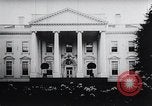
Past and present views of the White house and American presidents in United States
View of the North side of The White House. President Calvin Coolidge works at his desk and writes during his tenure in the 1920s. Next scene shows close up view of President Herbert Hoover addressing people at a microphone on an outdoor stage, with his speech carried on radio. View of President Franklin Roosevelt speaking while seated at a desk in the White House. President Harry S Truman seated at a desk in the White House and preparing to deliver a televised address. President Dwight D Eisenhower addressing a press conference in the White House. View of people visiting North Portico area of White House in the 1950s after the White House renovation. View of the extended West Wing of the White House. Man arranges notepads in conference room of West Wing of the White house before a meeting. Chair of the American President flanked by United States Flag and flag of the seal of the President. View of the Oval Office.
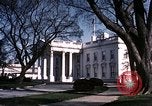
Views of Rooms in the White House Washington, DC, United States
View of exterior North Portico and entrance of White House. Interior view of the North entrance White House lobby with Presidential Seal on top of the door. Close up view of four dates inscribed on the marble floor: "1817" Repair after war damage, "1792" Construction date, "1902" First remodeling, and "1952" Latest remodeling. Views of the Blue room, the Green room, and the Red room in the White House, and various furniture and decorations in the White House in the late 1950s. View of State dining room. Gold candle stands placed on the dining table. Solid Silver chandelier hanging over the table. China crockery used by American Presidents and their families are preserved in the China room. Portrait of Mrs. Calvin Coolidge. View of the Oval office room. View of the East room. Portrait of President George Washington and Mrs Martha Washington. Grand piano placed inside the room. Plaque in White House state dining room with words of a prayer by John Adams. Exterior view as police escort motorcycle with sidecar drives on North Portico entrance driveway, followed by a Lincoln Continental limousine of the President's fleet.
CRITICALPAST.COM: About Us | Contact Us | FAQs - How to Order | License Agreement | My Account | My Lightboxes | Shopping Cart | Advanced Search | Featured Collections | Website Terms & Conditions | Privacy Policy ©2026 CriticalPast LLC.
License Agreement |
Terms & Conditions |
Privacy Policy
©2026 CriticalPast LLC.