


 Francais
 Deutsch
 Italiano
Refine Your Search
Mazamet France 1950 stock footage and images
- Showing 181 to 186 of 6221 results more
more Hide
Hide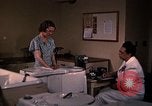
Researchers test household equipment like washing machines, electrical ovens and home freezers.
Research work by the Bureau of Human Nutrition and Home Economics Service (United States Department of Agriculture). Chief of the Bureau Dr. Hazel K Stiebeling talks about domestic science research in the field of household equipment. A researcher put clothes into a washing machine. Another woman takes notes. Fabric sample are uniformly soiled, cut and sown onto muslin. The researcher records temperature while putting the clothes in. A woman checks the amount of dirt removed by measuring the reflected light before and after the laundry. Cooking: A woman researcher develops a standardized cake recipe to test baking performance of an electric oven. She lays the batter in pans into the oven. Judges measure the upper and lower limits of browning compared to a reference cake. Engineering test of home freezers in a laboratory. The researchers load freezer with filled cartons. Some have thermocouples inserted. A researcher checks meters and time clocks for current, energy consumption and freezer motor measurements. Researchers compare the amount of two fuels used to cook a farm family meal. (Some scenes with camera closeups have the look of 1940s and 1950s era "housewife" or homemaker scenes)
Donald G. Williams speaks about private industry diversification programs and the activities of the people in Richland, Washington.
Activities of the Atomic Energy Commission on the Hanford Project in Richland, Washington. An animation depicts : a plant set up for radioactive material recovery from storage by Isochem Inc. An electronic assembly plant by International Telephone and Telegraph Corporation. A plant for the use of nuclear power in the space by Douglas United Nuclear . The Battelle Memorial Institute scientists work in a laboratory. Computer Sciences Corporation employees work on machines in a Univac computer room, processing data transferred through telephone lines. Workers of the U.S. Casting Company work on machines. Meters and other equipment. Donald G William, the manager of the AEC Richland, speaks about various other organizations involved in the segmentation and diversification program. Various scientists and workers at work in the plant. A barge in a river. The center for graduate study. Visitors at the science center in the Richland administration building. A child stands. Houses and trees in the foreground. Building of the dental center. People on a street in Richland Washington, and view of 1950s and 1960s cars and various automobiles. Homes along streets in suburban neighborhoods of the Richland Washington area. People passing time at a local lake swimming area, with boy and girl children and families enjoying the water. A boat in water. Men water skiing. A U-37 Tri-Cities speed boat leaving dock area and speedboats in a race. An aerial view of the city. Vehicles on a road.
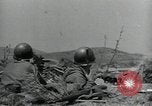
U.S. Army Medical Service at work during the Korean War.
The role of the American Army Medical Service during the Korean war. U.S. Army Captain Carl Zimmerman introduces Major General George E. Armstrong, Surgeon General of the U.S. Army who speaks from Washington, DC, about the work of the medical service. Scenes from the Korean War. U.S. troops rushed from japan, in July 1950 after a Chinese offensive at the 38th Parallel. Troops disembarking from ship and unloading artillery. Medical personnel offloading from assault boats, including doctors, medics, ambulances and drivers. A crane offloads medical equipment and supplies from a ship. Nurses with a mobile surgical hospital unit. Medics remove a casualty from an ambulance, on a stretcher. U.S. infantry slogging through difficult terrain. An ambulance driven on a mud road. Korean refugee families. Children sit and eat. People walk. An old Korean man is helped into a car. U.S. C-54 transport aircraft unloading supplies and evacuating wounded on stretchers. Medical supplies being unloaded from an aircraft and loaded into a truck. Surgeons in a tent hospital. A doctor treats a patient who is receiving blood plasma in an IV. Medics moving with tanks and infantry. Walking wounded being assisted. U.S. wounded lying on the ground, attended by medics. The U.S. medics treat injured soldiers during a tank battle. Soldiers on tanks. Thousands of paratroopers jumping from aircraft, their parachutes filling the skies. U.S. Army wounded being treated on stretchers around the Yalu River. Tenth Corps Troops in long winter withdrawal. U.S. Marine aircraft evacuating wounded. Troops withdrawing by sea in Landing Ships.
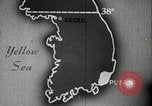
UN landings at Inchon and reoccupation of the capital, Seoul, by UN forces during the first year of the Korean war.
Animated map shows South Korea, from 38th parallel, South, and highlights Pusan, and the advances being made by UN forces after being reinforced. Next, the UN amphibious landings at Inchon (or Incheon) are shown on the map. Flashes of naval gunfire are seen in the blackness of night. Next, a Landing Craft Tank (Rocket), LCT(R), is seen firing barrages of rockets toward shore, at Inchon. On September 15, 1950, U.S. troops are seen landing at Incheon, from boats of the attack transport ship, USS Noble (APA-218). Return to the animated map shows advance of UN forces from Inchon joining with those advancing from Pusan, until they occupy most of the area south of the 38th parallel. UN infantry are seen engaged in urban combat in the city of Seoul, accompanied by M26 Pershing tanks and M46 Patton tanks. Building burning in the city. UN soldiers firing rifles inside damaged building. American soldiers, under fire, carrying wounded on litter. Medical corpsmen tending to casualties, including wounded Korean civilians. Republic of Korea (ROK) infantry following four of their soldiers carrying their flag, stretched out horizonally, between them. (Narrator states they are carrying it back to the liberated capital of Seoul.) ROK troops escorting large number of prisoners of war, marching with hands on heads. UN forces distributing rice and clothing to the Korean inhabitants of Seoul. Soldiers helping little Korean children don clothing. Bodies of men, women, and children who were slain by retreating enemy troops, are laid out on the ground, attended by Grieving relatives. Large quantities of captured North Korean weapons are piled up, including those made in the Soviet Union.
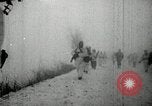
U.S. troops retreat as Chinese forces enter the Korean War.
United Nations forces retreat through snow as Chinese Communist troops enter Korean War in late 1950. An animated map of Korea shows Chinese forces overtaking North Korea. U.S. Marines marching in retreat from Chosin Reservoir region while artillery fires at enemy. Troops in sleeping bags covered in snow. Wounded loaded in small planes that take off from a field marked with a sign reading, 'Panicky Pocket Air Strip' View of retreating civilians and refugees moving south including many North Korean families with small children. Marines are evacuated from Hungnam. Civilians are transported in trucks with their belongings. General Ridgeway is shown sitting in a jeep after taking command of forces in Korea. A map highlighting Hungnam. Views of Security Council meeting. Shots of soldiers from many countries, including Belgium, Turkey, Greece, Taiwan, Philippines, Australia, and Canada. A sign marked with '25th Canadian Infantry Brigade'.
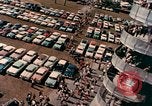
Views of an American college football game in the United States - 1958 Orange Bowl featuring Duke versus Oklahoma
Aerial view of 1950's automobiles parked outside Burdine Stadium (later the Miami Orange Bowl) in Miami, Florida. Fans of both Duke University (Blue Devils) and University of Oklahoma (Sooners) football teams entering the stadium at entrance gates. View at gates as tickets are checked. A fan tries on a festive hat. View of the field with marching bands on it during their show, displaying a large American flag formation. View of fans in the stadium. Some Oklahoma Sooners fans wearing cowboy hats. 1958 college football Orange Bowl game gets underway. Scenes from the game, crowd cheering, band and cheerleaders performing at half time and from sidelines.
CRITICALPAST.COM: About Us | Contact Us | FAQs - How to Order | License Agreement | My Account | My Lightboxes | Shopping Cart | Advanced Search | Featured Collections | Website Terms & Conditions | Privacy Policy ©2026 CriticalPast LLC.
License Agreement |
Terms & Conditions |
Privacy Policy
©2026 CriticalPast LLC.