


 Francais
 Deutsch
 Italiano
Refine Your Search
Mazamet France 1950 stock footage and images
- Showing 187 to 192 of 6221 results more
more Hide
Hide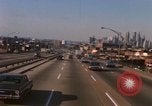
Traffic on Interstate 278 East Gowanus and Brooklyn-Queens Expressways in Brooklyn, New York.
Driver's POV view from car traveling eastbound on Interstate 278 in Brooklyn. Start at crest of Bridge over the Gowanus Canal, good view of Lower Manhattan, pass through "The Trench" section in Carroll Gardens and Cobble Hill, cantilevered roadways beneath "The Promenade" in Brooklyn Heights, ending just short of the Brooklyn Bridge exit. Good views of original 1950's and 1960's freeway signing and highway lighting hardware.
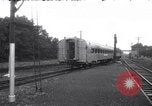
Engineers inspect the disc brake parts on a Pioneer III truck made by The Budd Company in the United States
In the 1960s, the Budd Company produced the Pioneer III electric m.u. coach for intercity travel. Here a prototype Pioneer III rail passenger car is seen, pushed by a Rail Diesel Car (RDC) as the locomotive power. People seated inside the train demonstrate size and comfort. (Mid-1950s automobiles seen parked at station where train arrives.) Engineers inspect the disc brake parts of the truck and a ventilator. The train is then pulled in the opposite direction by the RDC. Close up views of the train wheels near the tracks.
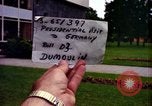
U.S. President John F Kennedy arrives at the U.S. Military Hotel General Von Steuben in Wiesbaden Germany
A U.S. Army VH-3A helicopter lands on the lawn of the Hotel General von Steuben, in Wiesbaden, Germany. A crowd of spectators stands across the drive from the hotel lawn, constrained by German policemen. U.S. Air Force Military policemen stand guard on the nearer side of the drive. Soon the Presidential VH-3 helicopter, Marine One, lands on the lawn. It displays the Presidential seal and that of the Military District of Washington, DC. Next, President John F. Kennedy is seen walking past the Army helicopter and into the U.S. Military's Hotel General von Steuben. He is accompanied by German Chancellor, Ludwig Erhard, U.S. Secretary of State, Dean Rusk and U.S. Army Aide, Brigadier General Chester V. Clifton, along with a phalanx of Secret Service Agents. Other officials look out from a dining room window of the hotel as the Presidential party arrives. (Note: In the 1950s, the U.S. built three large military hotels in Wiesbaden. In 1951,a star-shaped Hotel [the American Arms] was built on Frankfurter Strasse. In 1955, the 9-story Amelia Earhart Hotel was opened. It was a utilitarian structure, with row after row of windows. President Nixon once stayed there. It closed in 1995. The General von Steuben Hotel, depicted in this film, was the newest, built in 1956, on Auguste Viktoria Strasse, near the train station. It is now a commercial hotel, "the Dorint Hotel Pallas Wiesbaden.")
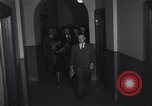
Black-listed actress testifies before the U.S. House Un-American Activities Committee (HUAC)
Black-listed actress and singer, Ella Logan, whose name appeared in the "Red Channels List" of June 22, 1950, testifies before the House Committee on Un-American Activities. She is seen, walking with companions, along a hallway. She wears a large brimmed hat that often hides her face. She testifies, and then leaves. She tries to avoid press photographers and covers her face. She waits, with companions, on sidewalk, outside the building, for a taxi. She expresses annoyance at someone standing nearby. Later she poses for a photograph, as her companions help her into a checker taxicab.
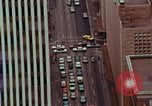
Pilot study on Freeway Control System to prevent traffic congestion on Gulf Freeway, Texas United States.
Pilot study on Freeway Control System for controlling the pressure of increasing automobile traffic on busy roads and highways. Elevated near aerial view of a busy city cross road intersection in downtown Houston, Texas, with private cars, taxi cabs and trucks and view of city as seen from a skyscraper. Camera view widens showing more of the downtown Houston skyline, the sign for the Texaco company is seen atop a skyscraper building, and the rotating Gulf oil company sign is seen atop another skyscraper. The Gulf Freeway six lane road busy with 1960s and 1950s models of trucks and cars such as sedans, station wagons, and pickup trucks. Increasing lanes and controlling entry of cars to control traffic situations. Cars enter main highway from sideways one after the other. Police officers on a signal control entry of cars and allow calculated number of cars to enter the highway. A driver of car with an equipment. Close circuit cameras mounted on highways. Monitors at Freeway Surveillance System head office. Scientists at work, observe camera videos and take readings from meter panel. Capacity Demand and Gap Acceptance methods to control merging traffic congestion.
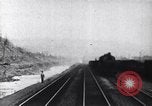
Immigrants to America working in various hard labor jobs and factories early in the 20th century.
Point of view shot out the front of a steam locomotive railroad train as it speeds along a track in western United States. Men stacking wood lumber for boat shipment beside a canal in the early 1900s. The mill and stacks of lumber seen across the canal. Miners at a coal mine ride an open car full of coal as it emerges from a mine in West Virginia, as seen from camera riding on same coal car. Glimpse, from a passing train, of a steel mill in Pittsburgh, Pennsylvania. Immigrants to the United States, from various European countries, at work in industrial production jobs. Men in factories; working at a power forge in a steel mill; Lumber operations: Men cutting down large trees with hand axes and sawing logs for timber in a forest, using large 2-man saws; Butchers moving sides of beef in a meat packing company. Women working in a metal parts factory (appears to be a sink faucet manufacturing company); women working in a textile spinning mill operation and stacking moving machine shelves with spools. A hose set up from a fire hydrant spraying water in a city street and children in bathing suits running underneath to play and cool off in hot summer weather. Montage of various still and moving images: Immigrant children in classrooms and in school yards. A woman instructing new adult immigrants in an English language instruction class. Immigrant workers engaged in skyscraper construction, high in the air without safety equipment. An iron worker perched atop a vertical steel beam with the Brooklyn Bridge in the background. A woman posing on a horizontal bar. Men and women posing in the surf at a beach. People at beach watching as a group of men create a human pyramid on the sand. A little girl with her feet in the surf. Boys in a classroom, with two of them dirty from work and another boy sleeping with his head on his desk. Mothers and fathers at home asking about what the children learned in school. A young girl leading a group of school children in reciting the pledge of allegiance (pre-1950s version of the Pledge of Allegiance is heard recited by a group of children, without the "Under God" wording that was added in 1954). Still image of a young girl employed in a fabric mill (child labor).
CRITICALPAST.COM: About Us | Contact Us | FAQs - How to Order | License Agreement | My Account | My Lightboxes | Shopping Cart | Advanced Search | Featured Collections | Website Terms & Conditions | Privacy Policy ©2026 CriticalPast LLC.
License Agreement |
Terms & Conditions |
Privacy Policy
©2026 CriticalPast LLC.