


 Francais
 Deutsch
 Italiano
Refine Your Search
Mazamet France 1950 stock footage and images
- Showing 3601 to 3606 of 6211 results more
more Hide
Hide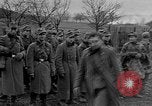
German army prisoners of war taken in Mulhouse (Mulhausen), Alsace-Lorraine, France, in World War II.
Large number of captured German soldiers is marched along a pathway,in Mulhausen (Mulhouse), Alsace, guarded by French soldiers of the 1st Army, during World War 2. They are followed by groups of French irregulars, who also perform guard duties as a contingent of the German soldiers is marched through the center of town, past Mulhouse Cathedral.German prisoners are herded into a narrow alleyway where they are searched and processed by French troops.
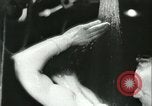
German U-boats receive friendly welcomes as they return to their base at St.Nazaire,France, in World War II
Opening scene shows German submariners taking "victory" shower baths. Versenkungswimpel (kill pennants) wave from a U-boat, showing tonnage of each ship sunk, as it returns to St. Nazaire, in World War 2. A seagull bird flies overhead. Officers are seen on the conning tower of a submarine, containing painted images of two satyrs flailing at each other. View forward,from conning tower of a submarine, as it moves on the surface. It displays banners reading "4500." Closeup profile silhouettes of two crewmen. The sun is low in sky. A sailor using semaphore flags signals to a submarine. View of crewmen crowding its conning tower, waving. This boat displays two kill pennants, a Kriegsmarine ensign flag, and a homemade flag reading "Ferner Liesen." It also displays flags with silhouettes of the two ships it sank. Along its deck are souvenir name plates and life preservers from those ships. The returning submarines are welcomed by a military band playing on the wharf. Crewmembers lined up on deck wave back. The boat's captain salutes as he is welcomed by Admiral Karl Doenitz (Dönitz), Commandant of the German U-boat fleet. Several women present flowers to the U-boat captain, as his crew stands on its deck, behind them. The women then give some to the crew members, as well. The crew leaves the boat deck. Closeup of the Captain saluting. Crew members seen being warmly greeted on the shore. One submariner drinks from a bottle of beer. Crew members seen standing on deck of U-boat as it moves toward, and enters steel reinforced concrete pen. View of maintenance being performed on hull of a submarine, inside the pen. A torpedo being loaded by crane and chains, into a submarine. Canned goods, supplies, being loaded into the U-boat.
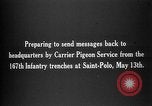
Troops of the Carrier Pigeon Service release pigeons from trenches in Saint Polo, France, during World War I.
Soldiers preparing to send msssages back to headquarters by Carrier Pigeon Service, from trenches of the the 167th Infantry Regiment (42nd Infantry,Rainbow Division) in World War 1. A soldier carefully removes a pigeon that had been secured in a wicker basket. Another pigeon is also seen. He attaches a message to the pigeon, as a companion holds it. Next scene shows 167th Infantry troops in their trench. The Pigeon Service soldier releases two pigeons above the top of the trench, and they fly away.
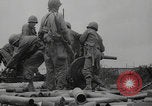
United States soldiers attack German pillboxes outside Cherbourg, France (WW2)
United States soldiers prepare to fire artillery at pillboxes in Cherbourg dock area during World War 2. Artillery fires at German pillboxes. The artillery being fired appears to be QF 6 pounder 7cwt Mk 2 anti-tank guns. Artillery being fired at point-blank range in the outskirts of Cherbourg. United States soldiers fire artillery from behind a barbed wire fence. More shells are loaded into the artillery gun. Shells scattered on the ground as soldiers prepare their rifles. Soldier loads shells into artillery. American soldier fires Browning M1917 .30 calibur heavy machine gun from a house window towards pillboxes. U.S. Army soldiers with machine gun and automatic rifle. A soldier aims his Browning M1919 machine gun at German soldiers. German troops emerge from pillbox, holding a white flag as they surrender to American forces. American soldier frisks a captured German soldier. American troops frisk German prisoners. German prisoners are made to march out of the dock area with their hands up.
Final days of WW I, and aftermath. Riots in Russia. Treaty of Versailles. League of Nations. Harding elected President
Final throes of World War I and postwar situation. German submarines sinking allied ships. American workers work in war plants. U.S. Army General John Joseph Pershing visits France. American soldiers disembark from a ship in France. Germans defeat Russians on Eastern front and divert troops to the Western front. German soldiers on horse drawn wagons and others walk carrying guns as they move. Riots in Russia after it collapses in war. American soldiers fire field artillery. U.S. President Woodrow Wilson writes letters to countries at war like Germany. Papers with the 14 points to maintain peace. The soldiers of Germany and America on battle field. Dead soldiers on ground. Soldiers carry another injured soldier on a stretcher. The people protest during a rebellion in Germany. Soldiers of America cheer signing of Armistice. Cemetery. .Americans on streets in the U.S. after the war. President Woodrow Wilson goes on a tour of Europe. He sails to different places. Prime Minister David Lloyd George of the United Kingdom, Prime Minister Vittorio Emanuele Orlando of Italy, Prime Minister Georges Clemenceau of France, and President Woodrow Wilson of the United States in France during the signing of the Treaty of Versailles. Map shows the different nations formed after the war. The president returns after his visit. Henry Cabot Lodge, a U.S. senator. President visits different places to explain the peace treaty. Sketches show the President suffering a paralytic stroke and his wife takes his important decisions. Sketch depict the opponents of the peace treaty and the defeat of the league of nations. Warren Gamaliel Harding elected as the new President Harbinger of the future: views of Adolf Hitler on the rise in postwar Germany.
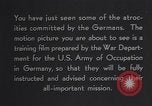
Training film for U.S. troops with the Army of occupation in Germany after world War II
Opens with bell tolling Victory against Germany in World War II. Next, a slate reads: "Victory Leads to Peace," and a farmer is seen with cattle pulling a plow. But narrator says "the problem now is future peace," and a map of Germany is shown overlaid with "Your Job in Germany." A cartoon of a soldier is superimposed on the map, along with one of a World War 1 American soldier and a figure of possible future soldier with similar mission. Camera focuses on parts of German aircraft in a jumbled heap. Closeups of weary defeated German soldiers at end ot World War II. Glimpse of Adolf Hitler speaking and haranguing an audience from a podium in an animated and forceful way. Swastika flags displayed from houses in a quaint German town. Joseph Goebbels, Nazi Reich Minister of Propaganda, at a microphone. Glimpse of a German concentration camp. But as they appear, each of the Nazi elements promptly disappears, showing the scenes without such Nazi symbols and persons. Skeleton remains of bombed buildings. Flower displays. Bucolic German rural countryside and quaint old villages in peaceful settings. Camera focuses on a book titled "German History." Chapter I, titled "Blood and Iron," shows Image of Otto von Bismarck. German troops march in a parade. Narrator states that "under Bismarck, the German empire was built." (He formed the German Empire in 1871, unifying Germany with himself as Imperial Chancellor, while retaining control of Prussia at the same time.) The film shows mounted German lancers as it alludes to Bismarck's campaigns against Denmark in 1867; Austria in 1866; and France, in 1870. Germany's leaders celebrating its status, in 1871, as the mightiest power in Europe. Troops marching and girls dancing nearby. Farmers plowing field with a horse and cow. Classic peaceful rural alpine scenes with local people in agricultural pursuits. A group of local German musicians playing folk music as village people dance outdoors. Back to the book, Kaiser Wilhelm II is shown on Chapter 2, entitled: "Deutschland über Alles." Gathering of German soldiers in Pickelhaube (spiked helmets). A German Big Bertha howitzer firing. German troops marching against Serbia; Russia; and France (with view of war damaged French cathedral). German invasion of Belgium in 1940 (with view of clock tower resting in rubble). German troops seen in Italy, walking past battle-damaged buildings. German Zeppelin dropping bombs on British targets and view of bombed out London neighborhood. Next scene shows a capsized ship with survivors running across its hull. Film slate labels the scene as United States, as if it is a U.S. ship attacked by Germany. (Actually, it is the Austro-Hungarian Battleship, SMS Szent Istvan, torpedoed, by Italian torpedo boats, during World War I.) Next, American soldiers in trench are seen going "over the top" and into "no man's land" on the western front of World War 1. Glimpse through a window of Kaiser Wilhelm II, after defeat of Germany, in 1918. View of Germans in a Beer Garden. Picturesque view of German town. A German orchestra performing. American soldiers marching out of Germany, with flags waving. Back to the history book,as chapter III is revealed, entitled "Today Germany, tomorrow, the world," and featuring Adolf Hitler. German troops invading Austria (where a civilian lies dead on the ground). German troops entering Czechoslovakia (where local people in tears render the Nazi salute). They march into Poland (where a girl weeps over someone, not seen, on the ground). They march into France (where a wounded, bandaged child cries in a bed). Next, is a scene from England, where a British child victim of bombing lies dead in the remains of a shelter. German troops invading Norway, Holland, Denmark, Belgium, Luxembourg and Russia (where a woman tries to rouse a dead woman). They invade Yugoslavia (where women sit near coffins of children) and Greece (where a woman rescues a naked child). A U.S. merchant ship explodes after being torpedoed by a German submarine (unseen). Scenes of destruction with people plucking dead victims from rubble of buildings. American troops invading Normandy, France on D-day, June 6, 1944. Several American soldiers fall to German gunfire on the beach. Wounded American soldiers being transported in jeeps on the battlefield and being placed on landing craft for evacuation. Americans walking past huge piles of destroyed aircraft parts. A landing craft filled with wounded American soldiers. American wounded and dead on a battlefield. Sailors abandoning a burning American ship by jumping into the sea. A sailor picked up in a life boat. A wounded American soldier being dragged from the beachhead at Normandy. Various wounds being treated by U.S. Medical Corps personnel. More scenes of American wounded being moved on stretchers. Scene shifts abruptly to German people folk dancing. Film concludes with question marks about the future.
CRITICALPAST.COM: About Us | Contact Us | FAQs - How to Order | License Agreement | My Account | My Lightboxes | Shopping Cart | Advanced Search | Featured Collections | Website Terms & Conditions | Privacy Policy ©2026 CriticalPast LLC.
License Agreement |
Terms & Conditions |
Privacy Policy
©2026 CriticalPast LLC.